


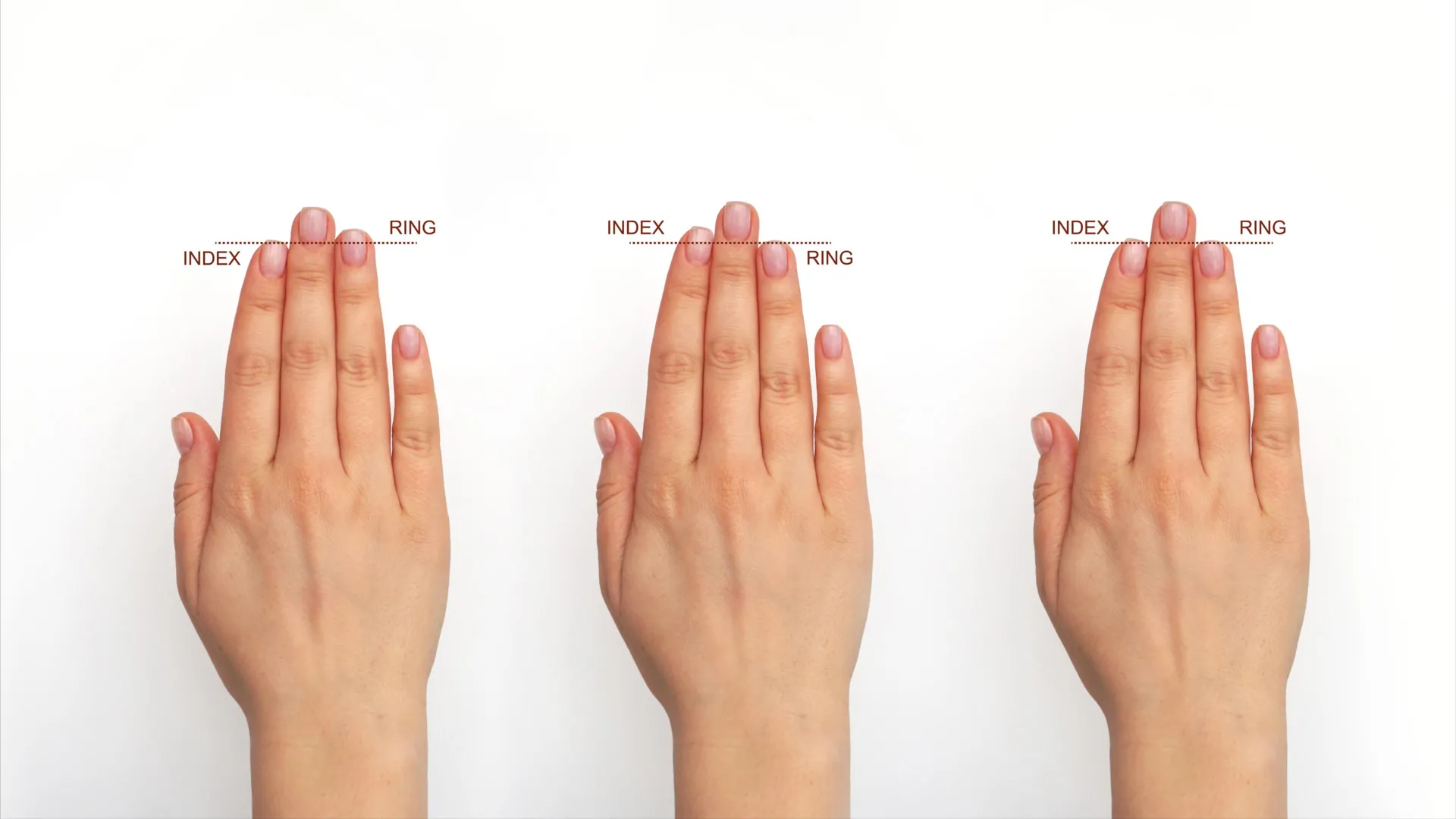
Human evolution significantly correlates with the development of a larger brain. Recent research indicates that elevated prenatal exposure to estrogen may have been a key factor in this expansion, with visible traces of this hormone’s influence noted in the relative lengths of individuals’ fingers.
Professor John Manning, a prominent member of Swansea University’s Applied Sport, Technology, Exercise, and Medicine (A-STEM) research team, specializes in the analysis of digit ratios.
The measurement of finger proportions, particularly the length of the index finger (2D) versus the length of the ring finger (4D), is known as the 2D:4D ratio. Researchers utilize this ratio as an indirect metric for assessing the hormonal balance of estrogen and testosterone a fetus may have encountered during early pregnancy.
Typically, individuals with a higher exposure to estrogen relative to testosterone display longer index fingers (2D) compared to their ring fingers (4D), resulting in an elevated 2D:4D ratio.
In this groundbreaking study, Manning teamed up with researchers from Istanbul University’s Department of Anthropology. Their findings were published in the esteemed journal Early Human Development.
Investigating Newborn Finger and Head Sizes
The research team evaluated 225 newborns, consisting of 100 boys and 125 girls. Each baby’s 2D:4D ratio was calculated and compared to their head circumference measurements.
Head circumference is frequently used as a general indicator of brain size in newborns. While intelligence is influenced by a myriad of genetic, environmental, and developmental factors, it is also closely linked to cognitive development and subsequent IQ assessments.
The researchers discovered that boys exhibiting higher 2D:4D ratios (indicative of increased prenatal estrogen) generally had larger head circumferences. Notably, this association was not found in girls.
Insights Into Human Brain Evolution
These results may bolster the estrogenized ape hypothesis, which proposes that the evolution of larger human brains coincided with physical changes that rendered the human skeleton less robust and more feminine compared to earlier ancestors.
Professor Manning stated: “These findings have profound implications for human evolution, as larger brain sizes appear to coincide with skeletal feminization, aligning with the estrogenized ape hypothesis. Elevated 2D:4D values in men have been linked to higher rates of heart disease, lower sperm counts, and a predisposition to schizophrenia.”
“However, the increase in brain size might mitigate these issues. Thus, the evolutionary trend towards larger brains in humans may inherently involve reduced male viability, encompassing risks of cardiovascular problems, infertility, and schizophrenia.”
The researchers propose that while larger brains could offer substantial evolutionary advantages, they may also carry biological costs related to hormone conditions affecting male health.
The Balance of Evolution and Trade-offs
This study contributes to the growing body of evidence that prenatal estrogen may play a beneficial role in the evolution of the human brain.
It is important to note that this study does not assert that finger length directly influences brain size. Instead, researchers regard digit ratio as a potential biomarker for hormone exposure during early fetal development, identifying a connection that may illuminate how prenatal hormones impacted human evolution.
Professor Manning’s earlier research explored the potential of digit ratios providing insights into soccer players’ alcohol consumption, post-COVID-19 outcomes, and oxygen uptake.
Source: www.sciencedaily.com