


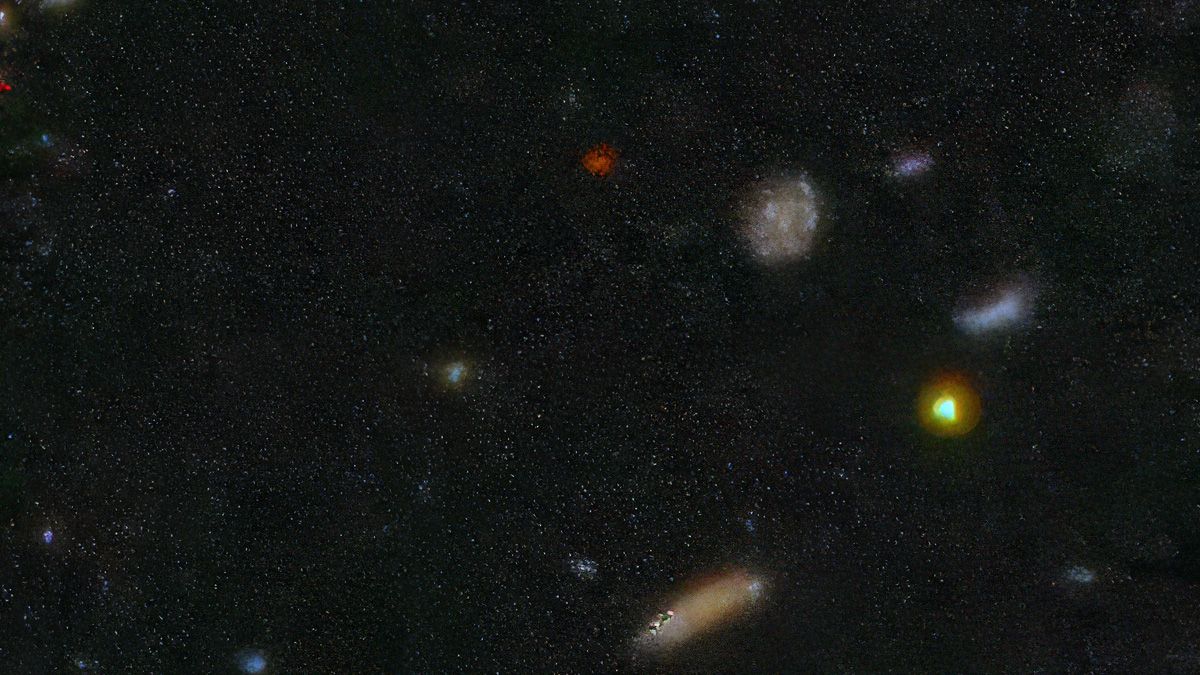
Astronomers have discovered the oldest known quasar, observing it only about 630 million years after the Big Bang. The object, detected by the European Space Agency’s Euclid space telescope and NASA’s James Webb Space Telescope, is around 40 million years older than the previous record holder and could offer new clues about how supermassive black holes formed and grew in the early universe.
Image credit: ESA/Euclid/Euclid Consortium/NASA, Wolf et al. 2026
“Finding increasingly distant quasars at the edge of the observable universe tells us something about how their central black holes grew,” Julian Wolfe and colleagues at the Max Planck Institute for Astronomy said in a statement. “The closer a black hole is discovered to the Big Bang, the faster it must have grown, or it must have had more mass at birth, or both.”
The object is estimated to have a mass equivalent to 360 million suns. The new study was published in the journal Science on Tuesday, Nov. 24. Its findings are also described in Astronomy & Astrophysics.
Why ancient quasars matter
Quasars, short for “quasi-stellar radio sources,” are extraordinarily bright nuclei found at the centers of some galaxies. These regions are known as active galactic nuclei, or AGNs. They form when a supermassive black hole begins consuming nearby matter. As material collects in a swirling disk around the black hole, it heats up and becomes intensely luminous before falling inward.
What distinguishes quasars from other AGNs is their extreme brightness: They can outshine all the stars in their host galaxy combined.
Quasars were much more common in the early universe than they are today. Their numbers are thought to have peaked about 10 billion years ago, so observing them can provide important information about how galaxies evolve and how supermassive black holes develop.
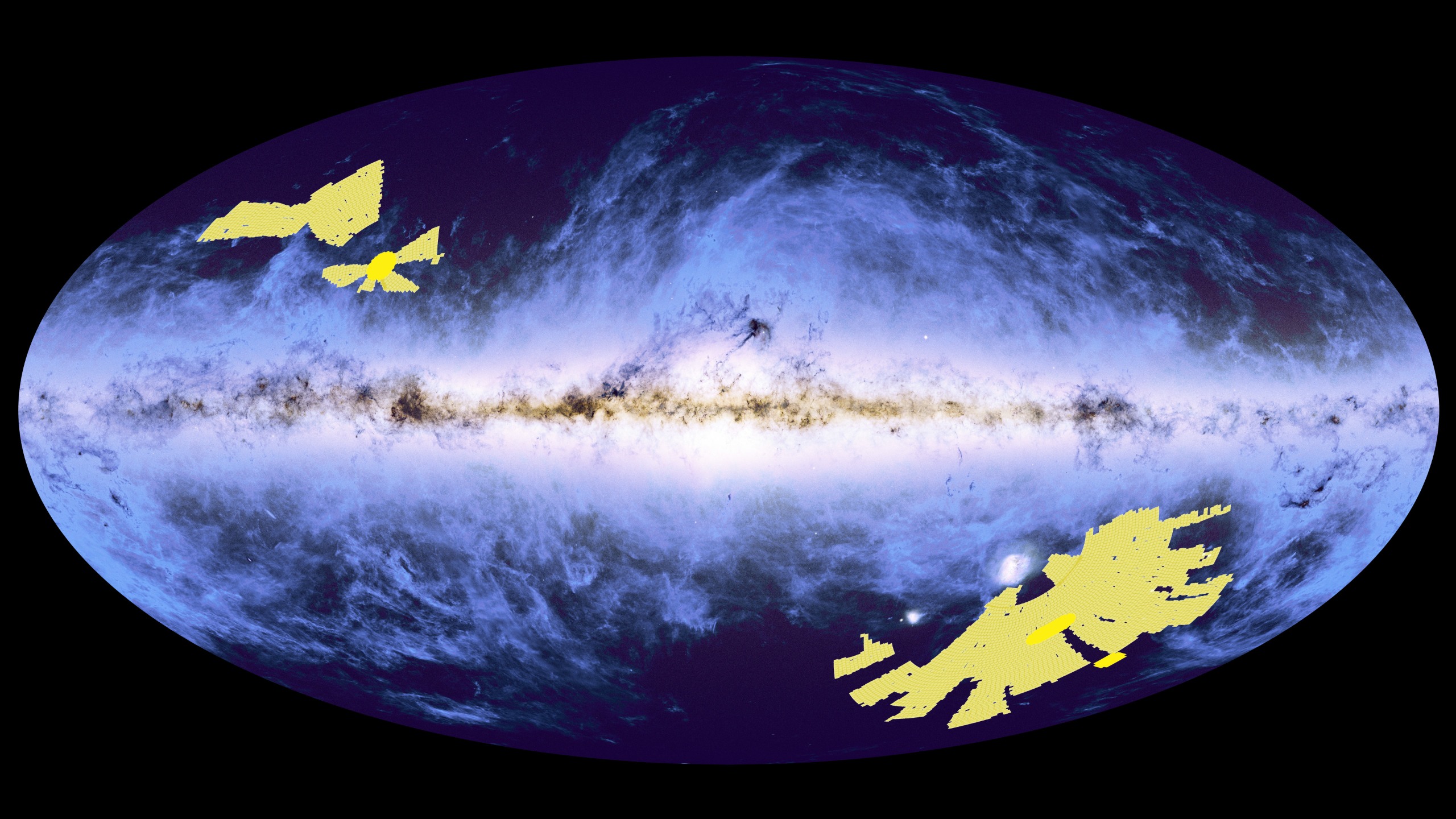
Image credit: ESA/Euclid/Euclid Consortium/NASA, ESA/Gaia/DPAC, ESA/Planck collaboration
A quasar from the universe’s first billion years
Because light takes time to travel, telescopes see distant objects as they were in the past. Light from galaxies billions of light-years away has taken billions of years to reach Earth. As the universe expands, that light is stretched toward longer, redder wavelengths in a phenomenon known as redshift.
Using data from NASA’s James Webb Space Telescope and the European Space Agency’s Euclid Wide Survey, the researchers identified a quasar with a redshift of 8.13. It is the first object ever discovered with a redshift greater than 8.
The quasar is about 13.1 billion years old, while the universe is thought to be approximately 13.8 billion years old. Its discovery therefore provides a view of the universe when it was only about 630 million years old.
According to a research announcement, the object was named Dun Aongasa after the prehistoric cliff fortress on the Atlantic-facing edge of Ynys Mór, an island off the coast of Ireland. The name is intended to reflect the quasar’s position at the edge of the current observational frontier of the universe.
Black-hole growth in the early universe
Researchers say Dun Aongatha appears to be growing more slowly than astronomers would previously have expected for a black hole of its size. This could mean that the supermassive black hole experienced a major growth spurt early in its history and then entered a period of much slower growth.
If confirmed, the finding could place new constraints on established models of black-hole growth. It also adds to questions raised by earlier James Webb Space Telescope observations of oversized black holes that appear too massive for their place in the early history of the universe.
Future observations by Euclid and JWST could test this explanation and determine whether similar growth patterns occur in other ancient quasars.
Learn more
Find out how much you know about black holes with this black hole quiz.
Topics: James Webb Space Telescope
Source: www.livescience.com