


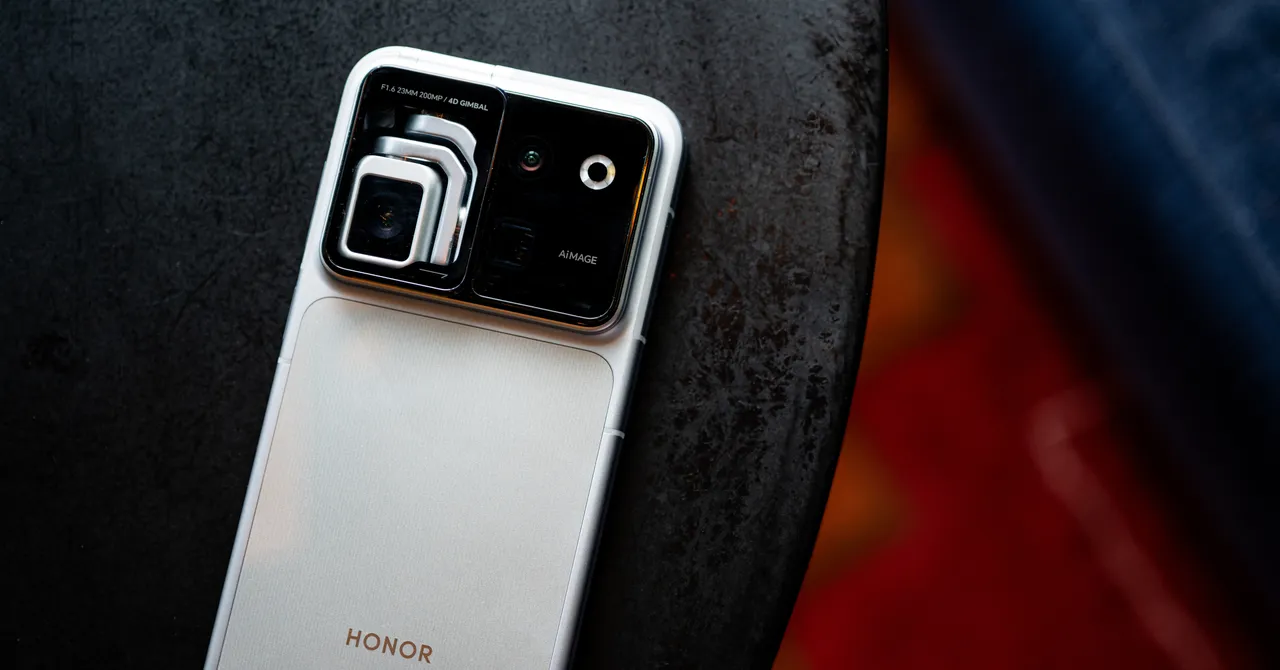
The Honor Robot Phone features more than a 200-megapixel gimbal camera. Its camera system also includes a 200-megapixel telephoto lens, a 50-megapixel ultra-wide camera, and a 50-megapixel front-facing selfie camera. The four-axis gimbal can be controlled through the camera app or with palm gestures detected by the selfie camera. With up to 300 degrees of rotation, the gimbal camera can even turn around to capture selfies.
Despite its advanced camera hardware and large 7,060-mAh silicon-carbon battery, the Honor Robot Phone weighs just 248 grams. That is heavier than the 206-gram iPhone 17 Pro, but the phone does not feel unusually top-heavy. Although most of the camera components sit near the top, the device remains surprisingly well balanced in the hand.
A glass cover protects the gimbal camera when it is not in use. Slide the cover to the right to activate the gimbal, then use the camera app to adjust its movement manually or select preset motions for smoother, more cinematic videos. The phone also supports natural-language voice commands, such as, “Turn around for 5 seconds.”
Electronic image stabilization helps the Honor Robot Phone produce remarkably smooth action footage, even in situations where a traditional smartphone camera might appear shaky. Tracking tools such as Subject Tracker keep a selected person centered in the frame as they move. This could be especially useful for solo travelers, vloggers, and content creators who want to record themselves without carrying additional camera equipment.
The gimbal camera’s features are also useful beyond video creation. Subject tracking works during video calls, allowing you to place the phone on a table while the camera follows the action around you. Honor includes a protective case and magnetic stand in the box. The gimbal can also capture a panoramic group selfie by taking left, center, and right images before combining them into one wide shot. The process is fast and seamless.
The integration with Honor’s Yoyo virtual AI assistant feels less practical and more like a novelty. On the phone’s display, the gimbal camera resembles a small robot with two eyes. It can move to the beat when asked to dance, respond with movements that suggest emotions such as happiness or anger, and act as Yoyo’s visual perspective. Ask the assistant about a scene in front of the phone, and the camera will turn toward it.
Source: www.wired.com