


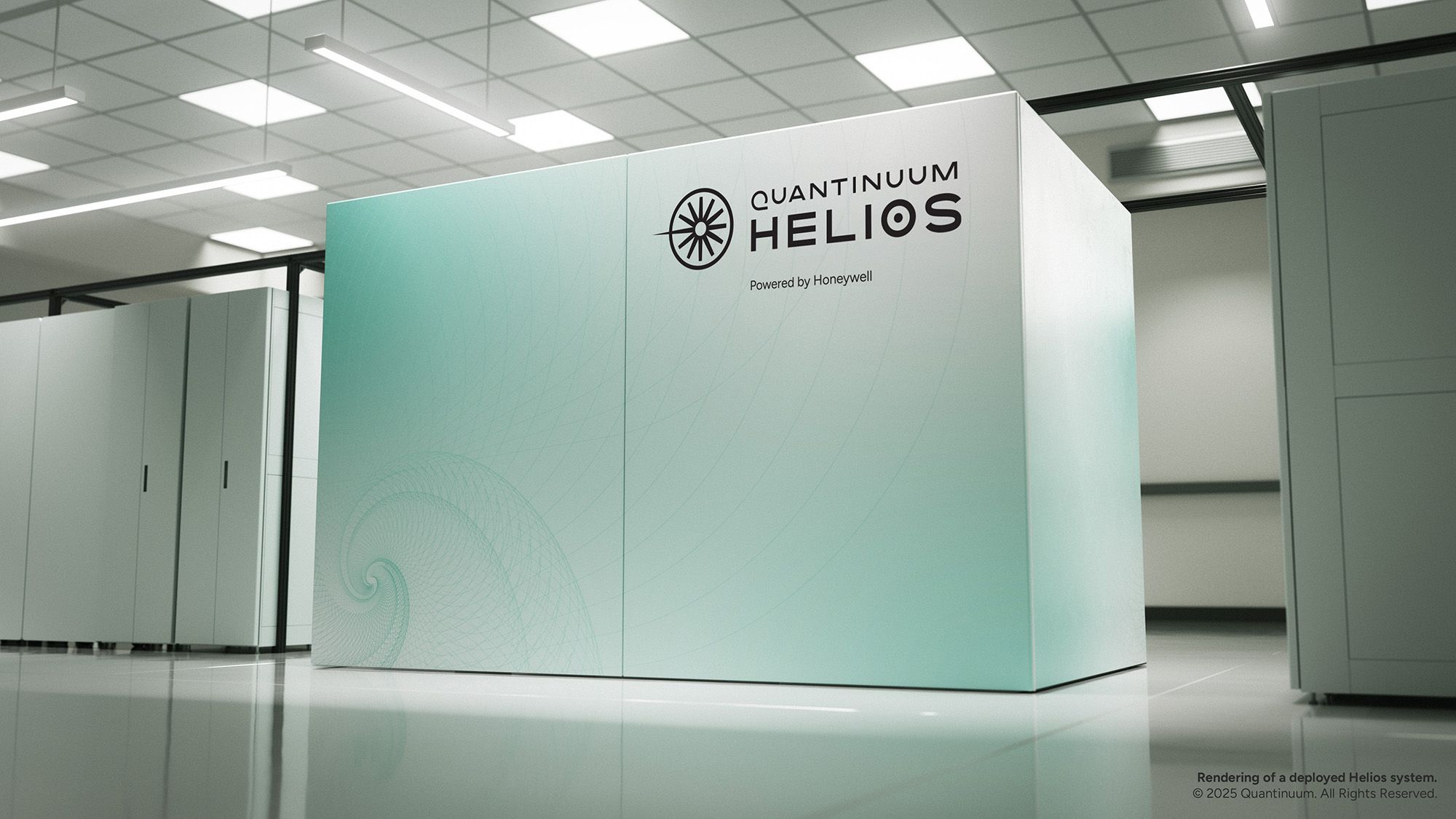
Quantinuum scientists say they have achieved a new quantum error-correction record with a 98-qubit system called Helios, which demonstrated a failure rate of just 0.0005% in quantum-memory tests. The result, equivalent to about five uncorrectable errors per million error checks, could bring large-scale, fault-tolerant quantum computing closer to reality, although the study has not yet been peer-reviewed.
The reported error rate is substantially lower than a previous benchmark set by Google’s 105-qubit Willow quantum chip, which demonstrated an estimated 772 uncorrectable errors per million rounds. In comparable tests, that corresponds to an error rate of 0.0772%.
The researchers described their findings in an arXiv preprint published on October 16, 2026. Quantinuum also outlined the results in a statement.
The result suggests that the researchers are approaching what they call a “mega-op regime,” in which the system could perform more than 1 million operations without an error.
Robin Blume-Kohout, co-director of Sandia National Laboratories’ Quantum Performance Laboratory, called the result “an important milestone that quantum computing researchers have been working on for years.” Blume-Kohout was not involved in the research.
“A scaled-up version of this system could achieve the reliability required for useful fault-tolerant computations at a feasible size of less than 1 million physical qubits, improving prospects for practical quantum computing,” he added.
Why quantum computing is so error-prone
Preserving the fragile information stored in qubits is one of the biggest challenges in quantum computing and a major barrier to making the technology practical.
A quantum bit, or qubit, is the fundamental unit of quantum information. Its delicate quantum state can be disrupted by heat, vibrations and other forms of environmental “noise.” If that happens during a calculation, the result becomes less reliable.
Quantum error correction addresses this problem by introducing redundancy into a quantum system, helping prevent small, potentially manageable errors from ruining an entire calculation.
Researchers distribute quantum information across multiple physical qubits to create a “logical” qubit. If one physical qubit loses its quantum state because of interference, the redundancy across the logical qubit can help preserve the information stored collectively.
However, building in enough redundancy for longer and more complex calculations requires adding more physical qubits. This creates a difficult trade-off: larger systems provide more redundancy but also create more opportunities for errors.
A flexible architecture and “leak re-pumping”
Unlike Google’s Willow, Helios is based on superconducting circuits and uses charged barium ions that can be dynamically rearranged.
By moving ions around the processor, scientists can connect different pairs of qubits and exchange information directly. This avoids routing information through multiple intermediate qubits, a process that can introduce additional errors.
The team also developed a technique called “leak re-pumping.” It uses precisely timed laser pulses to return qubits that have fallen out of their information-storing quantum state to a usable state.
To test how effectively Helios corrects errors as more physical qubits are added, the researchers used a color code. They tested three progressively larger versions, known as code distances 3, 5 and 7. These corrected errors affecting one, two and three physical qubits, respectively.
Helios became significantly more reliable as the researchers added physical qubits. For each increase in code distance, the probability of an uncorrectable error fell by approximately a factor of 12. At the highest level tested, distance 7, Helios achieved a failure rate of approximately one uncorrectable error per 200,000 rounds.
The path to practical fault tolerance
Although the study has not yet been peer-reviewed, the scientists suggested that future quantum computers using Helios’ technology could achieve extremely low error rates without requiring an unrealistically large number of physical qubits.
Quantinuum representatives estimate that future trapped-ion systems could use about 30,000 physical qubits to support 100 logical qubits, compared with competing superconducting systems that could support about 900,000 logical qubits.
“Significant engineering is still required to scale to much larger systems and integrate all elements of fault-tolerant computation, but this work shows that our underlying hardware and error correction approach can deliver the exponential improvements in reliability that large-scale quantum computers rely on,” Dave Hayes, Quantinuum’s director of computational design and theory, told Live Science in an email.
The researchers said they plan to apply the findings to Quantinuum’s next quantum technology.
The preprint is listed as: Labasani, A., Reid, A.P., Dreyling, J.M., Park, A.J., Mills, M., Puviani, M., Matos, G., Allman, M.S., Berthosen, N., Brown, N.C., Coll. Essi, V.E., Estee, B., Foltz, C., Gresh, D., Hagshenas, R., Isanaka, A., Kotibhaskar, N., Lunsford, A., Ryan Anderson, C., . . Potter, A. C. (October 16, 2026). Quantum error correction well below color code thresholds. arXiv.org.
Source: www.livescience.com