


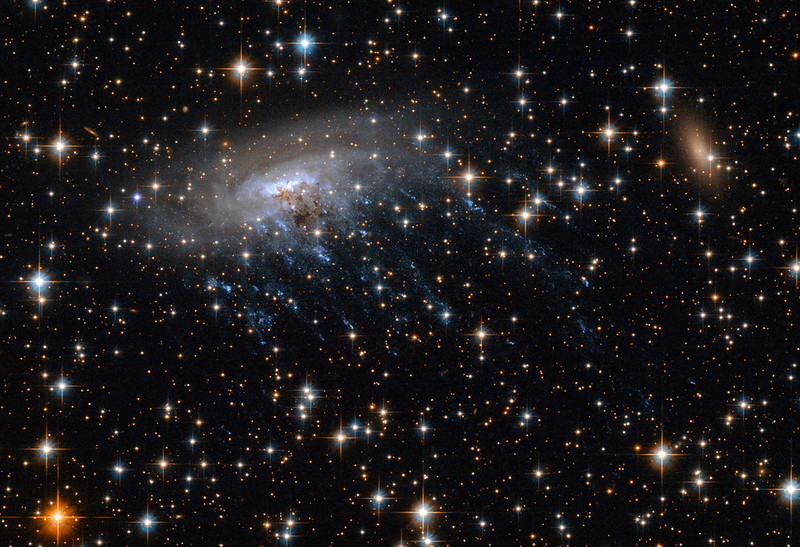
The universe, estimated to be approximately 14 billion years old, entered a phase known as the dark ages of the universe, during which it is theorized that no stars formed for the initial few hundred million years. Following this epoch, the first billion years saw the dawn of the universe, marking the assembly of the oldest galaxies from gas and plasma.
As these galaxies came together and more material became accessible, their star formation rates surged annually. Roughly two to three billion years post-Big Bang, galaxies experienced unprecedented growth, producing stars at record rates. This period is referred to as the noon of the universe.
Recently, Dutch researchers focused on three distant galaxies whose light traveled to Earth during cosmic noon. Their selection stemmed from ancient star-forming galaxies identified via ALMA, a comprehensive archival program aimed at enhancing kinematic analysis. alma alpaca project. They chose to investigate galaxies designated as ID1, ID3, and ID13.
By integrating two data types, they crafted a detailed depiction of these galaxies. They first gathered information from the Atacama Large Millimeter/Submillimeter Array, a powerful 66-antenna telescope situated in Chile. This ALMA telescope was utilized to detect radio emissions from carbon monoxide and elemental carbon within these galaxies. Researchers noted that analyzing these chemicals could unveil the movement of free-floating gas clouds across distant galaxies. Additionally, they utilized publicly accessible data from JWST’s near-infrared camera, known as NIRCam, to gauge the light emitted by stars within the galaxies. Through diverse analytical methods on these noonday galaxies, the researchers aimed to estimate their masses along with the contributions of normal matter and dark matter.
Utilizing computer programs developed by fellow astronomers, the team interpreted the JWST data into a series of maps illustrating the star distribution across each galaxy. They applied this emission data to assess the total mass of all stars in these galaxies. Subsequently, they developed their own software to map the gas distribution using ALMA data. These visualizations led to the creation of plots termed the rotation curve, which illustrates the speeds of particles orbiting each galaxy’s center relative to their distance from that center.
Astronomers leveraged these rotation curves to estimate dark matter quantities in each galaxy. Since dark matter is invisible but still exerts gravitational influence, the gravity it generates causes visible matter, like stars and gas near the galactic periphery, to move faster than in galaxies devoid of dark matter.
The study revealed that the selected galaxies have masses ranging from 39 billion to 80 billion times that of our Sun’s mass, or solar mass. They hosted free-floating gas amounting to between 4 billion and nearly 16 billion solar masses, alongside dark matter quantities estimated between 1 trillion and 31 trillion solar masses.
However, discrepancies arose when comparing luminescence data with rotation curves. Typically, dark matter forms shells or haloes around galaxies, primarily affecting outer regions. Consequently, astronomers generally ascertain central matter mass based on existing gas and star quantities. Yet, the researchers discovered that, near the centers of these galaxies, the mass derived from emissions was less than what rotation curves suggested.
They proposed several theories to explain this inconsistency. Firstly, they posited that the halo shape might not accurately represent dark matter distribution in all galaxies—implying that noonday galaxies could harbor dark matter in their centers. Secondly, densely packed stars in these galaxies might impede each other’s emissions. Lastly, in galaxy ID1, a supermassive black hole was found to constitute roughly 1.5% of the total star mass at its core.
The researchers concluded that they had achieved a comprehensive understanding of the mass distribution within these midday galaxies. However, the reason behind the central mass discrepancy remained unresolved. They suggested the existence of a complex interplay between dark matter haloes and the ordinary matter within these galaxies. Future astronomers could employ this methodology to investigate matter distribution in ALMA ALPACA and other distant galaxies in upcoming surveys.
Post views: 1,038
Source: sciworthy.com