


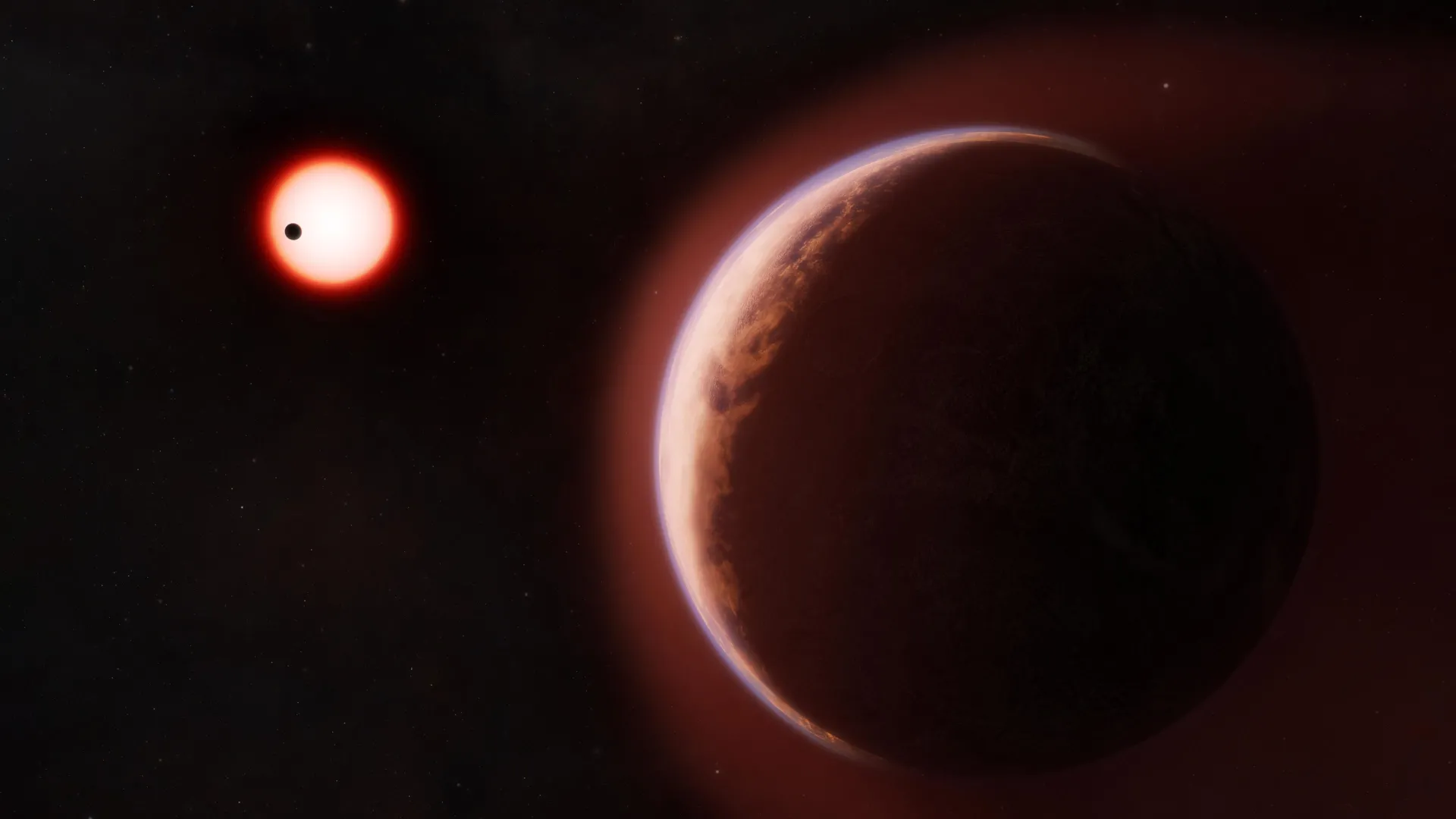
Astronomers have made a groundbreaking discovery in the quest for extraterrestrial life, detecting an atmosphere surrounding a rocky, Earth-like exoplanet located within the habitable zone of a distant star.
This significant finding offers compelling evidence that planets with Earth-like temperatures and rocky compositions exist beyond our solar system and could potentially possess conditions suitable for life.
“Atmospheres are critical for planets to sustain life as we understand it,” stated lead author Colin Cherubim, who recently earned his Ph.D. in Earth and Planetary Sciences from Harvard University.
“This marks the first instance where we’ve successfully identified the atmosphere of a rocky planet situated in the habitable zone of another star.”
Helium Indicates Exoplanet Atmospheres
The study, published on July 16th, reveals that Science has detected helium emissions from LHS 1140 b, a rocky exoplanet located approximately 48 light-years away from Earth. This observation aligns with early theoretical predictions suggesting the presence of an atmosphere around this planet.
LHS 1140 b orbits a red dwarf star within its habitable zone, a region where temperature and environmental conditions enable the existence of liquid water on the planet’s surface.
Scientists have cataloged thousands of exoplanets, including rocky worlds situated in the habitable zone. However, ascertaining whether these planets possess atmospheres remains one of the most formidable challenges in exoplanet research.
“Twenty years ago, we questioned whether terrestrial planets existed,” remarked Robin Wordsworth, Gordon McKay Professor of Environmental Science and Engineering at Harvard University and one of Cherubim’s dissertation advisors. “We later discovered that they are common and found several in the habitable zone. The pressing question now is whether any of these can maintain an atmosphere. We now know at least one can.”
A Rocky World Retaining Its Atmosphere
Previous studies have identified rocky planets orbiting within habitable zones, but this research uniquely demonstrates that one of these worlds possesses an atmosphere that may have endured for billions of years.
Cherubim and his team developed a theoretical model predicting that LHS 1140 b’s upper atmosphere contains substantial helium, which is expected to gradually escape into space.
The researchers validated this prediction using the Warm Infrared Echelle (WINERED) spectrometer at the Magellan Observatory in Chile, timing their observations to capitalize on a rare event where LHS 1140 b and another planet transited in front of the star simultaneously.
While the second planet showed no signs of an atmosphere, LHS 1140 b emitted a distinct signal indicating helium leakage, providing evidence that it retains an atmosphere.
Telescope Data Supports Predictions
Cherubim’s co-advisor, David Charbonneau, an esteemed astronomer at Harvard’s Center for Astrophysics, initially harbored doubts about the project’s feasibility. This prediction stemmed from a mathematical model, and such a signal had never been documented from a rocky world before.
The compelling results reshaped his perspective.
“Colin meticulously analyzed the planet and predicted the presence of a helium atmosphere,” Charbonneau remarked. “He skillfully timed the observations, and the data confirmed a statistically solid detection.”
This discovery suggests that astronomers could be able to study the atmospheres of rocky exoplanets from Earth by observing gases escaping into space.
Focusing on Promising Targets in the Search for Life
Astronomers estimate that LHS 1140 b’s atmosphere has been intact for over 3 billion years. Given its longevity, this planet presents a particularly compelling target for further observation.
Cherubim aims to determine the full chemical composition of the atmosphere and eventually assess whether the planet possesses a surface ocean or other features critical for habitability. He and his colleagues intend to use the model to investigate additional rocky worlds showcasing atmospheres.
“This serves as a validation of the model, and we anticipate this is just the beginning of many more observations to come,” he concluded.
Source: www.sciencedaily.com