


Researchers have unveiled a groundbreaking predictive technique that forecasts the intensity of the Sun’s upcoming solar cycle up to seven years in advance.
This innovative method centers on analyzing the sunspot count during the newly discovered “switch-off” phase of the solar cycle. During this critical phase, the Sun’s most severe space weather phenomena appear to conclude suddenly. This technique has already been employed to formulate early projections for Solar Cycle 26.
Initial predictions indicate that Solar Cycle 26 may be moderate, with anticipated sunspot numbers ranging from 100 to 120. This suggests that Cycle 26 could either match or be less intense than the current Solar Cycle 25. However, more precise forecasts will not be available for about two years, leaving room for both stronger and weaker outcomes.
The research findings will be shared later this week at the National Astronomical Conference organized by the Royal Astronomical Society in Birmingham.
Sudden Halt of Abnormal Solar Weather
Sandra Chapman, a Physics Professor and Director of the Center for Fusion, Space, and Astrophysics at the University of Warwick, commented, “The sun does not simply fall asleep and then gently awaken again.
“Our research has shown that the most extreme space weather abruptly switches off at a specific juncture in each solar cycle. By pinpointing this crucial moment, we have discovered a dependable method for predicting the activity level of the next solar cycle.”
Professor Chapman anticipates further refinement of the predictions for Cycle 26 within approximately two years. By then, Solar Cycle 25 will have reached its own identified “switch-off” point, enabling scientists to base their estimates on direct observations instead of mere predictions.
The Sun operates in cycles lasting roughly 11 years. Throughout this time, its magnetic field’s polarity reverses, leading to fluctuations in the number of sunspots.
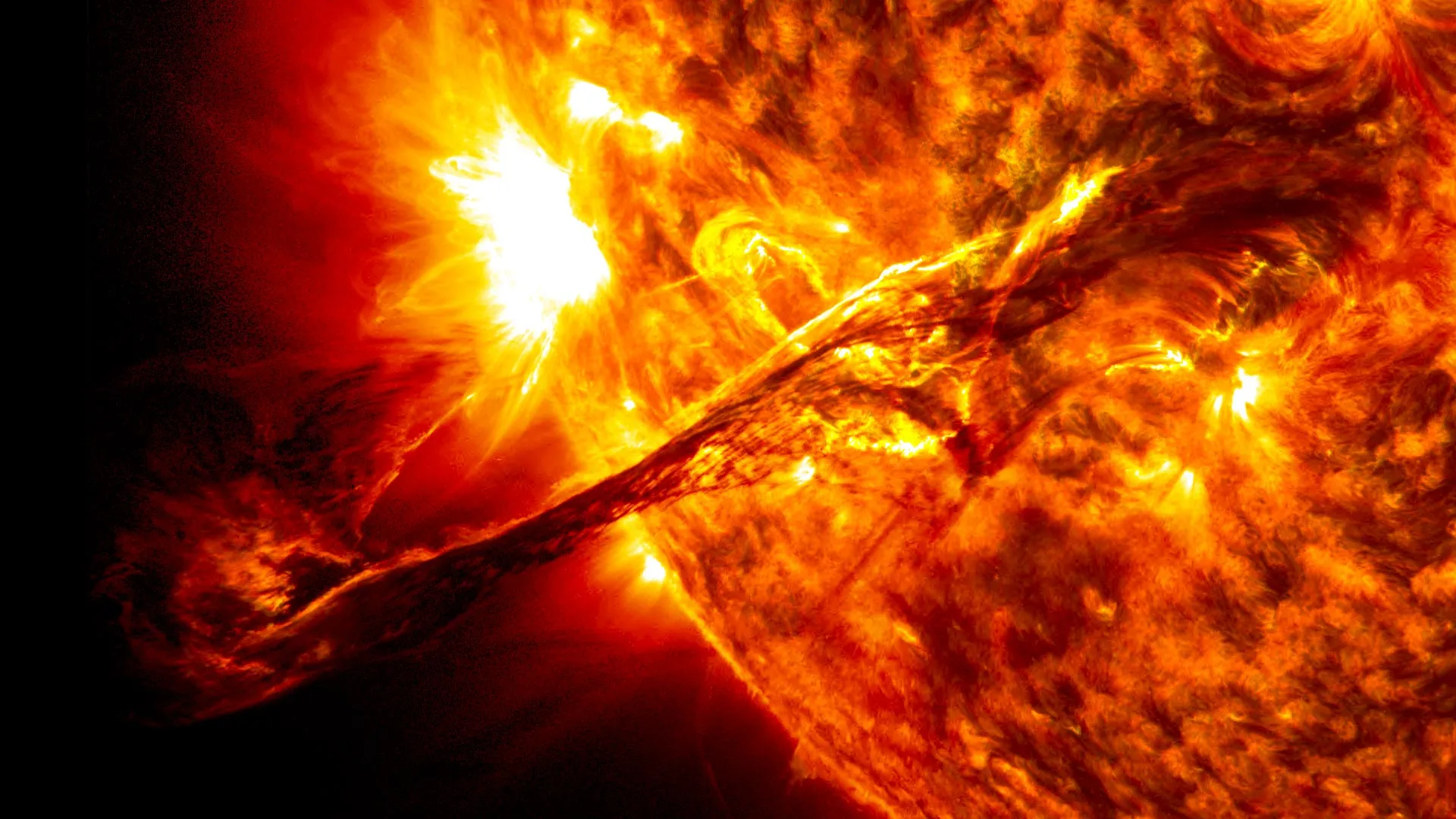
Sunspots are highly magnetic regions on the Sun’s surface that can trigger powerful solar flares and coronal mass ejections, launching energy and charged particles into space. Such space weather can disrupt satellites, communication systems, navigation networks, and power grids on Earth.
Astronomers have meticulously tracked sunspots for centuries, observing different behaviors across various solar cycles. Some cycles may differ in duration, intensity, and overall characteristics, complicating the prediction of future cycles’ strength.
New Solar Clock Enhances Predictions
This advanced technology builds on Professor Chapman’s earlier ‘solar clock’—a system that standardizes the Sun’s irregular cycles. The study revealed that extreme space weather events do not gradually taper off after the cycle concludes but terminate at a distinctly defined stage.
Professor Chapman and her team discovered a close correlation between the number of sunspots observed during this stage and the peak sunspot count expected in the upcoming solar cycle.
This new approach enables estimates of future cycle strengths approximately six to seven years prior to their peak. Traditional prediction methods typically provide less lead time since scientists must wait until the solar minimum—the quietest phase of the solar cycle.
The technique also identifies the specific phase during which the magnetic field responsible for the subsequent cycle is predicted to be established. Researchers are optimistic that this timing will enhance their understanding of the solar dynamo—the mechanism that generates and sustains the sun’s magnetic field.
Professor Chapman stated, “We are about two years away from reaching the current switch-off point for Solar Cycle 25. For now, we need to estimate where that point will fall, but once we arrive, we can provide more accurate predictions for Solar Cycle 26 based solely on observations.”
“Nonetheless, we will gain about seven years of advance warning regarding the anticipated strength of this cycle.”
Cycle 25 Predictions Prove Accurate
This predictive method had previously indicated that Solar Cycle 25 would be more active than many estimates suggested. This heightened activity has resulted in some of the most impressive auroras seen in recent times.
The UK experienced significant solar storms in 2024 as Cycle 25 neared its solar maximum, the period of highest activity. Notable events occurred between May 10th and 13th.
A massive sunspot cluster close to solar maximum generated the strongest magnetic storm to affect Earth in over 20 years, causing brilliant and widespread auroras across the UK, extending as far south as Devon and Cornwall.
In 2022, Professor Chapman received the Royal Astronomical Society’s prestigious Chapman Medal for her pioneering research on planetary magnetic fields and their role in generating space weather.
Understanding Why Solar Storms Cease
The newly identified switch-off point occurs when the active sunspot region migrates below approximately 15 degrees of solar latitude.
Throughout each solar cycle, sunspots form a “butterfly pattern,” initially appearing at high latitudes before gradually moving towards the Sun’s equator as the cycle advances.
The Sun exhibits differential rotation, whereby different latitudes rotate at varying speeds. However, below about 15 degrees of latitude, this speed difference diminishes, creating a co-rotating region around the solar equator known as the solar “jet stream”.
Professor Chapman believes that the most forceful coronal mass ejections arise due to differential rotation. As different parts of the Sun rotate at distinct speeds, emerging magnetic fields twist and store energy. When an active sunspot region shifts within 15 degrees of the equator, this twisting mechanism weakens, effectively turning off the primary driver of extreme space weather.
To validate this hypothesis, Professor Chapman examined the correlation of Earth’s geomagnetic activity, tracked over a 27-day solar rotation period, and compared it to recorded space weather events.
Post switch-off, geomagnetic storms became less intense and adhered to a 27-day cycle, indicating they were likely produced by corotating flows rather than coronal mass ejections.
Source: www.sciencedaily.com