


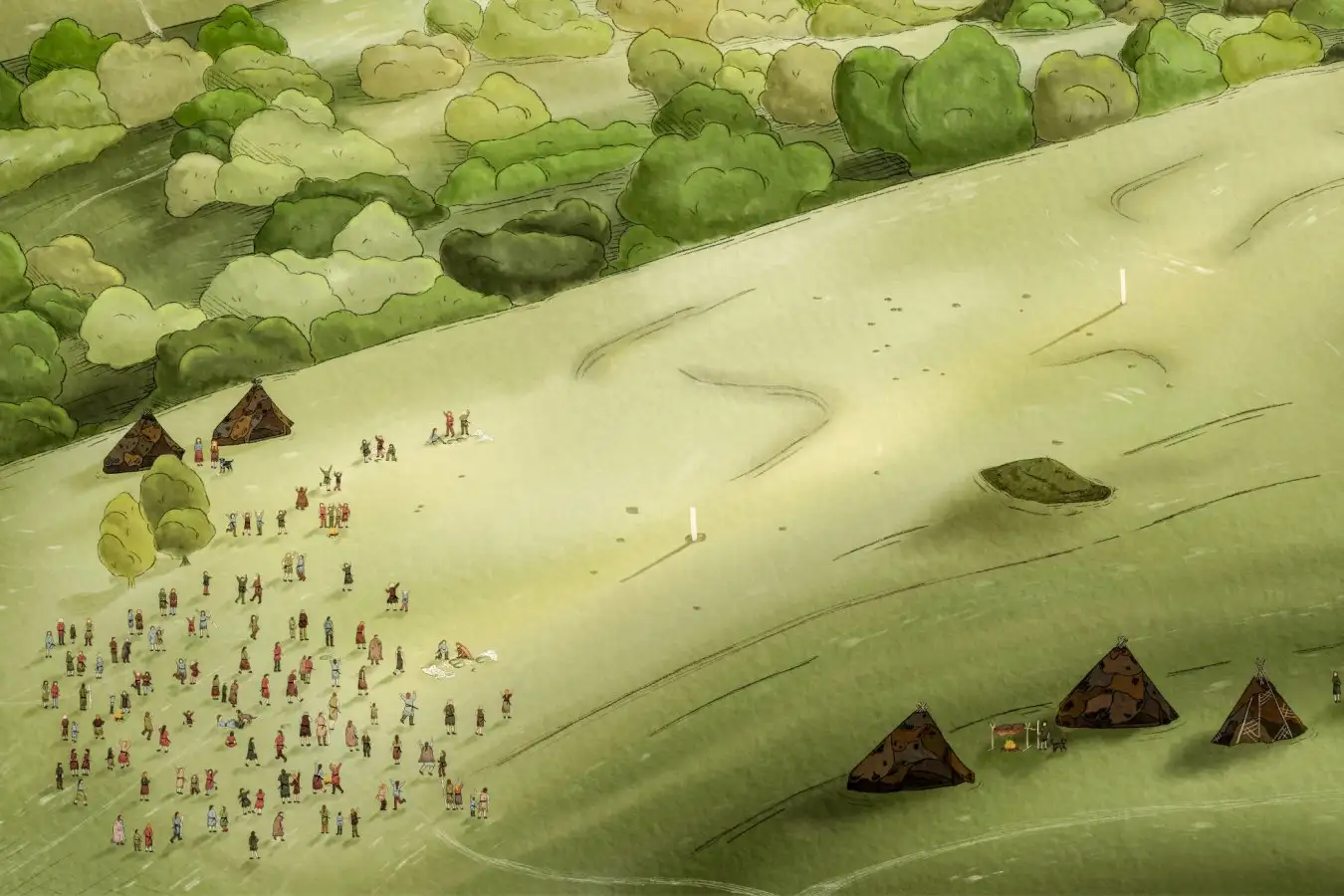
Reenactment of the summer solstice celebrations at Bulford
Marijane Porter, Wessex Archaeology
Ancient Stone Age communities in Britain constructed wooden monuments to honor the summer solstice, predating the iconic stone circles of Stonehenge by around 500 years.
Interestingly, the alignment of Stonehenge also marks the summer solstice, suggesting that this earlier wooden monument may have served as a prototype. This discovery represents one of the earliest instances of monuments designed for the observation of astronomical events in Britain.
“Our findings provide clear evidence that these ancient peoples understood the solar cycle,” stated Phil Harding from Wessex Archaeology, which led the excavation, during a press conference revealing the discovery.
Stonehenge is a remarkable Neolithic monument situated on Salisbury Plain in England. It features a circular arrangement of vertical sarsen stones topped with lintels, alongside a smaller inner circle of bluestones. This oldest section of the site dates back to around 3100 BC, with additional stone placements continuing until about 1600 BC.
Some of the standing stones are believed to have been strategically positioned to align with the summer solstice sunrise and the winter solstice sunset, with the surrounding stones erected approximately around 2500 BC.
Harding and his team uncovered the remnants of a 500-year-old monument located about five kilometers northeast of Stonehenge, near the village of Bulford. Planned military housing for 5,000 soldiers prompted an excavation by Wessex Archaeology from 2015 to 2017.
The research team found several pits containing fluted Neolithic pottery. Radiocarbon analysis dated the pottery to approximately 2950 BC, with 40 clustered dates indicating the site was likely occupied for a brief period, around 10 years.
“This site represents a significant Middle Neolithic settlement,” said Susan Greaney from the University of Exeter, who was not part of the study.

Neolithic pottery found at Bulford
Wessex Archaeology
Among the pits excavated in Bulford, two exhibited a unique shape with sloped sides, tapering from 1.2 meters wide at the top to approximately 0.5 meters at the base. These postholes did not contain pottery but were filled with chalk rubble, indicating they had once supported tall timbers. Notably, one such posthole contained rowan charcoal.
The two postholes are spaced around 120 meters apart, and a line drawn between them points toward the northeast at about 48.1 degrees, coinciding with the sunrise on the summer solstice. “I was incredibly excited about this alignment,” stated Harding.
Fabio Silva, a skyscape archaeologist from Stone X Sky, utilized 3D landscape reconstructions and data on the sun’s trajectory to further analyze the posthole positioning. Silva confirmed that the holes were aligned with historical summer solstice sunrises.
Despite a slight alignment deviation of roughly one degree, Silva noted the significance of the timber diameter, suggesting that a 50-centimeter post could account for this variation. “The likelihood of this being mere coincidence is less than 0.5 percent,” he affirmed.
“Approximate alignment was likely sufficient for the rituals intended at these locations,” remarked A. Cesar González Garcia from Spain’s National Research Council in Santiago de Compostela, who was not involved in the analysis. “There appears to be a widespread cultural interest in the sky amongst these ancient peoples.”
Historical remnants in the surrounding area also suggest that early inhabitants tracked solar movements, albeit with less precision. “From the earliest Neolithic communities, astronomical phenomena were integrated into their ceremonial structures,” commented Matt Leivers, also with Wessex Archaeology.
“Numerous wooden monuments have been arranged in similar patterns,” said Greaney, emphasizing the importance of the Bulford site as a significant addition to the narrative of Neolithic construction techniques. Nearby Larkhill features a Neolithic enclosure dating back to approximately 3700 BC, pre-dating both Bulford and Stonehenge, with its entrance aligned to capture the sunrise at midsummer.
Standing at the enclosure’s entrance on a summer morning offers a direct view of the sun rising over Sidbury Hill, the highest point on the horizon,” Leavers concluded.
Topic:
Source: www.newscientist.com