


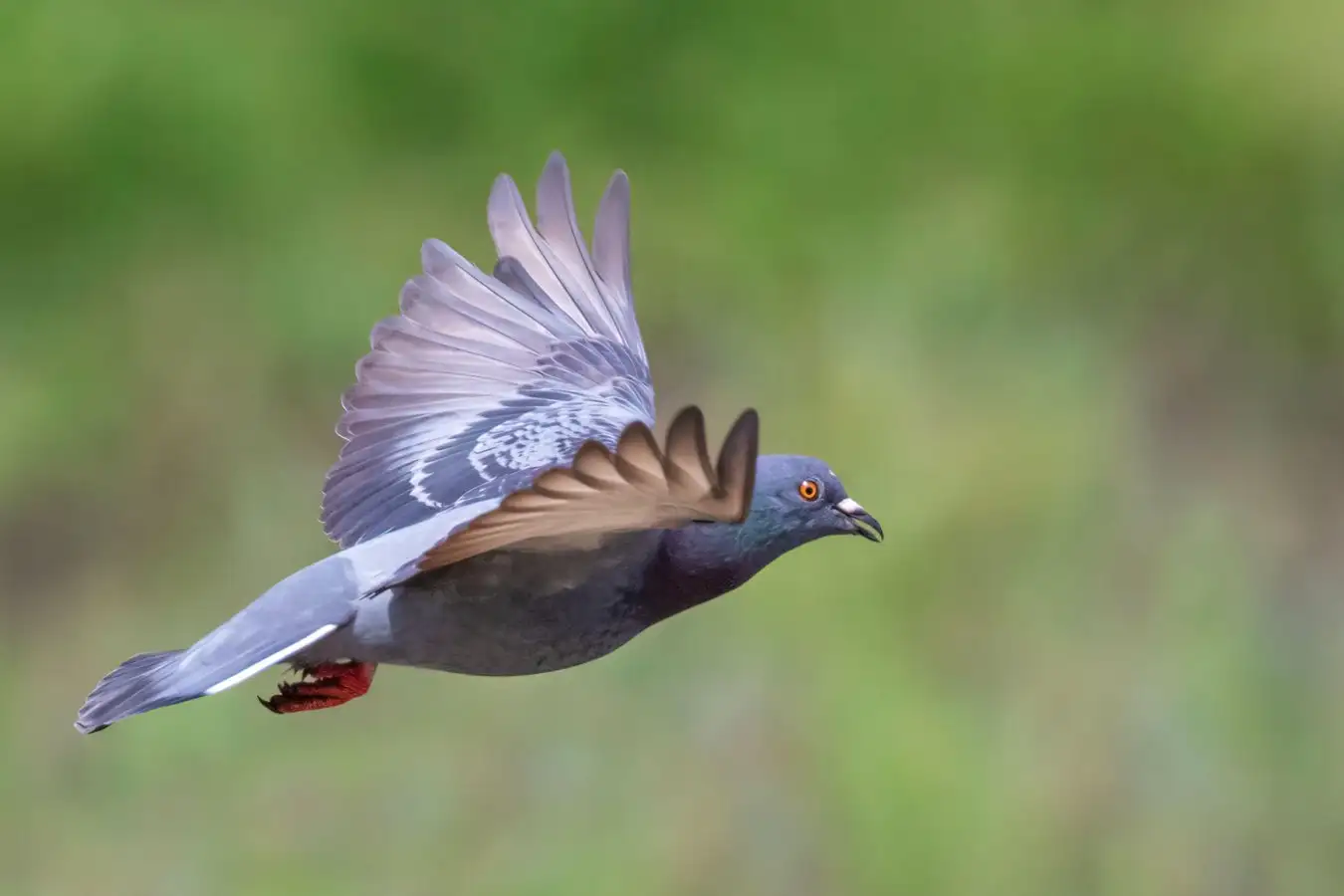
Pigeons are Always Looking Forward
yod67/alamy
Recent research has unveiled a fascinating insight into avian behavior: scientists tracked the eye movements of birds in flight for the very first time, specifically observing that pigeons maintain a fixed gaze rather than scanning their surroundings. This unique flight pattern might assist in navigation but could inadvertently expose them to potential predators.
When terrestrial animals wish to observe their environment, they move their heads and eyes, employing rapid pupil movements known as saccades for stable vision. However, little was known about the eye movement dynamics of flying birds.
To address this gap, Ivo Ross and researchers from the California Institute of Technology created a lightweight mirror-and-camera rig that can be easily attached to pigeons (Columba livia). This setup includes a compact backpack containing the camera control board and battery, enabling seamless monitoring during flight.

Pigeon Equipped with an Eye Tracking Device
Andrew Biewener
In their experiments, researchers trained six pigeons indoors to navigate between two perches spaced approximately 20 meters apart, while three pigeons were trained to return to the coop after flying about 25 meters outdoors.
During test flights in both environments, eye-tracking data revealed that upon takeoff, the pigeons increased their pupil size and maintained a locked eye position, stabilizing their gaze throughout the flight.
“When you start flying, your eyes tend to rotate forward,” explains Ross.
When their heads move, the eyes synchronize in movement. This fixed eye position aligns with the primary horizontal axis of the bird’s visual and vestibular systems, providing essential balance and spatial orientation.
“We discovered that pigeons can move their eyes independently, with a maximum range of about 15 degrees,” states Graham Martin from the University of Birmingham, UK. “The minimal eye movements observed during flight suggest that these birds are actively stabilizing their visual focus.”
While the reasons behind their fixed gaze remain unclear, Ross theorizes that this behavior aids in balance and navigation, enabling pigeons to differentiate between their movements and external stimuli, such as branches or approaching predators.
Minimizing eye movements may also alleviate the cognitive load on their brains. “The environment moves much faster during flight compared to when they’re grounded,” he emphasizes.
Equipping pigeons with a horizontal field of view of around 340 degrees indicates that a forward-facing fixation likely results in a significant blind spot behind them, providing an advantage against potential threats.
All experiments were conducted at low altitudes, leaving researchers intrigued about the pigeons’ eye behavior under different conditions. “If they were flying at higher elevations with fewer obstacles, the outcomes might vary,” Ross notes. He ponders their perceptual awareness while flying in flocks: “Are they vigilant about other pigeons, discerning predators, or monitoring distant horizons?”
Martin suggests that other avian species, including raptors, may similarly stabilize their gaze while in flight. For instance, when a peregrine falcon pursues prey, “the falcon likely maintains a fixed gaze along a curvy trajectory rather than moving its eyes,” he concludes.
Topics:
Source: www.newscientist.com