


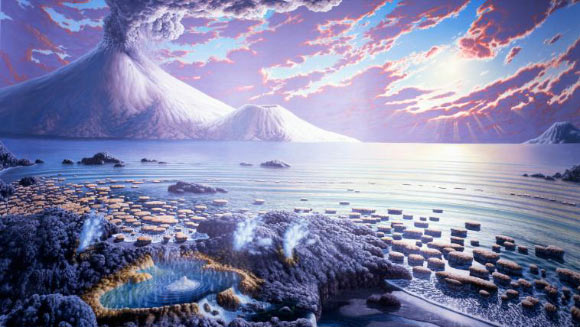
Chemical signatures preserved in ancient rocks reveal that marine environments began deteriorating well before the catastrophic event that led to the extinction of numerous species at the end of the Triassic period, approximately 201 million years ago.
Early Earth. Image credit: Peter Sawyer/Smithsonian Institution.
“The late Triassic period witnessed one of Earth’s most severe mass extinctions, the end-Triassic mass extinction, occurring just before the Triassic-Jurassic boundary, approximately 201 million years ago,” said Kayla McCabe, a geologist at Virginia Tech.
“This event resulted in a loss of around 60% of marine invertebrate species and coincided with several paleoenvironmental disruptions.”
“It is hypothesized that extensive volcanic activity from the central Atlantic magma belt initiated the environmental changes leading to the Triassic mass extinction.”
“These changes involved climate warming, ocean acidification, and deoxygenation, among others.”
In their recent study, McCabe and collaborators examined geological records.
Between 2017 and 2022, they conducted fieldwork at Grotto Creek in Wrangell-St. Paul, Alaska, a remote area accessible only by small aircraft.
The researchers compared sedimentary rock layers deposited before, during, and after the mass extinction.
Rock formations serve as archives of ancient environmental conditions, including those of the Panthalassic Sea.
Historical data indicates that oxygen levels in shallow oceans started to decline roughly 8 million years prior to the end-Triassic mass extinction.
This early decline in oxygen is believed to have stressed marine ecosystems long before significant extinction events unfolded.
Geochemical analyses confirm that oxygen depletion intensified during the extinction, becoming a primary driver of species loss.

Bengwigwisingaskas eremicalminis on the Panthalassan Sea coast. Image credit: Jorge Gonzalez.
“There are indications of another volcanic field that aligns with this time period,” stated Ben Gill, a geochemist at Virginia Tech.
“While the exact cause remains unclear, our understanding of the processes involved is improving.”
“This provides a valuable insight into future patterns, as our current oceans, including the Chesapeake Bay, are facing similar challenges of acidification and deoxygenation.”
“Earth has undergone this phenomenon before, indicating that climate warming and its associated impacts are likely to follow.”
“This gives us a clearer picture of what to expect moving forward.”
These findings are published in Nature Communications Earth and Environment.
_____
K.E. McCabe et al. 2026. Deoxygenation of the equatorial Panthalassan Ocean preceded the mass extinction at the end of the Triassic. Nature Communications Earth and Environment 7, 460; doi: 10.1038/s43247-026-03362-w
Source: www.sci.news