


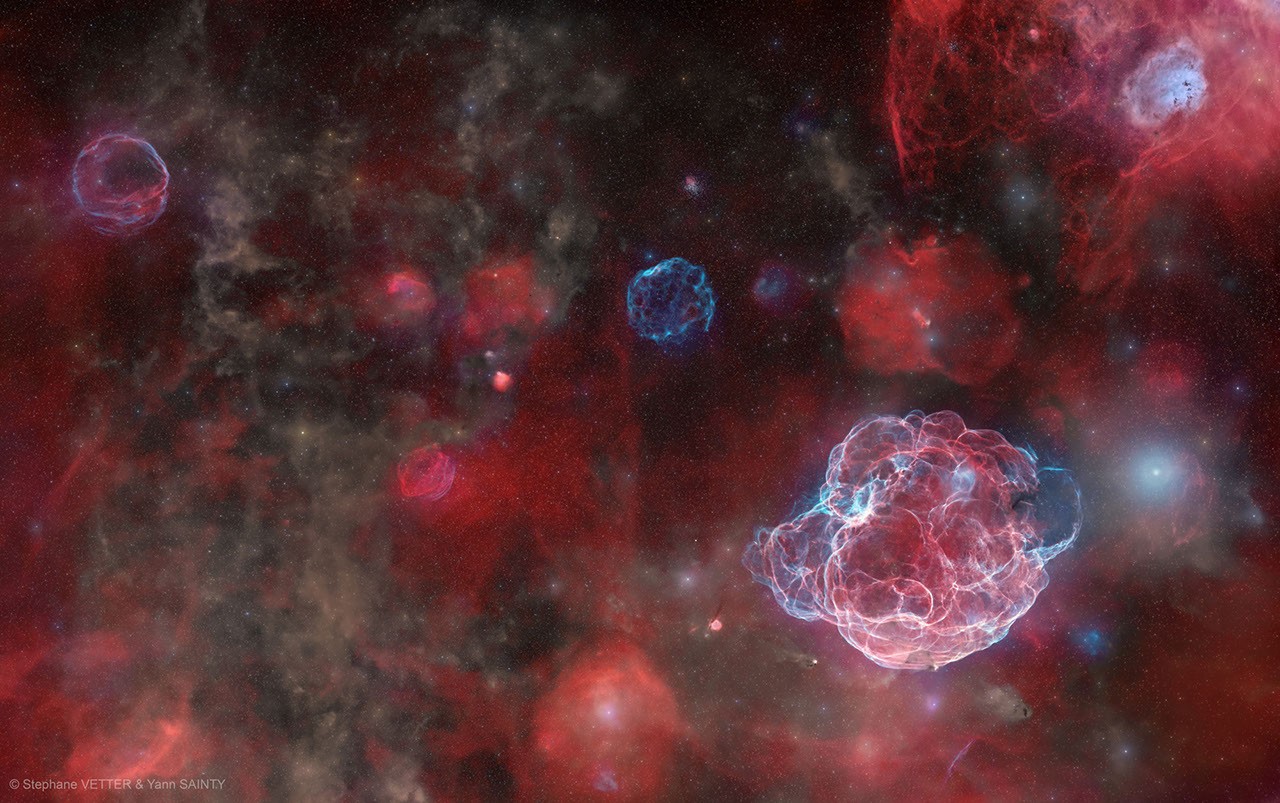
Five Supernova Remnants Haunt the Auriga Constellation
This wide-field image reveals five ancient supernova remnants across an unusual region of the sky. It was captured at the Oukaimeden Observatory in Morocco after approximately 200 hours of observations.
A vast celestial landscape in Auriga
The image covers an area equivalent to roughly a thousand full Moons arranged across the constellation Auriga, also known as the Coachman. The five supernova remnants visible across the field, from left to right, are:
- G181.1+9.5
- G182.4+4.3
- G179.0+2.6
- G180.0−1.7, also known as Sh2-240 or the Spaghetti Nebula
- G178.2−4.2
These objects are highlighted in the annotated image. The scene also includes the open star cluster M37 and the Tadpole Nebula.
Ghostly shells from ancient stellar explosions
Each supernova exploded and expanded into space, creating a growing shell of shocked gas and delicate filamentary structures. In the image, hydrogen appears red, while oxygen appears blue, as shown in these references for expanding stellar remnants, hydrogen, and oxygen.
These ancient stellar explosions occurred independently. The remnants lie at different distances, up to several thousand light-years from Earth, and are estimated to be tens of thousands of years old. Early humans may have witnessed some of them as bright new stars before they faded over weeks or months.
APOD submission and website updates
APOD’s email address for posting images has changed. Please visit the APOD Submissions page for details.
NASA’s main site for APOD is moving. Visit On the move for more information, or go from apod.nasa.gov to science.nasa.gov/apod.
Tomorrow’s photos: What’s next?
Source: science.nasa.gov