


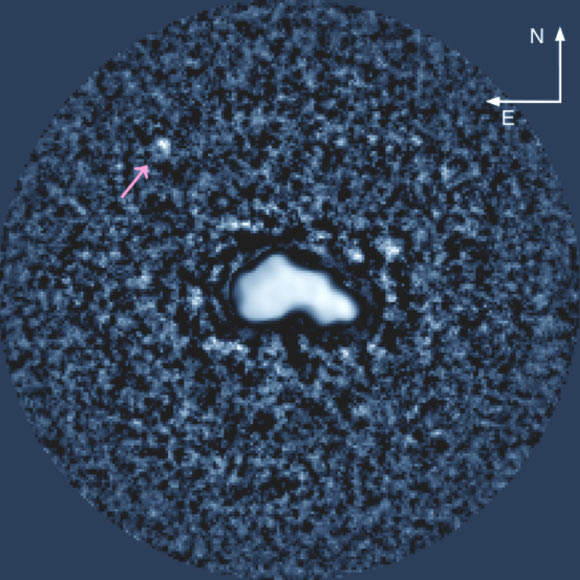
New high-resolution images from ESO’s Very Large Telescope and the Large Binocular Telescope suggest that the E-type asteroid (44) Nysa may be unlike any other known world in the Solar System. The observations reveal a rare three-lobed, or trilobate, structure and a newly identified satellite that could provide important clues about the asteroid’s formation.
This image of the Nysa asteroid system was captured on February 15, 2026. Image credit: Minker et al., arXiv: 2607.25786.
Asteroid Nysa is one of the largest and brightest asteroids in the main asteroid belt with an enstatite-like, or E-type, surface composition.
E-type asteroids are rare and are associated with enstatite-rich meteorites, including aubrites and enstatite chondrites. Scientists believe these materials may have formed from some of the same building blocks that contributed to the formation of the terrestrial planets.
“The images reveal a remarkably unusual object,” said Dr. Kate Minker, an astronomer at Lowell Observatory.
“The most likely explanation is that Nysa is either a contact trinary, consisting of three connected components, or an extremely irregular coherent body unlike anything we have previously observed.”
The observations also indicate the presence of a faint satellite orbiting Nysa. Studying this newly discovered companion could help astronomers better determine the asteroid’s mass, internal structure and evolutionary history.
“These observations had to be combined with specially developed image-processing techniques to sharpen the images and remove the bright halo surrounding the asteroid, which could otherwise hide faint companions,” added Dr. Anthony Berdeu, an astronomer at ESO.
To determine the unusual shape of Nysa, the research team used the SPHERE instrument on ESO’s Very Large Telescope and the SHARK-VIS instrument on the Large Binocular Telescope.
Both instruments use adaptive optics to correct for atmospheric distortion, allowing astronomers to obtain exceptionally sharp, ground-based images of the distant asteroid.
“These observations likely represent the closest competition to spacecraft-quality imaging ever achieved from the ground,” Dr. Minker said. “This was made possible by an exceptional combination of advanced instruments and sophisticated data-reduction techniques.”
The images show that Nysa measures approximately 80 km across and consists of three distinct regions, or ‘lobes,’ connected by two narrower sections. These constricted areas wrap around the asteroid and resemble ‘necks’ between the larger components.
Asteroids with neck-like structures have previously been interpreted as bilobate objects, meaning they contain two lobes. Nysa appears to be different: its three connected lobes make it the first convincing example of a trilobate asteroid.
The researchers propose two possible explanations for Nysa’s extraordinary shape.
One possibility is that Nysa began as a single body and was severely deformed by one or more collisions. Alternatively, it may be a composite object formed when three separate bodies collided and merged, creating necks at their points of contact.
Additional observations will be needed to determine which scenario best explains the origin of the trilobate asteroid. The newly detected satellite may provide an important piece of evidence by helping researchers understand Nysa’s mass distribution and past collisions.
“The new images appear consistent with several earlier clues that Nysa is truly a unique object,” said Dr. Al Conrad, an astronomer at the Large Binocular Telescope Observatory.
“For the first time, we can directly investigate whether those clues point to a deeply indented body or to a genuine multi-lobed structure.”
The team’s paper will be published in the journal Astronomy & Astrophysics.
_____
Kate Minker et al. 2026. Unmasking (44) Nysa: Evidence for a trilobate structure. A&A, in press; arXiv: 2607.25786
Source: www.sci.news