


Essential Facts about Lake Skadar
Location: Lake Skadar, Montenegro, Albania [42.201087364, 19.303135741]
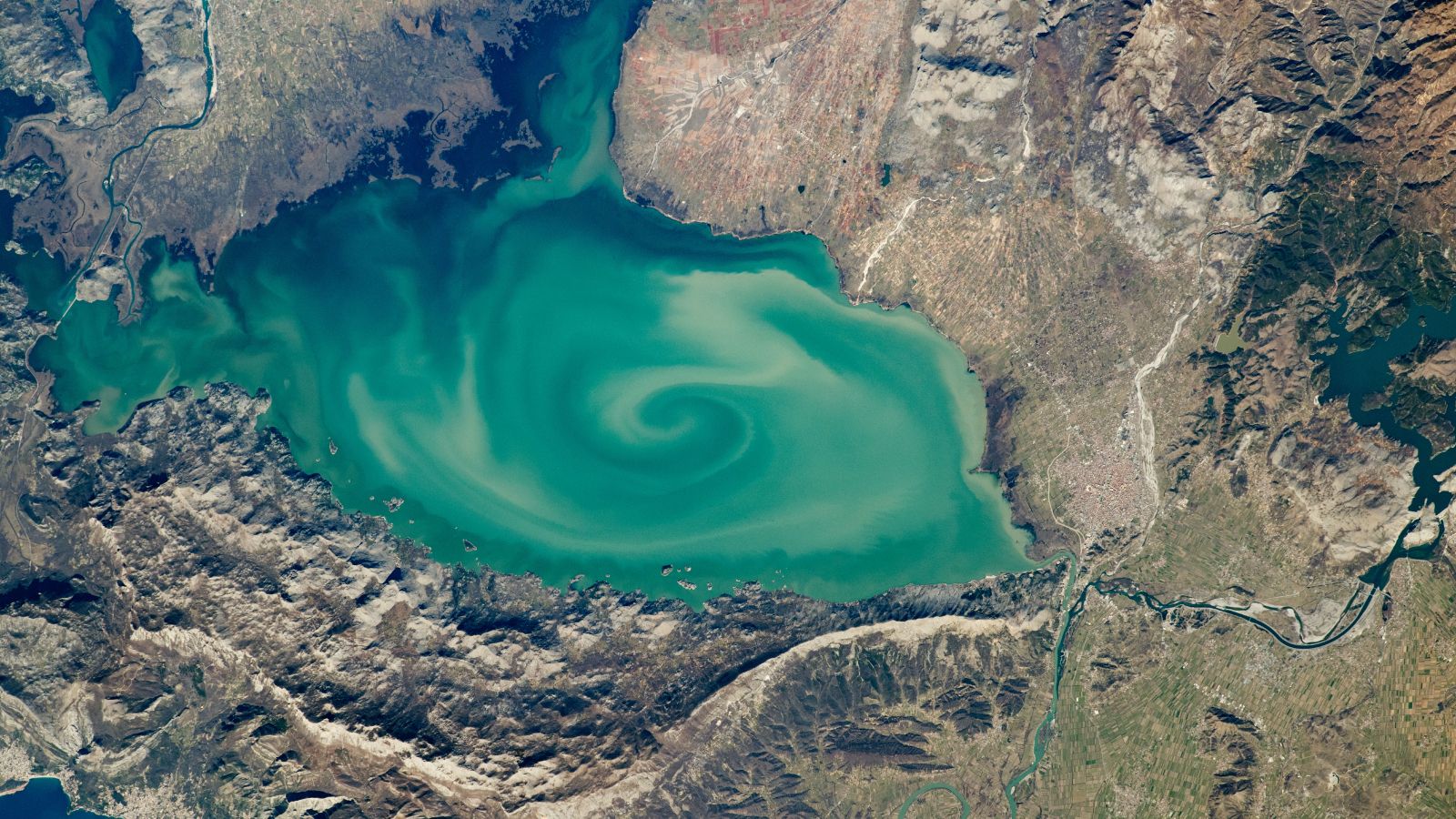
Image Description: A stunning milky whirlpool captured on the lake’s surface.
Photographer: Unknown astronaut from the International Space Station.
Date of Capture: February 21, 2020.
This captivating astronaut image reveals sediment clouds forming a massive milky whirlpool on the surface of one of Europe’s largest lakes.
Lake Skadar, renowned as Shkodar, Shkodra, and Scutari, is the largest lake in southern Europe. Covering a surface area of 140 to 200 square miles (360 to 520 square kilometers), it straddles the border of Montenegro to the west and Albania to the east, with 65% of the waters within Montenegro’s territory.
The primary water source feeding Lake Skadar is the Morača River in the northwest, with its largest outlets being the Bojana and Drin Rivers. These rivers eventually flow into the Adriatic Sea and are partially visible in the photo. Nestled along the southern edge of the lake is the majestic Dinaric Alps mountain range.
During late winter and early spring, the lake typically sees water levels rise, causing a milky white substance to emerge. This material often swirls due to a combination of wind-driven currents and the natural inflow from the lake’s main points of entry and exit.
This swirling material, though reminiscent of algal blooms, consists mainly of sediments like limestone and dolomite from the nearby Dinaric Alps, washed into the lake during snowmelt.
Lake Skadar, formed millions of years ago, was once interconnected with the Adriatic Sea (visible in this image).
(Image credit: Wikimedia)
This karst lake, Lake Skadar, originated from an ancient cave system that submerged and collapsed, possibly due to the same erodible rock that contributes to the current surface sediment. NASA Earth Observatory describes it as a “submerged cyclone” since most of its lakebed lies below sea level.
According to the International Lake Environment Commission Foundation, Lake Skadar was formed during the Cenozoic era, about 66 million years ago. The lake features several small islands like Beška, renowned for its two 600-year-old churches, and Gurmodur, home to a 19th-century fortress ruin on its shores.
Get the world’s most fascinating discoveries delivered straight to your inbox.
The remains of a paddle steamer named Skanderbeg can be found along the lake’s western shore. Sunk in 1942 by local partisans during World War II, parts of the wreck become visible during low water levels.
Lake Skadar stands as a vital biodiversity hotspot and a protected wildlife habitat across the Montenegro-Albania border, becoming especially significant for bird life, including the Dalmatian Pelican (Pelecanus crispus) and various endemic species, as documented by BirdLife International.
The lake is home to about 50 species of freshwater snails—more than any other lake worldwide, according to a 2013 survey.


This 2018 satellite image shows a mysterious substance swirling across Poland’s Gdańsk Bay, later revealed to be something unexpected.

A 2016 astronaut photo captures remarkable milky plumes swirling beneath Turkey’s Lake Van, the largest alkaline lake globally.
Source: www.livescience.com