


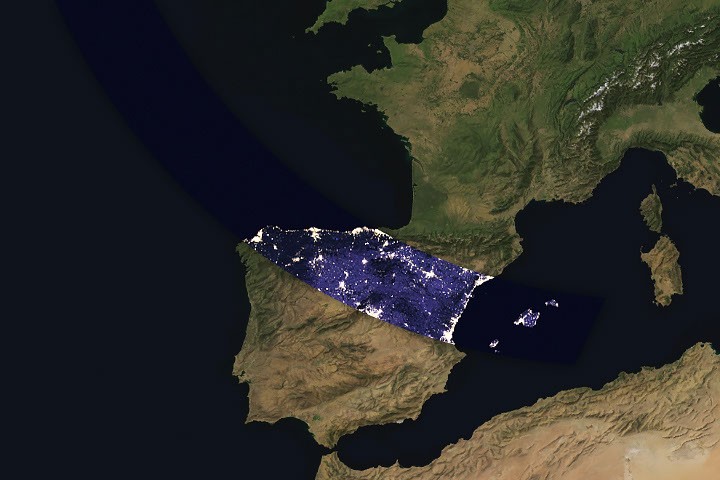
Total Solar Eclipse on August 12, 2026: Best Viewing Locations in Iceland and Spain
A total solar eclipse will occur on August 12, 2026, when the Sun, Moon, and Earth align. During totality, the Moon will completely block the Sun and reveal the ethereal solar corona. Unlike the April 8, 2024, eclipse—which crossed a large portion of North America—the 2026 eclipse will have a more limited path of totality. Only a few land areas in the Northern Hemisphere, including parts of Iceland and Spain, will experience a total eclipse.
2026 Total Solar Eclipse Path of Totality
On August 12, the Moon’s shadow will first cross the Arctic Circle from northern Russia before moving along the eastern coast of Greenland. At approximately 5:45 p.m. local time in Iceland, or 17:45 Universal Time, totality will reach the country’s western regions. The Snæfellsnes Peninsula, shown in the Landsat image above, is expected to be one of Iceland’s most notable eclipse-viewing destinations.
The greatest eclipse will occur near the sparsely populated Snæfellsnes Peninsula. At this point, the Moon will appear slightly larger in the sky and cover a greater portion of the Sun, creating the longest and most complete phase of the eclipse.
Viewing the Total Solar Eclipse in Snæfellsnes, Iceland
The Snæfellsjökull volcano stands at the western end of the Snæfellsnes Peninsula. The ice-covered stratovolcano last erupted roughly 1,800 years ago and is the centerpiece of Snæfellsjökull National Park. Visitors are expected to gather in the area to watch the 2026 total solar eclipse.
Snæfellsjökull is also famous in literature. In Jules Verne’s A Journey to the Center of the Earth, the protagonists enter the underground world through the volcano’s crater before emerging during an eruption of Stromboli in Italy. In 2025, a larger section of the peninsula became a UNESCO biosphere reserve. The reserve includes more than 70 percent of Iceland’s plant species, along with diverse volcanic landscapes, wetlands, and grasslands.
Total Eclipse Viewing in Northern Spain
After passing over Iceland, the eclipse’s central shadow, known as the umbra, will travel across the North Atlantic and reach northern Spain shortly before sunset. The path will move east-southeast across the country, following a route similar to that of the Ebro River, or Río Ebro, shown in the Landsat image below.
The upper Ebro River begins in rugged terrain within Parque Natural de Montes Obarenes-San Zadornil. There, the river cuts through canyons and gorges in the eastern foothills of the Cantabrian Mountains. Farther downstream, it winds through La Rioja, one of Spain’s best-known wine regions. Approximately 400 kilometers, or 250 miles, away, the Ebro reaches its delta on the Mediterranean coast between Barcelona and Valencia.
Where Will the 2026 Solar Eclipse Be Visible?
Long-term satellite observations of August cloud cover suggest that Spain may offer better odds of clear skies than Iceland. However, weather conditions can change quickly, so eclipse viewers should monitor local forecasts and prepare backup locations.
Although the path of totality crosses only a limited number of populated land areas, a much wider region will experience a partial solar eclipse. Viewers across much of Europe, parts of Africa, Canada, and the northern and northeastern United States will be able to see the Moon cover at least part of the Sun.
Important: Never look directly at the Sun without certified solar viewing glasses or other approved eye protection. Regular sunglasses are not safe for viewing a solar eclipse.
NASA Earth Observatory images and map by Michala Garrison, using Landsat data from the U.S. Geological Survey, base imagery from Blue Marble: Next Generation and Black Marble, and eclipse path data from Xavier Jubier. Story by Lindsey Doermann.
- NASA (2026) August 12, 2026, Total Solar Eclipse. Accessed August 11, 2026.
- NASA (2026, July 31) What’s Up: August 2026 Skywatching Tips from NASA. Accessed August 11, 2026.
- NASA Scientific Visualization Studio (2025, July 13) Animations of the August 12, 2026, Total Solar Eclipse. Accessed August 11, 2026.
- NASA Space Place (2024, March 29) Lunar Eclipses and Solar Eclipses. Accessed August 11, 2026.
- Patrimonio Natural de Castilla y León, Parque natural Montes Obarenes-San Zadornil. Accessed August 11, 2026.
- Snæfellsjökull National Park (2026) Snæfellsjökull National Park. Accessed August 11, 2026.
- UNESCO (2025) Snæfellsnes. Accessed August 11, 2026.
Source: science.nasa.gov