


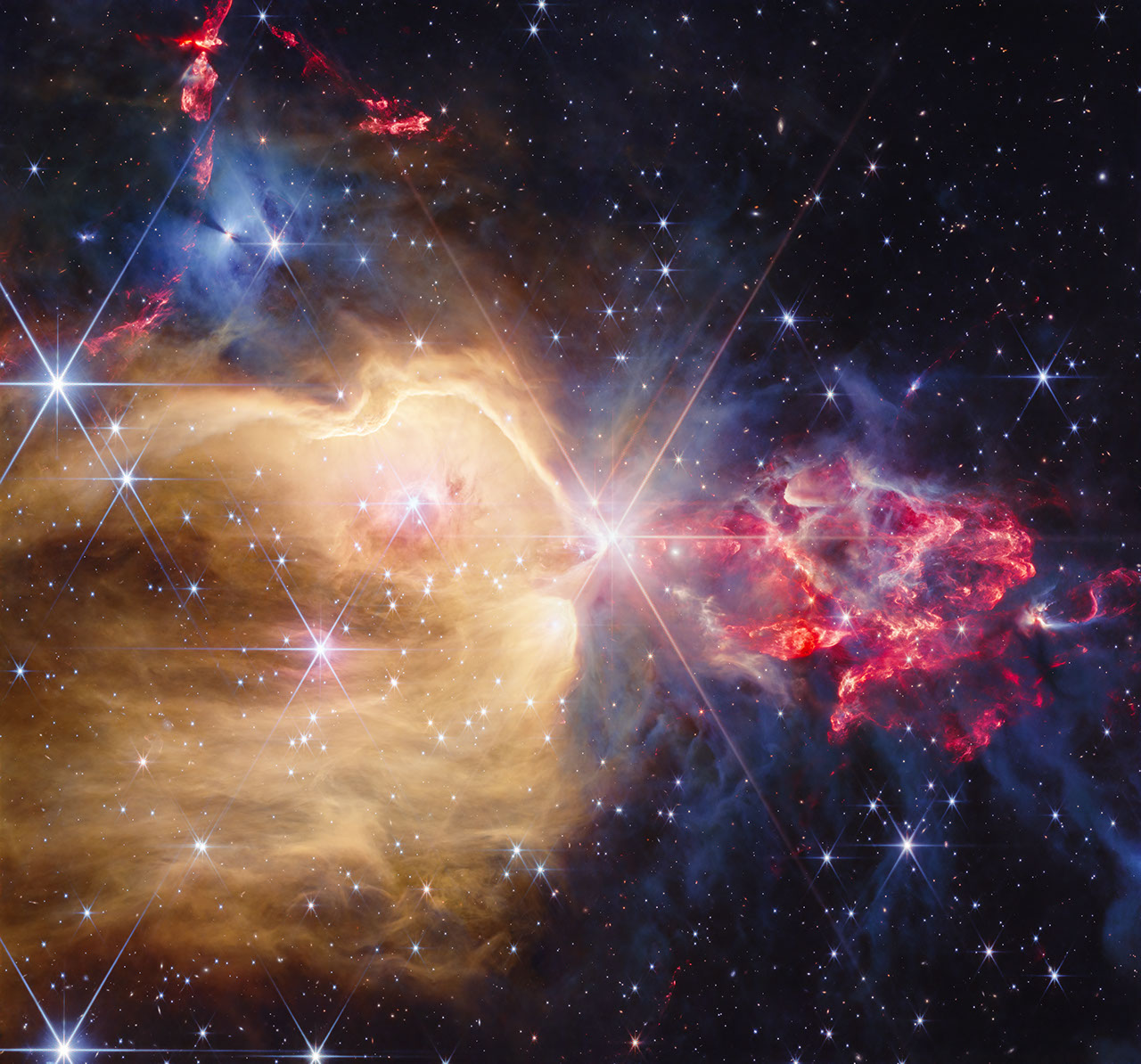
NASA’s James Webb Space Telescope has revealed many protostars and stars within NGC 7129’s glowing gas. Hot atomic hydrogen gas is shown in gold, while cold molecular hydrogen gas bombarded by an embedded protostar appears red.
Images: NASA, ESA, CSA, STScI; Image processing: Alyssa Pagan (STScI)
Webb Reveals a Stellar Nursery Bursting With Hidden Protostars in NGC 7129
New images from NASA’s James Webb Space Telescope reveal a cauldron of cosmic creation. Webb uncovered a large number of stars previously hidden by clouds of dust in the stellar nursery known as NGC 7129, located about 3,300 light-years from Earth.
Stars are the driving force behind the creation of elements. Their life cycle begins in molecular clouds—cold, dense regions of dust and gas. Because young stars are surrounded by dusty cocoons, they are often invisible to telescopes that cannot capture infrared light. Webb’s advanced infrared sensitivity allows astronomers to peer through the dust and study the earliest stages of stellar development.
Webb sees stars at different stages of formation
The stars in NGC 7129 are at different stages of development. More massive stars form and evolve fastest. The region’s brightest central star, LkH(alpha) 234 (pronounced rick-H-alpha), is the most massive and mature object in the area. It shows the image’s most prominent diffraction pattern and is a pre-main-sequence star with about five to eight times the mass of the Sun.
Pre-main-sequence stars have mostly finished collecting mass. They are shrinking under gravity while increasing in temperature. Eventually, LkH(alpha) 234 will begin fusing hydrogen, as the Sun does.
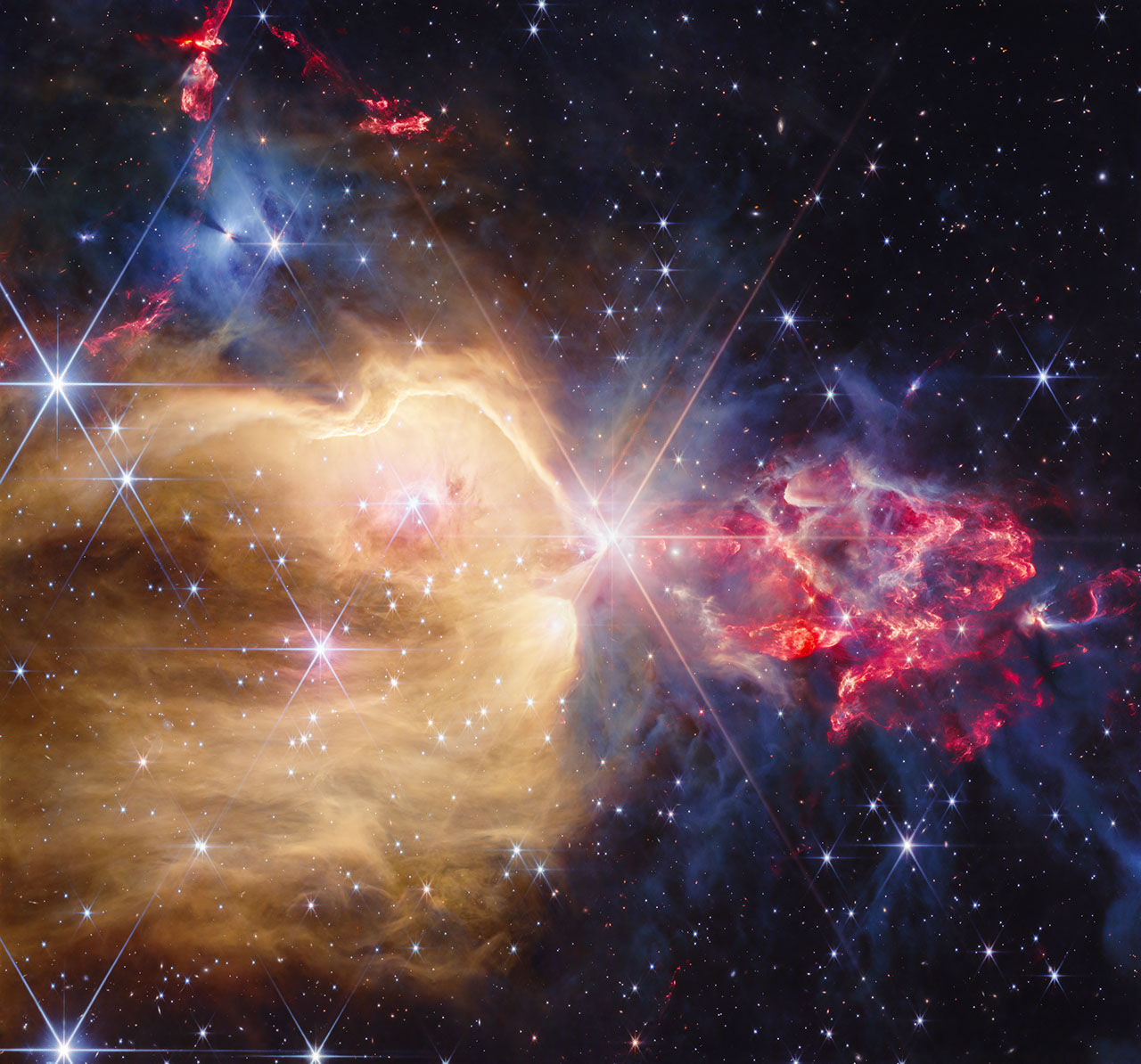
Webb’s NGC 7129 image shows many protostars and stars within glowing gas. Hot atomic hydrogen gas appears gold, while cold molecular hydrogen gas affected by an embedded protostar appears red.
Images: NASA, ESA, CSA, STScI; Image processing: Alyssa Pagan (STScI)
A golden cavity reveals ongoing star formation
The golden cavity to the left of the central star appears to be about 3.5 light-years long. It is the largest cavity in the region and represents an area shaped by the central star’s interaction with its surroundings.
Outflows from the early stages of a star’s life form dense clouds of hydrogen molecules. These outflows and the central star’s light energize the gas, causing it to glow. Although much of the hydrogen gas is blown away, large amounts are also compressed, creating conditions for more stars to form.
Some of these stars are visible inside the cavity. Several are also pre-main-sequence stars that produce stellar winds. A bow shock—a curved region of compressed gas—forms when stellar winds push energetic gas around a star, creating a small cavity of its own.
The central star and embedded stars also help create the sharp ridge at the top of the golden cavity. Their light produces a hot environment that pushes against the cooler, denser molecular gas outside the cavity. This boundary is known as a photodissociation region, where hydrogen molecules break apart into atoms.
Together, these stars provide insight into how molecular clouds gradually erode over millions of years as the stars influence the region’s temperature and chemistry.
A younger protostar hides inside the red plume
The area to the right of the central star tells a different but equally chaotic story. The red blob of material conceals a much younger object: a protostar. The protostar stage occurs after the initial compression and fragmentation of a molecular cloud of gas and dust and before the pre-main-sequence stage.
As a protostar gathers material and gains mass, superheated material flows outward. These outflows interact with the dense, gray, translucent material surrounding the protostar, producing shocks and a textured appearance. The red glow also results from this interaction. Multiple outflows from multiple stars overlap from our perspective, giving the region its chaotic appearance.
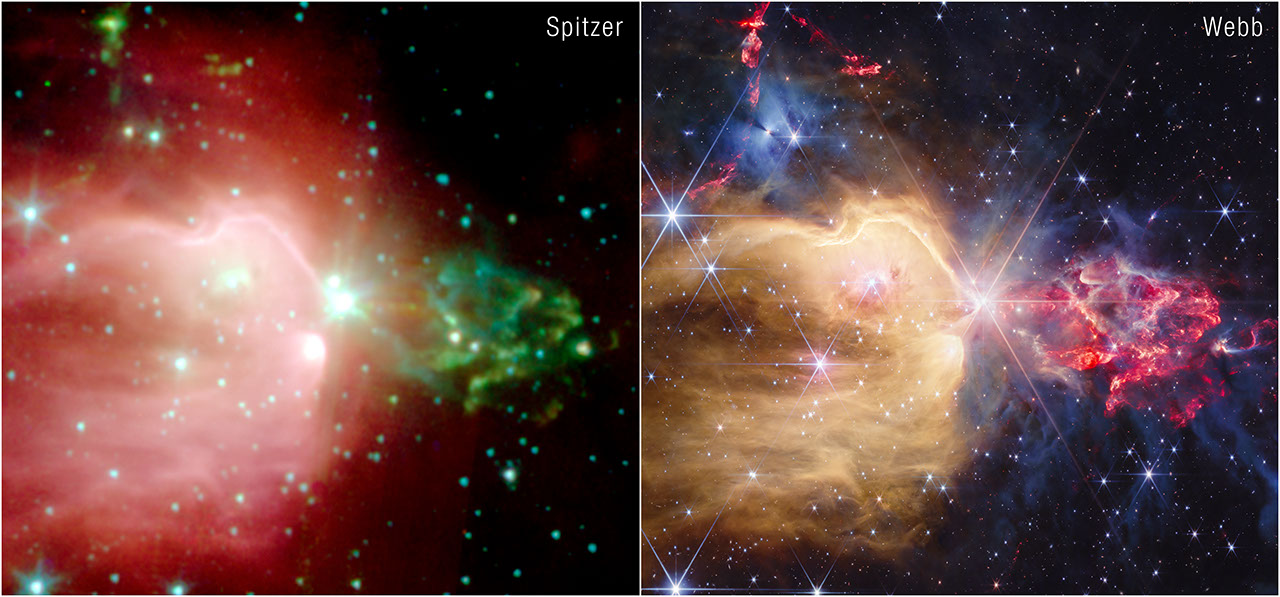
NASA’s retired Spitzer Space Telescope observed gas and dust inside NGC 7129. Webb’s improved resolution reveals filaments of gas and dust in greater detail, along with many galaxies in the background.
Images: NASA, ESA, CSA, STScI, NASA-JPL; Image processing: Alyssa Pagan (STScI)
Webb exposes details hidden from earlier observations
Much of the protostellar outflow appears in the upper left of the image near the blue nebula. At the center of this blue region is a protostar surrounded by a donut-shaped disk. The disk casts a shadow across the surrounding nebula, resembling a similar structure known as the “bat shadow” observed by NASA’s Hubble Space Telescope.
Webb’s high spatial resolution reveals rich structures throughout the gas. Previous research used NASA’s retired Spitzer Space Telescope observations of NGC 7129. Astronomers will continue using Webb’s data to study how the stars and protostars in this region affect the surrounding gas and dust.
About the James Webb Space Telescope
The James Webb Space Telescope is the world’s premier space science observatory. Webb investigates the mysteries of our solar system, examines distant worlds around other stars, and explores the structure and origins of the universe and humanity’s place within it.
Webb is an international program led by NASA and its partners, the European Space Agency (ESA) and the Canadian Space Agency (CSA).
Related images, videos, and resources
- NGC 7129 NIRCam image: Webb’s detailed view of stars and protostars inside the glowing gas of NGC 7129.
- NGC 7129 side-by-side image: A comparison of observations from Spitzer and Webb.
- Read more: Webb’s discovery of star formation.
- Image tour: Herbig-Haro 46/47.
- Visualization: Herbig-Haro 49/50 stellar jets.
- Learn more: Star formation in the Eagle Nebula.
- Visualization: Celestial Lightsaber: Stellar Jet in HH24.
- Further Webb information: News, images, science, and the Webb homepage.
Related topics
Keep exploring star formation, protostars, molecular clouds, nebulae, and NASA’s James Webb Space Telescope.
Source: science.nasa.gov