


Google Is Testing AI Data Centers in Space. Could Satellites Power the Future of Computing?
On October 1, Google plans to launch a satellite capable of running artificial intelligence technology in space. Other technology leaders say they may not be far behind.
Elon Musk, founder of SpaceX, recently said that “AI in space” could be the cheapest way to expand technology “less than five years from now.” Jeff Bezos, founder of SpaceX rival Blue Origin, OpenAI CEO Sam Altman and Nvidia president Jensen Huang also support the idea of building data centers in space and powering them with sunlight.
However, many experts question how achievable the vision really is. Here is a guide to Silicon Valley’s latest big idea: space-based AI data centers.
Will Google Really Launch a Data Center Into Space?
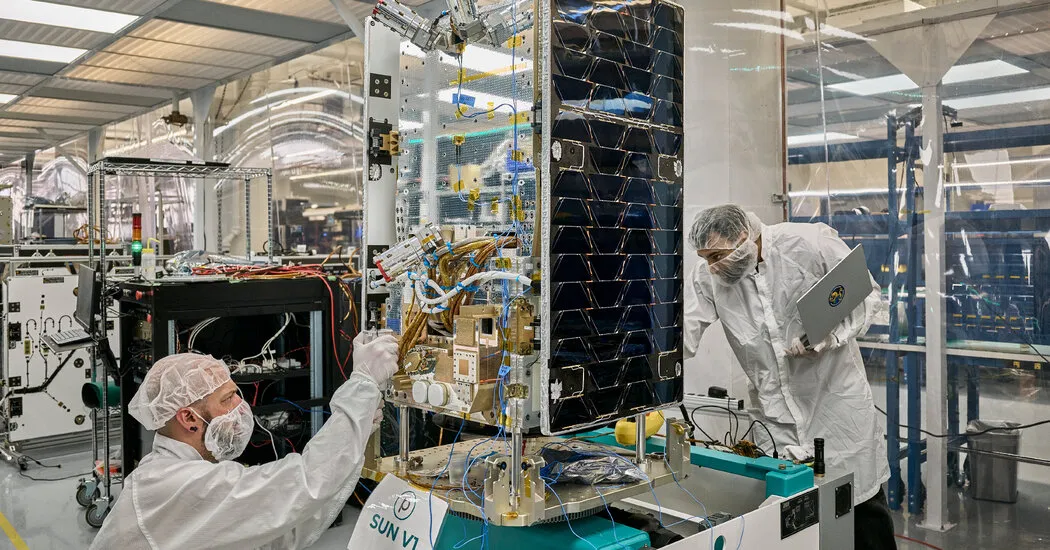
Not exactly. With help from SpaceX and satellite company Planet Labs, Google is launching a satellite with the computing capabilities of a single data center server. The mission is an early test of what Google hopes to develop on a larger scale over the next few years.
The server resembles the thousands of machines Google typically operates in its enormous data centers around the world. It contains four specialized computer chips called tensor processing units, or TPUs. These chips are used to build and operate chatbots and other artificial intelligence technologies.
Google’s long-term plan is to place many of these computers in orbit so they can communicate and work together like a giant data center.
“When people hear ‘data centers in space,’ they imagine something the size of an Amazon fulfillment center magically strapped to a rocket ship. That’s never going to happen,” said Brandon Lucia, a professor of electrical and computer engineering at Carnegie Mellon University who has researched similar technologies.
“This is about small satellites that are independently equipped with highly efficient computers and radio links to connect them.”
Why Do Technology Companies Want Data Centers in Space?
Google and other major AI companies spend hundreds of billions of dollars each year on the data centers needed to power artificial intelligence. Because these companies spend so much money and take on so much debt, many experts worry that the AI boom could create economic bubbles that eventually burst.
Companies such as Google are also concerned about running out of the land and electricity needed to keep expanding their massive computing facilities. Blaise Aguera y Arcas, Google’s vice president who launched the company’s space data center project, is particularly concerned about the environmental damage caused by generating more power.
“When you look at the indicators of what this situation is going to be over the next 10 or 20 years, it starts to look alarming,” he said.
Space-based data centers could theoretically address both the land and power problems. Solar energy is widely available in orbit, and satellites would not require large plots of land. However, the financial challenge would remain. Launching all of that equipment into orbit is expensive, even if companies expect costs to decline over time.
How Would Space-Based Data Centers Get Power?
The proposed data centers would operate in a so-called sun-synchronous orbit. In this type of orbit, Earth would not pass between the satellite and the sun, allowing solar panels attached to the spacecraft to receive constant sunlight.
The solar panels would generate electricity for the satellite’s computer servers. This could give space-based AI systems a continuous power source without relying on the electrical grids used by data centers on Earth.
Is There Enough Room in Space for More Data Centers?
Thousands of satellites already orbit Earth, but there is still plenty of room for more. “The universe is really big, and satellites, even if they are large, are relatively small compared to that,” explained Lucia of Carnegie Mellon University.
That does not mean additional satellites would be risk-free. Astronomers have shown that large satellite constellations can interfere with research telescopes and potentially increase the risk of collisions.
SpaceX’s Starlink satellites, which provide internet access to people and businesses around the world, must actively maneuver to avoid other satellites and objects in orbit. A large network of AI satellites would face similar challenges.
Google plans to destroy its satellites by directing them into Earth’s atmosphere at the end of their operating lives, where they would burn up. Scientists say this method is only partially effective.
“They don’t burn up completely,” said Patrick Seitzer, an astronomer at the University of Michigan who studies orbital debris. “They leave behind residues that pollute the upper atmosphere.”
Why Doesn’t Google Launch as Many AI Satellites as Possible?
Putting a computer in space may sound simple, but launching and operating one is extremely difficult.
When Google and its partners pack servers into rockets and accelerate them to speeds of more than 17,000 miles per hour, the intense forces can damage the hardware, including the specialized computer chips at the heart of the servers.
Even if a chip survives launch, it faces bigger challenges in orbit. Once outside Earth’s protective atmosphere, radiation from the sun, stars and other celestial bodies can alter mathematical calculations. Those calculations are essential to modern AI systems.
“Space is full of strange particles, high-energy radiation that we would never be exposed to on Earth,” Lucia said. “Sometimes you get a random attack of high-energy particles, like someone throwing a dart inside a computer chip.”
Google must also find a way to cool its computer hardware. AI chips become extremely hot because they perform trillions of calculations every second. If the temperature rises too far, the hardware may stop working.
Space Is Cold, So Why Is Cooling Still a Problem?
Space is cold, but it is also a vacuum. That means Google cannot use the same cooling methods that data centers rely on on Earth.
Inside terrestrial data centers, companies cool machines by moving cold air or liquid next to them. Heat naturally travels from the chip to the cooler air or liquid through a process called convection.
Convection does not work in a vacuum because it requires physical matter. Google would instead need to develop a specialized system capable of radiating heat away from the hardware as electromagnetic waves.
“This cooling problem is actually very difficult,” Lucia said. “These computers are going to be in the sun all day long, because we want to collect all the nice solar power that we can get for free.”
Are AI Data Centers in Space Actually Possible?
Perhaps, but significant scientific and engineering obstacles remain. Even Google acknowledges that its engineers still do not know how to make every part of the concept work. And even if the technology succeeds, it is unclear when space-based AI computing would become economically viable.
“There’s still a lot of scientific and engineering work to do,” said James Manica, Google’s senior vice president of research.
Some experts believe it could take a decade or longer to establish a significant number of data centers in space. Google’s satellite launch is an early test—but turning that experiment into a working orbital computing network could take much more time.
Source: www.nytimes.com