


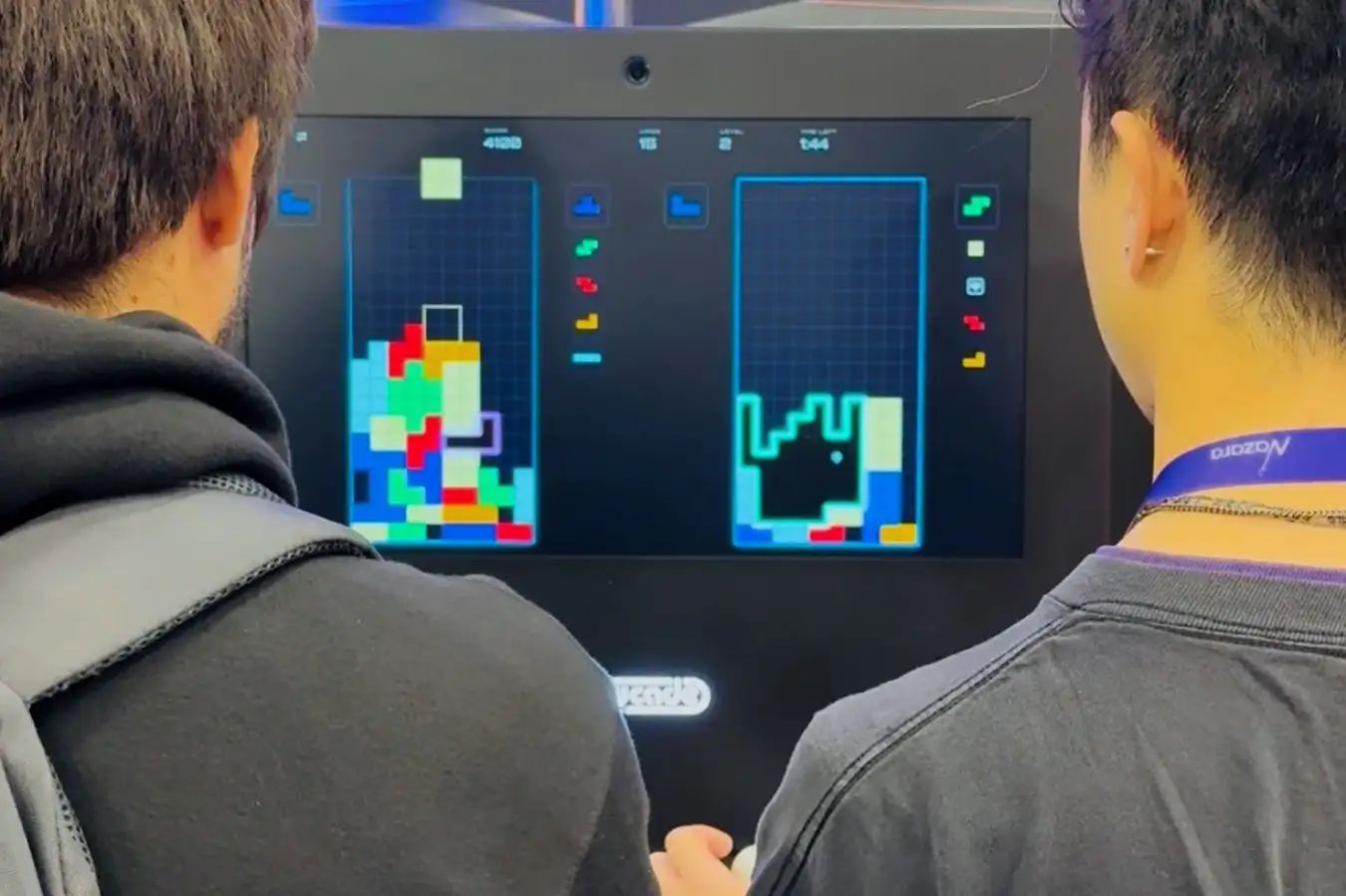

Quantris: A Quantum Twist on the Classic Game
Quantum Native
Blocks continuously fall on the screen—one pale yellow square awkwardly lands on a green block shaped like the letter “Z”. You might recognize this setup from Tetris. Nearby, a peculiar block with a white border seemingly encloses only empty space. According to the game’s description, this block represents a quantum state of superposition, an intriguing blend of existence and non-existence within the digital realm. Observing it is the only method to comprehend its utility. Suddenly, a small black square with an eye symbol descends from above, colliding with the blocks. Upon observation, it briefly flickers into existence, causing my stack of blocks to precariously smash into the ceiling. Although there was a chance it could disappear upon observation, luck wasn’t on my side this time. My game ends as another shape crashes onto the tower. I lost at Quantris, the quantum variation of Tetris. Not even the laws of quantum mechanics could help my gaming skills.
While I’m still a newcomer to quantum video games, the genre boasts a rich history. References to quantum physics date back to the 1980s, but it wasn’t until 2016—when quantum computers became cloud-accessible—that the proliferation of quantum mechanics-based games truly began. Tools like IBM’s Quantum Software Development Kit have gained traction, as noted by Laura Pispanen, a researcher studying quantum games at Aalto University in Finland. She estimates the current existence of nearly 400 quantum games. Many were born from the Quantum Game Jam, an event running since 2014.
One standout is Qubit the Barbarian, inspired by classic sword-and-sorcery tales, exemplifying early quantum gaming with its vintage design. Players navigate a maze of tiles representing quantum states, leveraging quantum mechanics. As players measure properties of these states, the tiles transform, creating new paths or barriers within the maze.
A vibrant community of researchers and gamers believes in the sustainable future of quantum video games. Combining new, largely untested technology, the nuances of quantum physics, and the universally relatable act of playing games is captivating. What will emerge from this synergy? What can quantum computers introduce to gaming? Can games, in turn, leverage quantum computing?
To clarify, we’re not talking about games that run directly on quantum computers. Despite recent strides, they remain largely experimental. Only recently have quantum devices displayed sufficient computational power and reliability to tackle challenging scientific dilemmas. Overall, they’re not general-purpose computers, and their utility is still unclear. Even at their best, quantum computers might only excel at select tasks. To date, it hasn’t been conclusively demonstrated that they can play video games in real time.
Nonetheless, elements of quantum computing are already influencing video game development. Earlier this year, Quantum Backroom, a horror game, utilized an IBM quantum computer for level generation. This eerie adventure explores the liminal spaces tied to an internet phenomenon recently depicted in a noted film. According to James Wootton, the rooms correspond to various quantum states within the computer, creating an immersive experience reflective of the device’s inner workings.

Screenshot from Quantum Backrooms
Moth
I wondered if this quantum approach could gain mainstream traction. Julian Togelius, an expert in creativity, video games, and artificial intelligence at New York University, observes that some games allow players to interact locally within game environments, independent of other elements. Enhancing connectivity and realism in in-game worlds poses challenges, but Togelius believes quantum computing could revolutionize developers’ methodologies. This ties back to mathematical issues laden with constraints, where quantum computing could provide solutions. However, he warns that this concept is more complicated than present-day quantum gaming endeavors, highlighting the imperfect nature of existing quantum hardware.
Even with Quantum Backroom, the application of quantum principles is limited to development. Players encounter quantum elements only after the quantum computer powers down and a classical computer takes over. While running games directly on quantum computers isn’t impossible—the first quantum version of rock-paper-scissors was coded by Wootton in 2017—many current quantum games operate on classical computer simulations mimicking quantum systems.
“At this stage, all my games run on their own simulators. The hardware isn’t quite there yet,” states Chris Cantwell, who developed Quantum Chess and other games at Quantum Native. In 2020, a Google quantum computer executed several rounds of Quantum Chess, yet Cantwell noted that the original code had to be entirely rewritten. The essence of integrating quantum mechanics into gameplay lies in designing quantum features based on the actual hardware, paving the way for games to eventually assess quantum computer performance. For instance, Evert van Nieuwenburg from Leiden University in the Netherlands created Quantum TiqTaqToe, a quantum rendition of tic-tac-toe.
Bringing Quantum Gaming into the Living Room
A multitude of these quantum games integrates facets of quantum mechanics, such as superposition and quantum entanglement, translating them into engaging gameplay mechanics. In Quantum Chess, for instance, two pieces can occupy overlapping squares, while Tic Tac Toe players can entangle their pieces. Van Nieuwenburg emphasizes that players don’t need an in-depth understanding of these phenomena to enjoy the games; they can simply experiment and learn.
Quantum physics can feel counterintuitive at first for many, largely because of its association with microscopic particles and extreme conditions. However, games may ease this introduction: “I remember at a science night at a school, there were three kids, maybe 6 or 7 years old, playing Tic Tac Toe. They probably didn’t grasp everything initially, but soon one of them exclaimed, ‘Oh, now you’ve got me involved!’” reflects Van Nieuwenburg. Even without comprehending quantum theory, children quickly adapt to the terminology, demonstrating the educational power of games. “In fact, Quantum Chess is superior to standard chess due to its strategic complexity.” Cantwell notes, “Even without comprehending quantum, players engage with real quantum phenomena,” suggesting that fostering a generation of quantum-savvy gamers could yield future developers in the field.
This notion struck me as I recalled my younger brother, often disengaged during physics lessons yet lost in his video games. Had quantum problem-solving been a game challenge, he might have excelled. Spiros Michalakis from the California Institute of Technology, who has worked on games like Quantris and Quantum Chess, echoes this sentiment on harnessing gaming for quantum outreach.
Michalakis began his quantum gaming journey in 2014, overseeing the integration of quantum elements into widely popular games like Minecraft. “My goal has evolved into not only crafting games with quantum backends but also creating enjoyable experiences where players say, ‘Wow, I can use these new tools and strategies to reshape my gameplay,’” he states, recognizing its complexity not merely in game mechanics but in delivering engaging content.
In some instances, ingenious solutions utilizing quantum properties can go unnoticed by players, akin to a shooting game where the strategy isn’t defined by players’ knowledge of physics. In Togelius’s words, “Creating a game is straightforward, but crafting one that resonates is remarkably challenging.” Currently, I remain cautious regarding quantum computing’s potential as the next frontier in gaming.
This scenario mirrors the overarching goals of quantum computer programming: leveraging unique quantum behaviors to achieve outcomes otherwise infeasible, all while maintaining reliability and yield meaningful results. This endeavor can be complex, yet exemplifying it through games adds a layer of excitement.
Topics:
Source: www.newscientist.com