


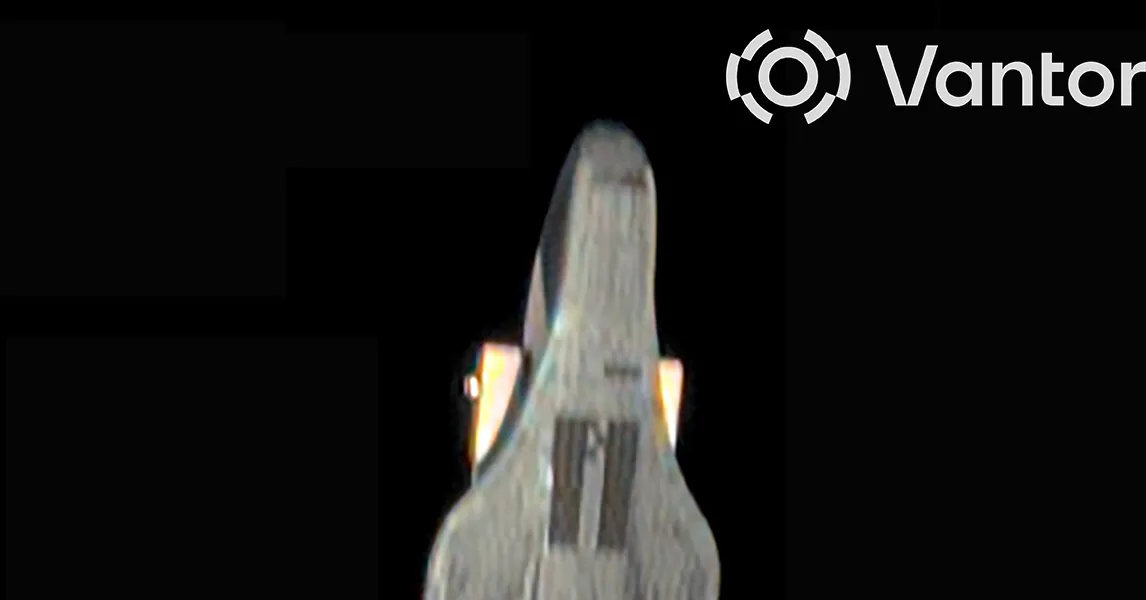
A Chinese spaceplane resembling the U.S. Space Force’s X-37B has been photographed in orbit by a commercial Earth-imaging satellite owned by Vantor, formerly known as Maxar. The image, captured during a satellite pass in 2024, shows a delta wing, payload-bay door, dark heat shield and aft-mounted service module with a solar array. The Pentagon released the full-resolution image in unclassified material on Monday.
The spacecraft’s design closely mirrors that of the X-37B, a reusable U.S. military spaceplane. Vantor is one of several companies that supplies reconnaissance imagery of locations around the world to the U.S. military and intelligence agencies, and its Earth-imaging satellites can also point their telescopes at objects in space.
Low-resolution images showing the general shape of the Chinese spaceplane had been released before the Defense Intelligence Agency’s evaluation. U.S. Space Force officials presented Maxar’s observations at a 2024 conference in South Korea, but the Pentagon did not make the full-resolution images public until Monday, when they appeared in unclassified materials accompanying the DIA evaluation, Threats to the United States in Space.
China’s reusable spaceplane missions
The DIA report provides little new information about the activities of China’s spaceplanes in orbit. China has launched four spaceplane missions since 2020, with missions lasting as long as nine months. The fourth mission launched in February and remains in orbit. It has not been disclosed whether China operates one such spaceplane or more than one.
The Space Force operates two X-37Bs in rotation. The longest of the vehicle’s eight previous missions lasted two and a half years, from launch to landing. U.S. authorities have released photographs of the X-37B airframe, published information about its design and dimensions, and disclosed several experiments conducted in orbit, although most of the spaceplane’s activities remain classified.
How the spaceplanes operate
Like the X-37B, China’s spaceplane launches inside the payload shroud of a conventional rocket and operates as a satellite while in orbit. At the end of a mission, it re-enters the atmosphere and lands autonomously on a runway, following a flight profile similar to that of a smaller version of NASA’s space shuttle. Ground teams can then refurbish it for another flight.
The DIA said the spaceplane’s “enhanced maneuverability” makes it “more suitable for certain missions than traditional satellites.” So far, Chinese spaceplanes have flown only in low Earth orbit (LEO), at altitudes of several hundred miles. One X-37B mission previously reached more than 34,000 miles in altitude. The spacecraft can use aerobraking to prepare for reentry and landing.
Source: www.wired.com