


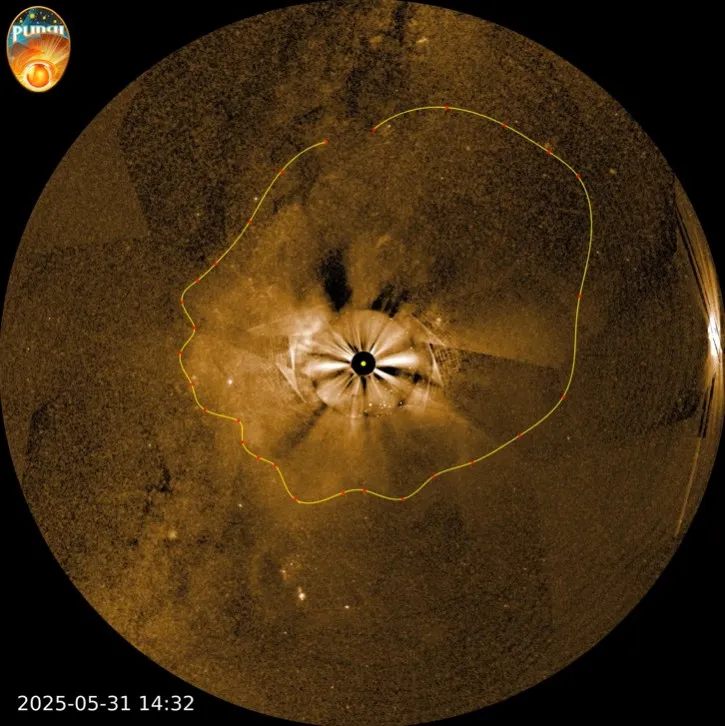
NASA’s PUNCH (Polarimeter to Unify the Corona and Heliosphere) mission has demonstrated a promising new approach to solar storm forecasting. Using continuous imagery, scientists predicted when a coronal mass ejection (CME) would reach Earth to within 30 minutes during an initial proof-of-concept test. The findings were presented Tuesday at the Committee on Space Research Scientific Meeting and are currently under review by the journal Space Weather.
The breakthrough could significantly improve forecasts of Earth-directed solar storms, helping officials prepare for disruptions to power grids, satellites, communications systems, navigation networks, and astronaut safety.
“We thought PUNCH would be good at this, but it’s a stunning result,” said Craig DeForest, principal investigator for PUNCH at Southwest Research Institute’s Solar System Science and Exploration Division in Boulder, Colorado. “To put it in perspective, this could be the space weather equivalent of going from a steam engine to a modern internal combustion engine.”
Solar storms begin with enormous eruptions of solar material known as coronal mass ejections. When these clouds of charged particles travel toward Earth, they can trigger geomagnetic storms and interfere with critical infrastructure. Accurately forecasting a CME’s arrival time is essential for reducing the effects of severe space weather.
Until recently, scientists could not continuously track coronal mass ejections during most of their journey from the Sun to Earth. That changed in 2025 with the launch of NASA’s PUNCH mission, which uses four spacecraft in low Earth orbit to create continuous, three-dimensional views of the inner solar system.
Before PUNCH, researchers could observe CMEs for only about one-fifth of the distance between the Sun and Earth. Scientists then had to estimate how the eruption would change during the remainder of its journey. PUNCH’s wide field of view now allows researchers to follow solar eruptions nearly all the way to Earth, capturing a new image every four minutes.
To test PUNCH’s potential for improving coronal mass ejection forecasts, scientists analyzed an eruption that left the Sun on May 31, 2025. They fed the mission’s images into a computer model that tracked the CME’s leading edge over time. By analyzing the eruption’s speed, shape, and changing geometry, the model calculated when the solar storm would arrive at Earth.
Twelve hours after the CME departed the Sun, the model produced a final forecast indicating that the eruption would reach Earth eight hours later. The prediction was accurate to within 30 minutes—approximately 10 times more precise than current forecasting methods, which typically provide an arrival window of about five hours.
The model also showed when its prediction had stabilized, giving space weather forecasters a way to determine when the estimated arrival time could be considered reliable.
“We accomplished an order of magnitude better result than the state-of-the-art method with a really basic process, just informed by the fact that the coronal mass ejection could be tracked continuously across the solar system,” DeForest said.
These early results highlight the value of PUNCH’s wide-field solar imagery for tracking CMEs as they move away from the Sun. With additional observations, improved data, and more advanced computer models, scientists hope to forecast CME arrival times even farther in advance.
PUNCH is also providing new insights into the structure and evolution of coronal mass ejections. High-resolution images show that these clouds of solar material are more clumpy than previously believed and continue to change as they travel through the solar system.
The mission’s observations are helping scientists better understand how plasma—the electrically charged solar material released by CMEs—moves through space. This knowledge could also help astrophysicists study plasma behavior throughout the galaxy, including in star-forming regions where these processes are difficult to observe on smaller scales.
Southwest Research Institute, headquartered in San Antonio, leads the PUNCH mission and operates its four spacecraft from facilities in Boulder. Space Science Mission Operations at NASA’s Goddard Space Flight Center in Greenbelt, Maryland, manages the mission for NASA’s Science Mission Directorate in Washington.
By Mara Johnson-Groh
NASA’s Goddard Space Flight Center, Greenbelt, Md.
Source: science.nasa.gov