


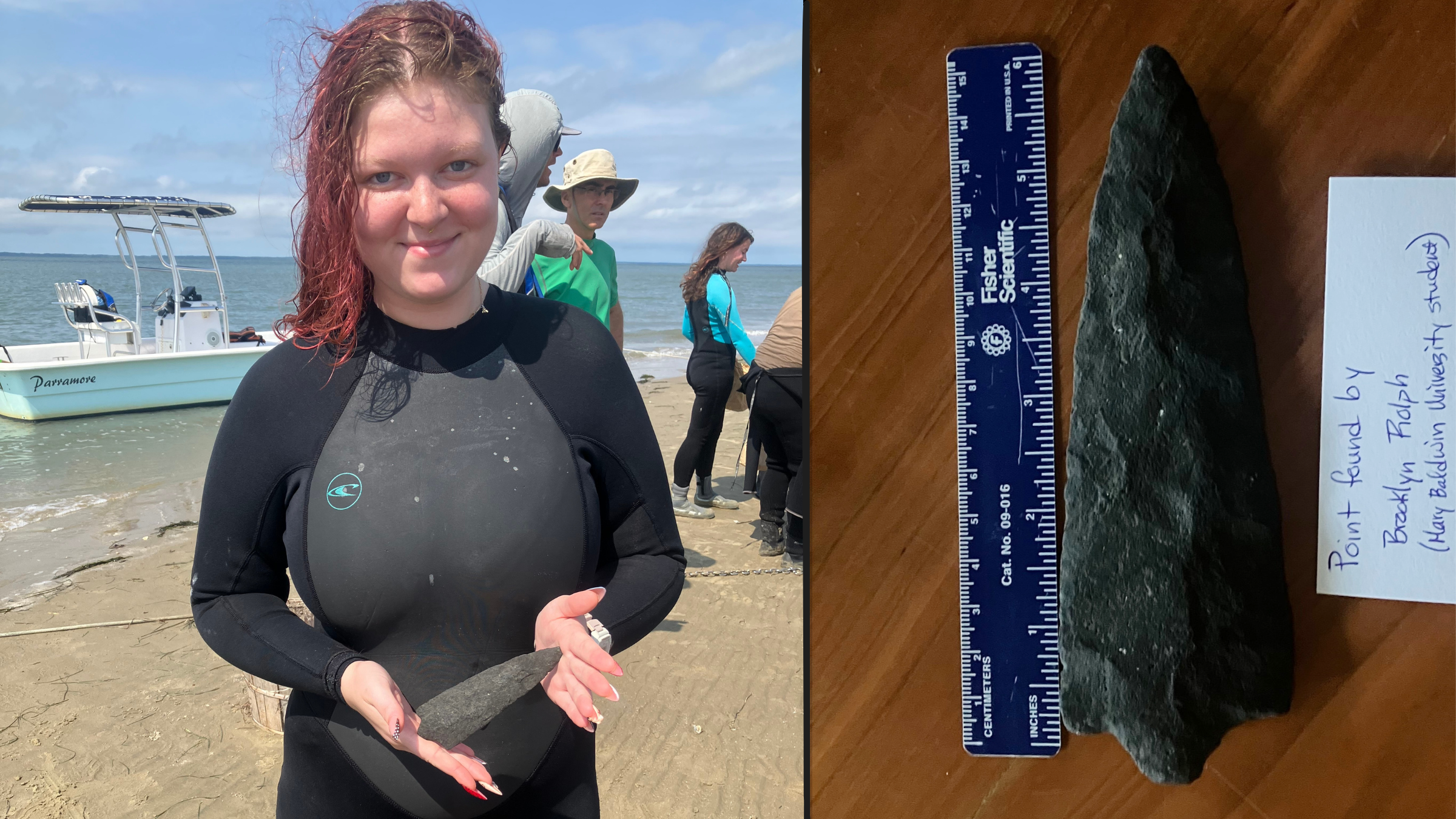
On Sept. 21, during the final day of an ecology field trip on Virginia’s Eastern Shore, Mary Baldwin University student Brooklyn Rolfe found a stone spear point near a cove. Archaeologists estimate that the artifact is between 3,000 and 4,500 years old, and it is now being studied by the Virginia Department of Historic Resources.
Rolfe had been searching the shoreline for shark teeth when she noticed the stone point at the edge of the water. “Wow, this is really crazy,” she said in a statement. She immediately alerted the professors leading the trip. “They were overjoyed,” she recalled.
A tool from the Late Archaic period
Local archaeologists said the stone artifact is about 6 inches (15 centimeters) long. It has been identified as a Lehi/Cohen Scrippin point, a type of stone tool made by Native American groups along the East Coast of the United States between about 4,500 and 3,000 years ago.
The pointed tool, sometimes called a “broadspear,” was used as a knife by hunter-gatherers during the Late Archaic period. Similar projectile points are documented in the Maryland Archaeological Conservation Laboratory’s diagnostic guide.
An unexpected discovery
The field trip was part of an ecology course led by Mary Baldwin University faculty. The group had received permission from the state to explore barrier islands off the Eastern Shore of the southern Delmarva Peninsula, a region that includes much of Delaware and parts of Virginia and Maryland.
Shortly after lunch on the trip’s final day, Rolfe examined shell piles while studying the island’s coastal plants and animals. She noticed the spear point just as the tide was coming in.
“The set of circumstances that allowed this to happen is absolutely incredible,” Paul A. Callo, a Mary Baldwin University biology professor who co-led the trip, said in a statement. “The tide was coming in, so the tip of the spear was about to be buried.”
When Rolfe showed Callo the artifact, he said he was “absolutely speechless.” “Seeing and touching something that was created by human hands thousands of years ago is certainly awe-inspiring,” he said.
The artifact belongs to Virginia
The barrier island where Rolfe found the point is part of a natural area owned by the Virginia Department of Conservation and Recreation. Because of that, the artifact is now property of the Commonwealth of Virginia. Archaeologists collected it from the Mary Baldwin group and transferred it to the Virginia Department of Historic Resources for further study.
Rolfe said she was happy to give up the find. “Then you will get it. Cursed!” she joked.
Source: www.livescience.com