


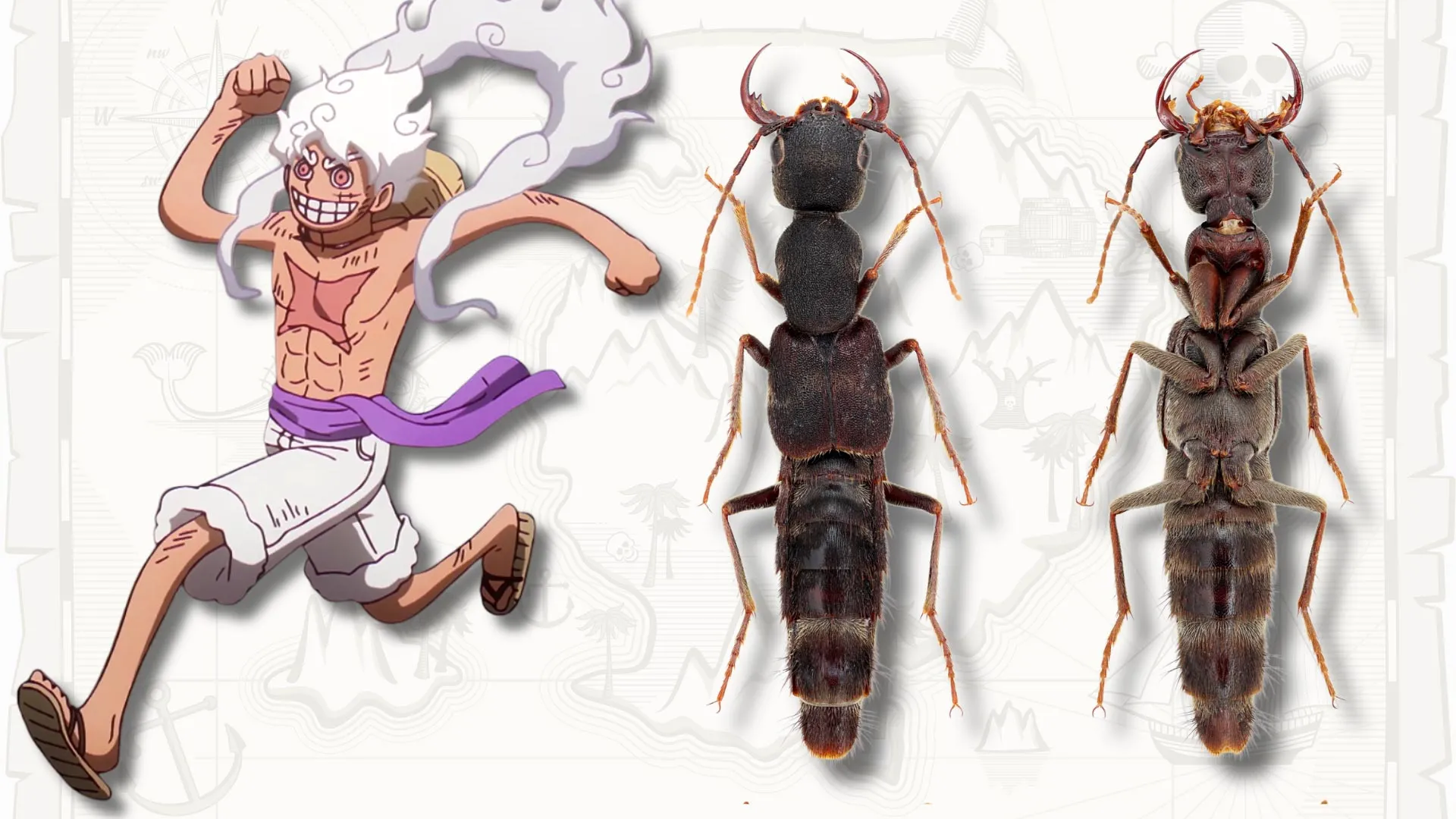
Scientists have named a newly established beetle genus Luffy after the popular One Piece character—not merely as a playful reference, but because the insects possess unusual physical features reminiscent of Luffy’s elastic abilities.
Compared with closely related rove beetles, species in the new Luffy genus have exceptionally long and slender mandibles, antennae, and maxillary palps. Their elongated body structures reminded researchers of Luffy’s rubber-like body, which allows the fictional character to stretch and enlarge his limbs.
The complete taxonomic descriptions of the new beetle genus and its species were published in the open-access, peer-reviewed journal ZooKeys.
Two New Species of Luffy Beetle
Researchers have so far identified two species in the genus: Luffy schillhammeri and Luffy nika.
Luffy schillhammeri was discovered in broadleaf forests in China’s Yunnan Province. The species was named in honor of Dr. Harald Schillhammer of the Natural History Museum Vienna, recognizing his extensive and influential contributions to rove beetle research.
The second species, Luffy nika, was found in Louang Namtha in northern Laos. Its name refers to Luffy’s legendary Devil Fruit awakening, “Hito Hito no Mi, Model: Nika,” also known as Gear 5.
This Luffy beetle has striking white bands of hair across its elytra and much of its body. The researchers said this coloration resembles Luffy’s white, smoke-covered appearance during his Nika transformation.
A Missing Link in Rove Beetle Evolution
The discovery is important for more than its memorable connection to manga. PhD student Fang-Shuo Hu and Alexey Solodovnikov of the Natural History Museum of Denmark conducted a comprehensive review of every known genus in the Ocypus group.
Their research also examined several beetle groups with uncertain or controversial positions in the evolutionary family tree, including Acupronotes, Apostenolinus, and Staphylinus. By analyzing numerous specimens and comparing subtle anatomical features, the scientists reassessed the evolutionary relationships among these groups.
The team identified the shared derived characteristics, or synapomorphies, that define the “Eucibdelus lineage.” These traits include dorsal ridge teeth on the left mandible and a completely sclerotized labrum.
Luffy beetles possess the dorsal ridge teeth associated with this lineage, but their labrum is not completely sclerotized. They also have several distinctive characteristics not found in the other groups. Based on this combination of features, the researchers concluded that Luffy is likely the sister group of the entire Eucibdelus lineage.
“This genus exhibits a unique combination of characters intermediate between the Eucibdelus lineage and other members of the Ocypus-group,” the researchers wrote in their study. Their findings demonstrate how scientists’ understanding of rove beetle evolution continues to develop as new species are discovered.
Because of its unusual evolutionary position, the Luffy genus helps fill an important gap in rove beetle classification. It also provides new insight into the evolutionary history of the subtribe Staphylinina.
Making Beetle Taxonomy More Accessible
The journey from manga-inspired naming to publication in an international scientific journal shows that biological research can be rigorous, creative, memorable, and accessible to a wider audience.
The researchers hope the story of the Luffy beetle will bring science closer to the public, raise awareness of the importance of biological taxonomy, and encourage more young people to explore biodiversity and classification with the same adventurous spirit associated with the One Piece character.
Source: www.sciencedaily.com