


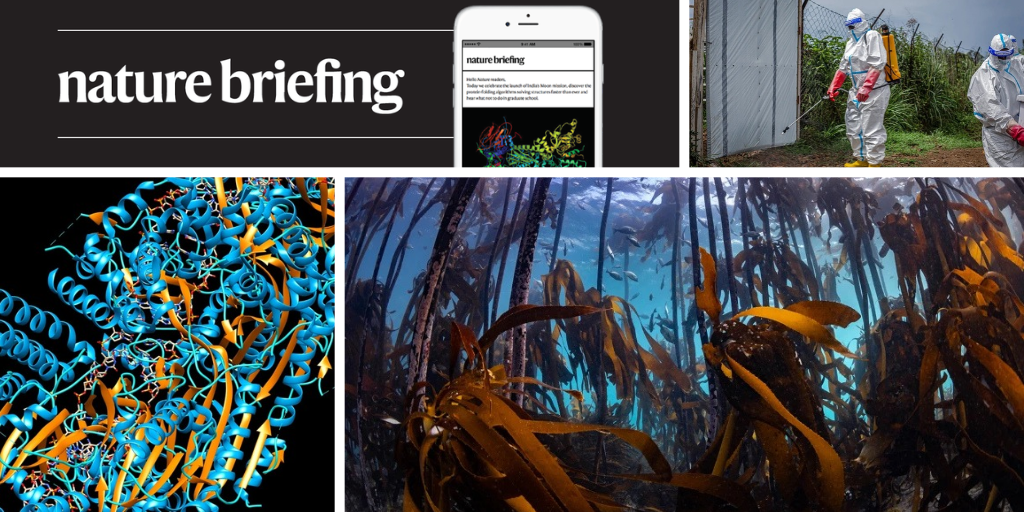
This edition of the Nature Briefing covers new findings on kelp reproduction, the early spread of Ebola in the Democratic Republic of the Congo, a potential first FDA-approved in-body CRISPR treatment, and a major atlas of the brain’s basal ganglia. It also examines newborn protection against RSV in Denmark, questions surrounding the work of the “Pathogen Hunters,” and the effects of climate change on cactus habitats.
Both male and female kelp have been shown to reproduce without fertilization. Credit: Madelein_Wolf/Getty
Kelp can reproduce without fertilization
Kelp forests support a wide range of marine life and can reproduce asexually, although kelp generally prefers to reproduce with a plant of the opposite sex. In laboratory isolation, both males and females of the Atlantic coast species Laminaria pallida were able to produce offspring without fertilization.
Gene expression in the male kelp changed, making it more similar to a female. By contrast, kelp grown in mixed-sex groups appeared able to detect nearby partners through chemical signals. Understanding how kelp switches between reproductive strategies could help explain its success in the wild.
Nature | 5 minute read
Reference: PLoS Biology paper
Tracking Ebola’s early spread
Epidemiologists used mobile-phone data and testing records to map the early spread of Ebola in the Democratic Republic of the Congo (DRC), weeks before the outbreak was declared. The study reported that the first case was confirmed on May 15th, although the person had already shown symptoms of infection on April 25th.
The researchers say the findings show how disease-surveillance systems failed to detect the virus at an early stage. They also highlight the role of human movement in spreading the virus during the initial phase of the outbreak.
Nature | 4 minute read
Reference: Science paper
Potential first FDA-approved in-body CRISPR treatment
A gene therapy called Lonvo-z (lombogran diclumeran) could become the first treatment approved by the U.S. Food and Drug Administration (FDA) to deliver the CRISPR-Cas9 gene-editing system directly into the body.
The treatment was designed for a rare genetic disease that causes painful and potentially dangerous swelling in the throat and other parts of the body. Data published by its developer, Intellia Therapeutics, indicate that Lonvo-z remains effective four years after treatment. Intellia is applying to the FDA for approval, with a decision expected by March 10th.
A 25.5-million-cell atlas of the basal ganglia
Researchers have published a large atlas of the basal ganglia, a group of cells deep in the brain that processes information involved in movement, cognition, mood and decision-making.
The atlas contains 25.5 million brain cells from humans, macaques and marmosets. Published across 26 papers, the work also includes understudied types of neurons. It provides insight into how some brain cells change with age and suggests which cells could be associated with disease.
“This is a huge dictionary that we needed in the field,” says neuroscientist Ana Muñoz Manchado.
Nature | 5 minute read
References: 26 papers in Cell, Cell Reports, Cell Reports Methods, Cell Systems, Cell Genomics and Neuron.
What researchers want from the next U.S. Congress
The U.S. midterm elections will put Democratic opponents of President Donald Trump’s administration in power in Congress. Science asked researchers to identify what they want lawmakers to accomplish and to assess the prospects for success.
Aside from limiting political oversight of federal aid, the prospects for many priorities—including halting changes to census-data collection—are uncertain or slim.
This week’s infographic

Source: Reference 1
Since Denmark introduced a national policy to vaccinate pregnant women against the respiratory pathogen RSV in 2025, the number of newborns hospitalized with the virus has fallen sharply. RSV usually causes mild symptoms, but it can cause severe illness and death in vulnerable groups, including infants.
“It’s amazing how we went from having no protection against RSV to being an embarrassment to the wealthy,” said pediatrician Buddy Creech.
Nature | 5 minute read
Reference: Lancet Community Health — Europe paper
Features and impressions
Questions about the “Pathogen Hunters”
Over the past four years, a group of researchers known as the “Pathogen Hunters” has published dozens of papers analyzing the genomes of pathogens including H5N1 avian influenza, mpox viruses and SARS-CoV-2. The analyses draw on tens of thousands of samples.
The group’s findings have raised concerns among some infectious-disease researchers. A Science report examines why some researchers say the results are difficult to believe. Some concerns have led to retractions; in other cases, the group has made substantial changes to a paper while standing by its conclusions.
Other reading
Readers can find answers to frequently asked questions about extraterrestrial encounters in How to live without aliens. The briefing also links to accept all changes, by an unidentified author.
Nature | 6 minute read and Nature | 6 minute read
Climate change threatens cactus habitats
Severe droughts and rising temperatures driven by climate change are placing hundreds of cactus species under pressure. “We think of cacti as highly drought-adapted organisms, but in reality they’re not that different from other plants,” says ecologist Michel Pilet.
Pillet and colleagues created a climate model to assess how severe drought could affect the habitats of about 1,000 cactus species across North and South America. They found that as many as 35% of these species could lose four-fifths of their habitat by 2100 if current climate trends continue.
Nature Podcast | Listen for 24 minutes
Subscribe to the Nature Podcast on Apple Podcasts, Spotify or YouTube Music, or use the RSS feed.
Quote of the day
From refugee camps in Europe to secret girls’ schools in Afghanistan, anthropologist Shahram Khosravi argues that people are producing knowledge that allows them to imagine new living systems. Aeon | 19 minute read
Can you find the penguin?
Today, Leif Penguinson is visiting the fascinating tourist attractions of Ayres Bay in Sandgreen, Scotland. Can you find the penguin?
The answer will be in Monday’s email. Many thanks to Briefing photo editor and penguin wrangler Tom Horton.
This newsletter is constantly evolving. Send feedback to [email protected].
Thank you for reading,
Flora Graham, Nature Briefing Editor-in-Chief
Contributed by Jacob Smith
- Nature Briefing: Careers — insights, advice and award-winning journalism to help you optimize your work life.
- Nature Briefing: Microbiology — microorganisms, the most abundant life forms on Earth, and their roles in health, the environment and our food system.
- Nature Briefing: The Anthropocene — climate change, biodiversity, sustainability and geoengineering.
- Nature Briefing: AI and Robotics — 100% written by humans, of course.
- Nature Briefing: Cancer — a weekly newsletter written with cancer researchers in mind.
- Nature Briefing: Translational Research — biotechnology, drug discovery and pharmaceuticals.
Source: www.nature.com