


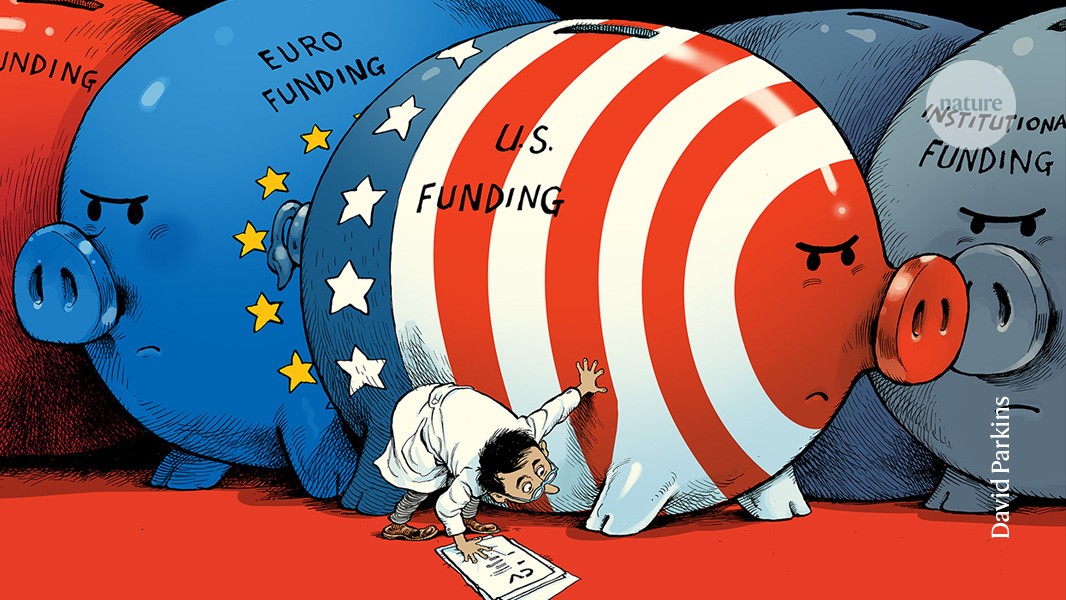
Why International Researchers Struggle to Get Academic Jobs Without Local Grants
National funding systems can give domestic researchers an advantage in faculty hiring, even when international candidates have strong publication records and extensive research experience.
Illustration: David Perkins
Why local grant experience matters in academic hiring
César Marin, an ecologist at the University of Santo Tomas in Santiago, Chile, agrees. “In many countries, experience and demonstration of success in obtaining national funding appear to be the primary recruitment criteria, regardless of publication or editorial track record,” he says.

A “painful aunt” for working scientists
In general, experience with a local research system “can serve as an implicit indicator in academia”, says Laura Asción, co-executive director of MetaDocencia, a capacity-building organization for researchers in Spanish-speaking communities. MetaDocencia research on career paths for scientists in Latin America1 suggests that “the lack of competitiveness with respect to European and US funding constitutes a structural disadvantage”.
This can be a major setback for academic job seekers. “As a foreigner, I think I’m behind the competition for a variety of reasons,” says Renan Laira, a Brazilian psychology researcher currently looking for work in the United Kingdom. He speculates that researchers with degrees in the United Kingdom may be trained to compile domestic grant applications and are more likely to work on such applications alongside senior researchers. Laira believes that hiring organizations often value experience that brings in funding.
Even researchers who move between resource-rich research systems notice gaps between them. Caroline Lynn Kamerlin began her independent career in Sweden before moving to the United States as a professor. She is now a computational chemist at Georgia Tech in Atlanta.
During the transition, she encountered a situation similar to the one described above. “When the US hiring committee looked at my résumé, the biggest thing they saw was that I had no US funding. And the fact that I was clearly able to get funding from multiple sources in Europe was not a consideration for them.”
One reason recruiters may favour funding experience is that they are familiar with certain grants that carry brand recognition associated with high quality. However, Marin says this can be problematic if it assumes that “the grant process in the Global South is not as rigorous as the grant process in the Global North”. “My own experience considering subsidies to European and Latin American countries is that this is not always the case.”
This is a structural problem, so there are limits to what one person can do. Still, several strategies can improve an individual’s chances of being employed in an unfair system.
How international researchers can strengthen their grant strategy
International collaboration can help improve a researcher’s grant record. But, as the letter writer points out, collaboration does not necessarily create leadership opportunities. In the United States, restrictions on grants involving foreign researchers can also make international collaboration more difficult.

How spreadsheets helped me land my dream job
Marko Sieber, a science policy researcher at the University of Agder in Kristiansand, Norway, says the importance of trust and personal connections in the research systems that applicants are trying to enter should not be underestimated. One possible first step is to attend a conference, give a presentation and use it as a starting point for collaboration.
“I cannot stress enough how important it is to foster diverse and strong networks and communities throughout a scientific career,” Asción adds. This should be reciprocal rather than transactional. It might include providing services to scientific organizations. Such networking can eventually help researchers enter other countries’ research systems.
Not securing a principal-investigator grant in the country where you want to work may not be a deal-breaker. “I think it’s always helpful to be a principal investigator on an international grant, but it’s not absolutely necessary, because there are so few international grants and the ones that do exist are so competitive,” Kamerlin says. If being a principal investigator remains important, other collaborators in a consortium may be willing to take on some of the administrative burden and provide a leadership role.
Funding opportunities for researchers moving to Europe
Some funding calls are aimed at foreign researchers at different career stages and may help applicants build a track record in the research system they want to join. Kamerlin highlights the European Research Council (ERC) funding scheme. “The ERC is particularly keen to attract and retain Europe’s best talent and actively encourages non-Europeans to apply to migrate to Europe,” she says.
Success rates are low. ERC Start-up Grants are aimed at young researchers and can provide additional funding to researchers relocating to the European Union. The success rate in 2025 was approximately 12%.
More broadly, in 2025 the European Commission launched the “Choose Europe” initiative to attract researchers to the European Union. One motivation was to attract researchers from the United States who are disillusioned with cuts in scientific funding, but applicants can, in principle, be of any nationality.
Source: www.nature.com