


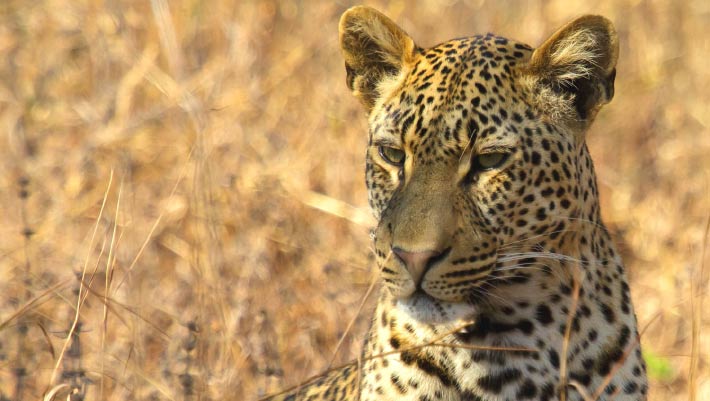
The Panthera pardus burgtonnae is a newly identified leopard subspecies that inhabited Europe during the Eemian interglacial period, displaying a significantly more robust structure compared to the modern leopard.
Despite its comparable body length to the modern African leopard (Panthera pardus pardus), the skeletal structure of Panthera pardus burgtonnae suggests a sturdier physique. Image credit: Thomas Fuhrmann / CC BY-SA 4.0.
The Panthera pardus burgtonnae roamed the region now known as Germany during the Eemian Interglacial, occurring roughly 130,000 to 115,000 years ago, before the last Ice Age.
This subspecies is defined by remnants of the lower jaw, upper incisors, and several limb bones.
The specimen was unearthed in 1993 by a private collector from the fossil-rich travertine deposits at Burgtonna, which have been subject to excavation for centuries.
“The discovery of large mammal fossils from the Burgtonna Travertine deposit in Germany’s Thuringia state marks a significant milestone for Quaternary paleontological research in Europe,” stated German paleontologist Helmut Hemmer of Mainz and Ralph Dietrich Kaalke of the Senckenberg Institute for Quaternary Paleontology.
“In 1696, Wilhelm Ernst Tenzel provided the earliest scientifically grounded interpretation of Pleistocene elephant remains, establishing Pleistocene fossils as a central focus of regional scientific inquiry.”
“Numerous individual studies and extensive monographs have been dedicated to fossils discovered in the limestone of Burgtonna, including previously recognized felids like Panthera leo subspecies (see Spelea) and Felis sylvestris.
“In the early 1990s, intensified travertine extraction in the Burgtonna area led to the emergence of new large fossil deposits, enabling private collector Andreas Lindner to recover numerous fossil finds, including remains of approximately 2,500 vertebrates.”
“The fossils of the new subspecies were located by Lindner in 1993 in the southernmost section of Bergtonna South Pits.”
Paleontologists describe the Bergtonna specimen as a slender-jawed, robust leopard, likely female, with minimal tooth wear indicating it was a relatively young individual.
This leopard likely weighed between 35-40 kg, with a head height around 107-112 cm.
The researchers propose that this leopard belongs to a group previously identified in Mosbach and Taubach, Germany, and possesses unique dental features that distinguish it from the more familiar leopards of the Last Ice Age in Europe.
These later leopards are reclassified by the team as Panthera pardus antiqua.
The Panthera pardus burgtonnae was first recorded in Central Europe during the late Middle Pleistocene cooling period, but by the early Late Pleistocene (MIS 5e or Eemian), it had a wider distribution from Central Europe to the Apennine Peninsula, reaching Western Europe just before the last Ice Age (MIS 2), the researchers noted.
“However, the last glaciers, particularly in Central and Southern Europe, were primarily characterized by extensive glaciation, particularly affecting Panthera pardus antiqua.”
The European leopards of the Late Middle and Late Pleistocene were both large animals, exhibiting high body mass indexes and heavy physiques akin to jaguars, contrasting sharply with today’s leopards from Africa and Asia.
For further insights, refer to the findings published in the journal Paleobiodiversity and Paleoenvironment.
_____
H. Hemmer & R.-D. Kaalke. Panthera pardus burgtonnae Subspecies from the Eemian of Burgtonna (Thuringia, Germany) – A new perspective on the Late Pleistocene European leopard. Paleobio Paleoembu published online June 13, 2026. doi: 10.1007/s12549-026-00702-8
Source: www.sci.news