


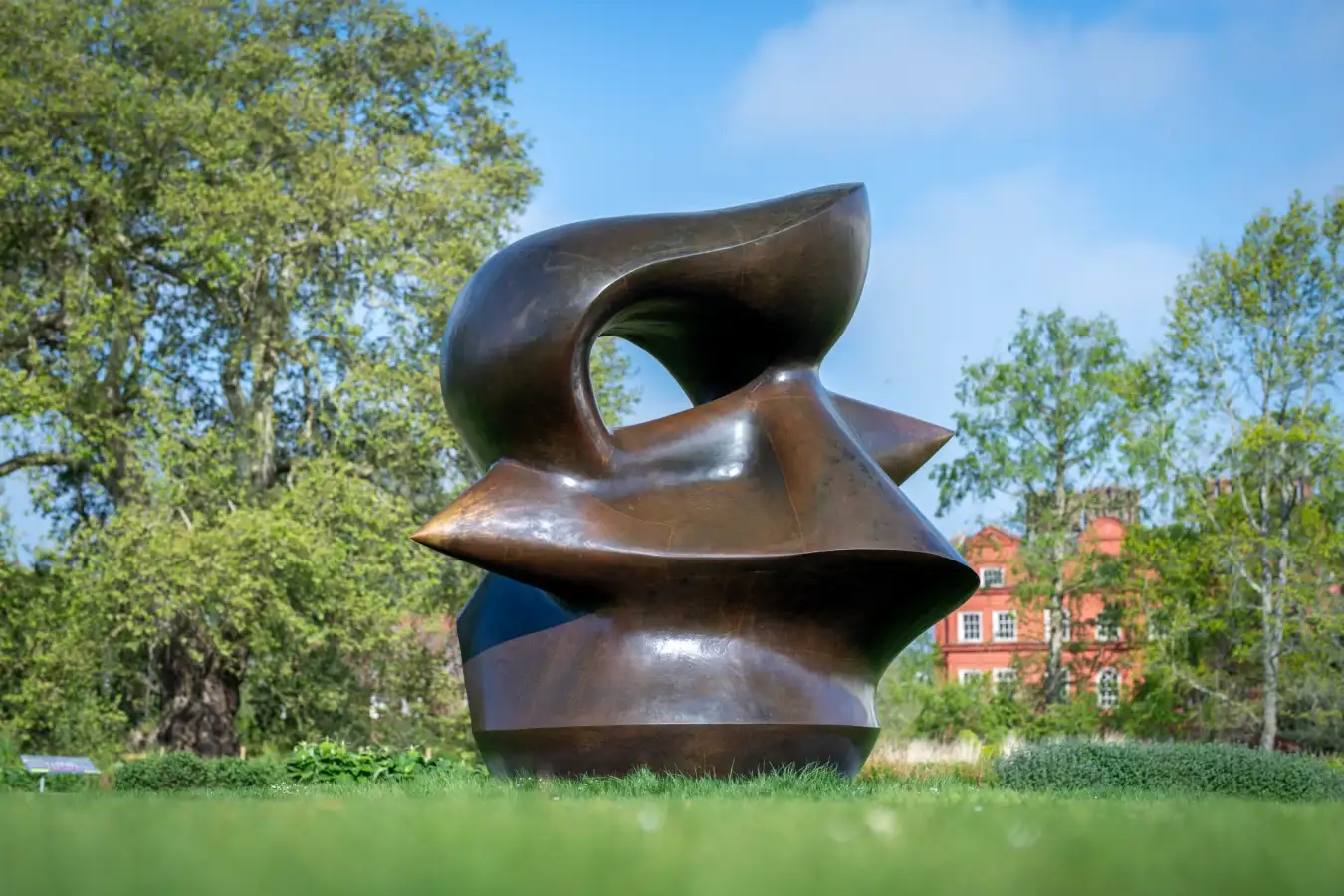
Henry Moore’s Large Spindle Piece (1966)
Ines Stuart Davidson/Royal Botanic Gardens, Kew
Walking around the large green sculpture, I noticed the interplay of shadows and light, which significantly lowered my stress levels. Henry Moore’s artwork radiates tranquility, evoking a serene moment like a mother and child relaxing in a lush garden, just as I was.
This sculpture is part of a stunning collection of 30 works by Moore, exhibited within the landscape and conservatory of London’s Kew Gardens. The exhibition, Henry Moore: Monumental Nature, runs until January 31st. The smooth curves and sharp edges of the bronzes, adorned in green and gold hues, showcase Moore’s remarkable inspiration from the natural environment. For example, the Large Spindle Piece reminds me of seeds, while the Sheep Piece reflects the bond between lamb and mother. Additionally, Three-Piece Sculpture: Vertebrae evokes the image of a backbone, even before I glanced at the title.
Moore’s innovative use of holes and spaces invites viewers to walk around each sculpture, offering fresh perspectives on both the artwork and the surrounding landscape. The Double Oval sculpture, reminiscent of a pelvis, features large openings that transform how I perceive both a palm house from one angle and a tree canopy from another.
An adjacent exhibit at the Shirley Sherwood Gallery of Botanical Art provides fascinating insights into Moore’s artistic process. His etching of an elephant skull captivates with its masterful play of curves, shadows, and light that create an impressive depth. The intricate squiggles depicting bone growth were the only anchors in these claustrophobic labyrinths, grounding them to their original forms. If you plan to visit the exhibition, don’t miss these pieces alongside his stunning tree paintings, which deepen your understanding of his abstract inspirations.
From June 5th, four of Moore’s sculptures will also be showcased alongside contemporary works at Kew’s sister site, Wakehurst, near Haywards Heath. Henry Moore Etc. Wakehurst, with its breathtaking meadows, woodlands, and wetlands, is also home to the Millennium Seed Bank, which has a fascinating history beginning with an Elizabethan mansion on the grounds. Prior to the opening of the new facility, seeds were stored and tested in the elegant chapel and billiards room, with photos and a small exhibition inside the chapel narrating this captivating story.
My favorite time to visit is April and May when the grounds come alive with thousands of bluebells. Henry Moore Etc. will conclude in May 2027, making it the perfect time to experience the blooms alongside the awe-inspiring art and natural beauty.
Topic:
Source: www.newscientist.com