


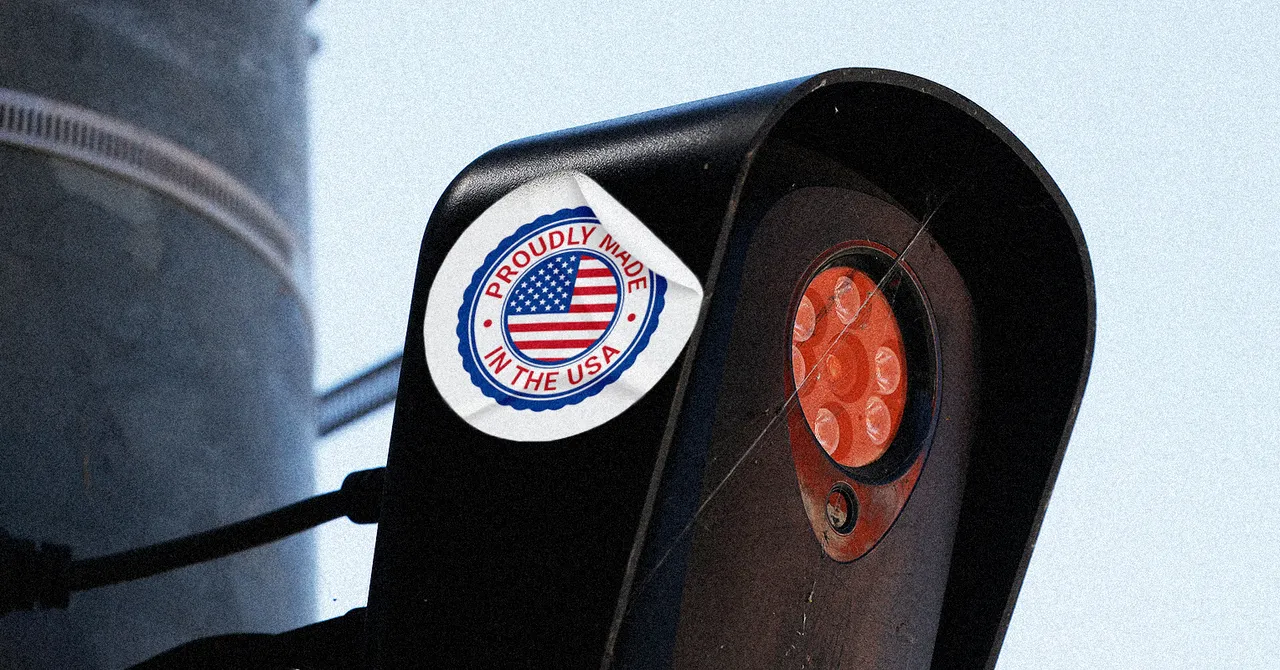
Where Are Flock License Plate Cameras Made? Inside the Company’s Opaque Supply Chain
Flock CEO Garrett Langley said the company built its first license plate camera at his home in Atlanta, leaving permanent drill marks on his dining table. A decade later, the location where Flock assembles its signature—and highly controversial—surveillance product is increasingly unclear.
For years, Flock publicly advertised that its devices were made in the United States. But recent marketing materials reviewed by WIRED no longer specify where the cameras come from. A US manufacturer that previously identified Flock as a customer also quietly removed references to the company from its website earlier this year, as public backlash over Flock’s surveillance technology intensified.
The startup has faced nationwide protests, and dozens of local governments have abruptly suspended use of its cameras. Congress is also considering legislation that would reduce federal funding to states that do not restrict the use of Flock and other automated license plate readers. Police departments describe the cameras as important tools for deterring and solving crimes. Critics, however, say Flock has allowed users to track the cars of officers’ ex-girlfriends, share footage with immigration authorities, and monitor the movements of pedestrians.
Flock’s manufacturing supply chain has received far less attention, even though the origins of its hardware could have implications for US national security. WIRED spoke with current and former Flock employees and supply chain analysts, reviewed US import records, and watched past marketing videos featuring Langley to examine how the company’s hardware pipeline has evolved.
Flock’s Cameras Depend on Global Suppliers
Flock’s cameras rely primarily on suppliers around the world that provide noncustom parts also used in products made by other companies. “Our value lies in bringing all of this together and packaging it as a waterproof, consumer-friendly device,” Langley said in a 2021 marketing video.
Import records collected by ImportGenius show that Flock is increasingly importing “commodity” cameras, radar systems, and other components from Primax Electronics in Thailand. Primax is based in Taiwan but operates manufacturing facilities in China, Thailand, and other countries.
“My understanding is that these are components, but Primax appears to be manufacturing the entire security camera solution,” says ImportGenius analyst Lynn Hughes. “A significant number of shipments include ‘radar’ in the product description, which may be related to the radar sensor pod attached to the camera.”
Flock did not answer most of WIRED’s detailed questions about this article but provided general information. “All products manufactured by Flock are compliant with the National Defense Authorization Act,” Flock spokesperson Paris Rubel said in an email. The law effectively prohibits government contractors from using parts made by a small number of Chinese high-tech companies, citing security concerns.
Chris Van Pelt, founder of the anti-Flock advocacy project Have I Been Flocked, said that while a camera’s manufacturing location may have a relatively small impact on American communities, the lack of transparency about its origins reflects a broader problem.
“All of this speaks to the fact that there are tens of thousands of literal and figurative black boxes on American roads with no real oversight,” Van Pelt said. “If any part of the supply chain is compromised, we never know. It’s a much bigger problem than where the final product is assembled.”
From an Android Phone to a Commercial Camera System
Early Flock prototypes used a camera removed from an Android phone purchased on Alibaba. Langley recalled in a video that the camera was attached to a battery and soldered to a solar panel. The goal was to prove that a useful device could be built from parts costing between $200 and $300. WIRED reported earlier this week that Flock’s cameras continue to use smartphone-style processors, leaving sensitive data unencrypted.
After Flock began winning contracts with homeowners associations, the company moved into a corporate office that also served as an assembly line. Langley said the arrangement was fun but unprofessional and difficult. Pallets of parts shipped from China had to be dragged 400 meters through the building multiple times a week.
Source: www.wired.com