


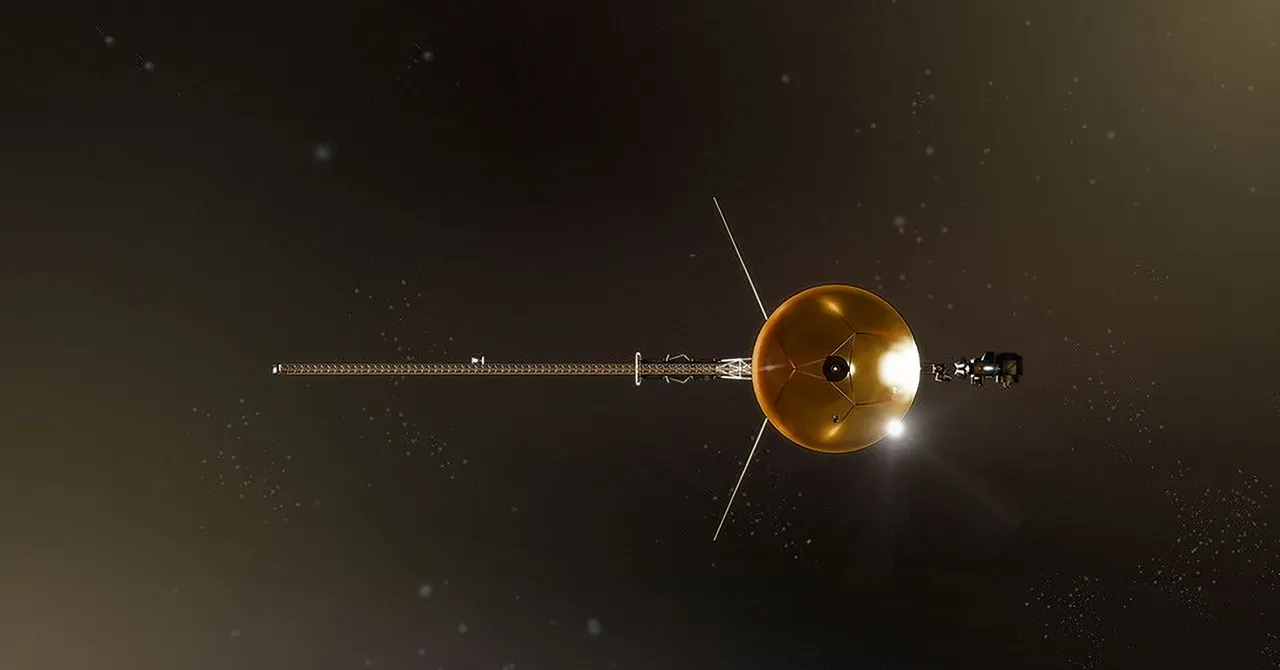
Voyager 1 is now far from the Sun, where its motion is influenced only weakly by gravity, solar wind and magnetic fields. Although the spacecraft is gradually slowing, the Sun’s diminishing gravitational pull means Voyager will not simply come to a stop and fall back. Unless another force intervenes, it will continue traveling through interstellar space.
The only object with a substantial gravitational relationship to Voyager 1 is Jupiter, which has a mass of 1.9 × 1027 kilograms. However, it was not until Voyager came much closer to Earth in 1979 that Jupiter’s gravitational influence became even partially comparable with its interaction with the Sun.
Other, more exotic interactions can affect a spacecraft, but these forces are also small. The solar wind—charged particles emitted from the Sun’s surface—passed through Voyager. These particles travel at very high speeds, but their mass is extremely small. Their intensity also decreases as the distance from the Sun increases.
Voyager 1 can also detect the effects of magnetic fields and other unusual phenomena as it moves from the heliosphere—the region dominated primarily by the Sun’s interactions—into the interstellar medium, where interactions with other stars and matter become more significant.
Will Voyager 1 last forever?
Newton’s second law of motion states that a force applied to an object changes its motion. It can be expressed as:
Net force = mass × acceleration
Acceleration is the rate at which velocity changes over time.
Voyager 1’s average speed has been calculated at about 164 kilometers per second, but that speed is not perfectly constant. The Sun’s gravitational force on the spacecraft has been estimated at 1.4 × 10⁻⁴ newtons. If that were the only force acting on Voyager, its acceleration would be approximately 2 × 10⁻⁷ meters per second squared.
Because the Sun’s gravity is generally directed opposite to Voyager 1’s motion, this acceleration acts as a very small deceleration. The spacecraft slows by only about 0.012 meters per second over the course of a day.
That change is negligible on a daily basis, but it does gradually reduce Voyager 1’s speed. At the same time, the spacecraft is moving farther from the Sun, so the gravitational force causing the slowdown is becoming weaker.
An object can continue slowing without ever coming to a complete stop and falling back toward the Sun if it has enough speed to escape. This minimum speed is known as escape velocity. Voyager requires a speed of at least 3.2 kilometers per second to escape the Sun’s gravitational influence. If it were moving more slowly, it would eventually fall back toward the Sun, much as an apple thrown into the air falls back to Earth.
Other events could still alter Voyager 1’s journey. Even a very small amount of interstellar dust could gradually slow the spacecraft further and, in extreme circumstances, potentially bring it to a stop. Or, as imagined in Star Trek: The Motion Picture, it could somehow become V’Ger. Only time will tell.
Source: www.wired.com