


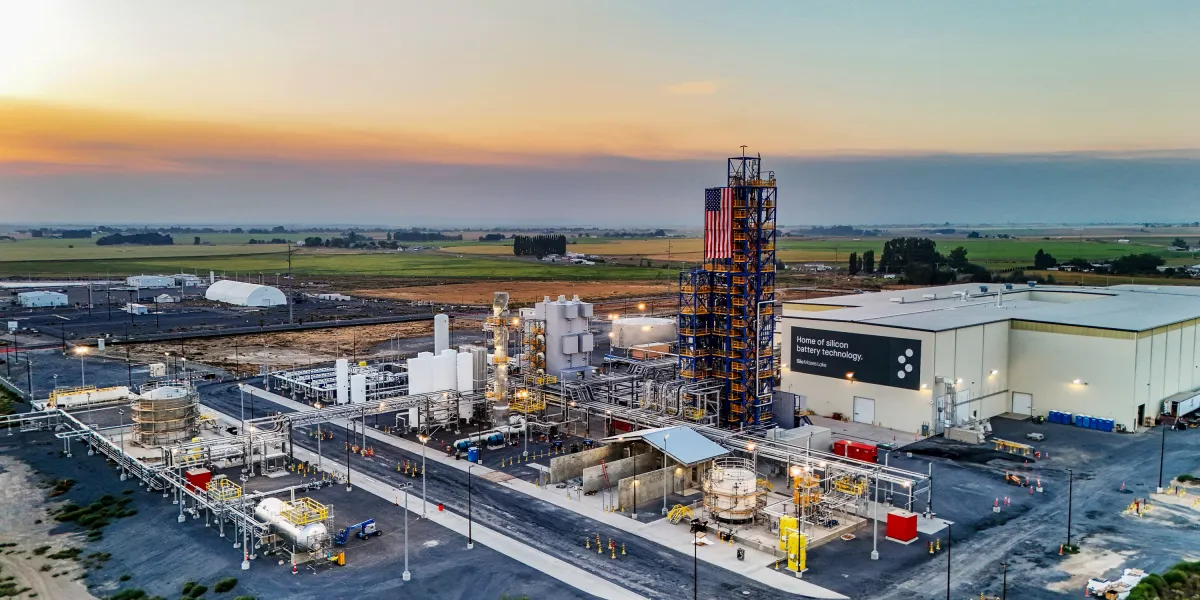
Sila’s battery-materials factory in Moses Lake, Washington, reflects how quickly battery policy and manufacturing priorities have shifted. The facility is largely financed by a $1.4 billion loan from the Trump administration’s Department of Defense, while a separate Panasonic deal is expected to help Sila increase production by at least 10 times. The company’s silicon-based anode technology is designed to improve battery energy density, charging speed and power output, although the wider battery industry is increasingly shaped by geopolitics as well as the energy transition.
Sila’s silicon anode technology
Founded in 2011, Sila manufactures silicon-based negative electrodes, or anodes, for lithium-ion batteries. The company says its silicon anode will weigh one-fifth as much as the graphite currently used in conventional anodes and occupy half the volume.
By reducing the weight and volume of the anode, the material could enable batteries to store more energy within the same physical space. That could help extend the driving range of electric vehicles, among other applications. Sila also says the material can deliver more power and recharge faster than traditional battery chemistries.
From wearable devices to large-scale production
Sila and its competitors have been followed for years. In 2021, James Temple reported on the company after its batteries first appeared in Whoop fitness wearables.
The company’s ambitions have expanded significantly since then. In 2022, Sila announced plans to build a factory in Moses Lake and received $100 million from the U.S. Department of Energy. The funding was part of a multibillion-dollar grant program intended to strengthen the U.S. battery supply chain under the Biden administration.
Sila opened the factory in September 2025, and the facility is already operating. An agreement with Panasonic is now expected to support a substantial production increase.
Gene Berdichevsky, Sila’s co-founder and CEO, said the deal will allow the company to scale production to at least 10 times its current levels.
Source: www.technologyreview.com