


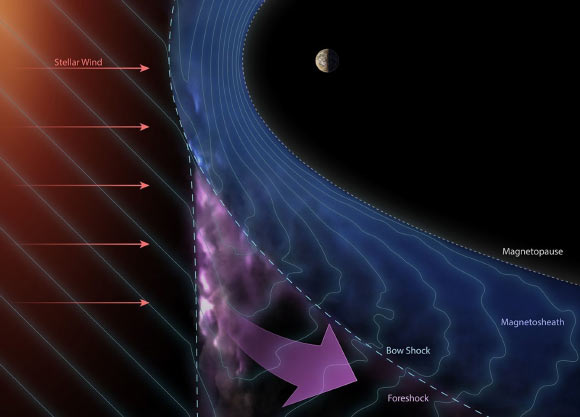
Recent analysis of data from NASA’s Juno spacecraft reveals that Jupiter’s bow shocks not only deflect the solar wind, but also function as powerful particle accelerators, propelling electrons to relativistic energies exceeding 1 MeV.
As planets and stars traverse streams of charged particles in space, their magnetic fields create obstacles. Incoming particles are slowed and redirected, forming a boundary known as a bow shock. Just beyond this boundary lies the foreshock, where fluctuating magnetic conditions can accelerate particles to near-light speeds. Image credit: Ben C. Smith, Johns Hopkins Applied Physics Laboratory.
A shock occurs when an object moves through a fluid faster than the local speed of sound, causing a sudden change in pressure at the interface of the two mediums.
One of the classic examples is the bow shock, where a planet’s atmosphere interacts with the solar wind, akin to the impact created by a ship’s bow in water.
Most shocks in space plasma are collisionless due to the low particle density, which prevents direct collisions from converting impact energy into heat. Instead, electromagnetic forces facilitate this process.
Collisionless shocks are believed to be the sites where cosmic rays can achieve relativistic speeds, a phenomenon known as relativistic electron acceleration.
Despite this understanding, scientists’ insights into how these structures operate remain limited due to insufficient direct observational evidence.
“Since cosmic rays were discovered over 100 years ago, astronomers have endeavored to pinpoint their origins,” stated Dr. Savas Raptis from the Johns Hopkins University Applied Physics Laboratory.
“These high-energy particles can originate from diverse sources, such as supernovae and solar eruptions.”
“When solar cosmic rays reach Earth, they can induce space weather events disrupting satellites, communications, and power systems.”
“The NASA mission illuminated how certain electrons gain high energy in regions near Earth, termed foreshocks, where solar particles first encounter Earth’s magnetic field.”
“Scientists have long suspected that a similar acceleration process occurs for high-energy particles in the foreshocks of other planets and astrophysical systems, but confirmation has been elusive.”
Researchers examined data collected as Juno approached Jupiter on October 1, 2023.
Prior to entering the bow shock, the spacecraft navigated through a foreshock—a turbulent area formed upstream where the solar wind first detects the planet’s magnetic influence.
Within about 20 minutes, Juno identified a significant bubble-like disturbance referred to as a foreshock transient.
The spacecraft utilized three onboard instruments to measure electrons accelerating to energies up to 1 MeV in this region.
“Utilizing these observations, we propose a universal scaling law for the Hyras limit that empirically connects the size of observable transients to maximum particle energy,” the researchers noted.
“This scaling applies across various environments, from planetary bow shocks to protostellar jets and supernova remnants, offering a straightforward model for determining maximum particle energies ranging from MeV to tens of GeV and TeV, respectively, thus providing a method to constrain cosmic ray energies in astrophysical shocks.”
The team’s study was published in the journal Nature on June 3, 2026.
_____
S. Raptis et al. 2026. Relativistic electron acceleration in Jupiter’s bow shock and beyond. Nature 654, 47-51; doi: 10.1038/s41586-026-10473-z
Source: www.sci.news