


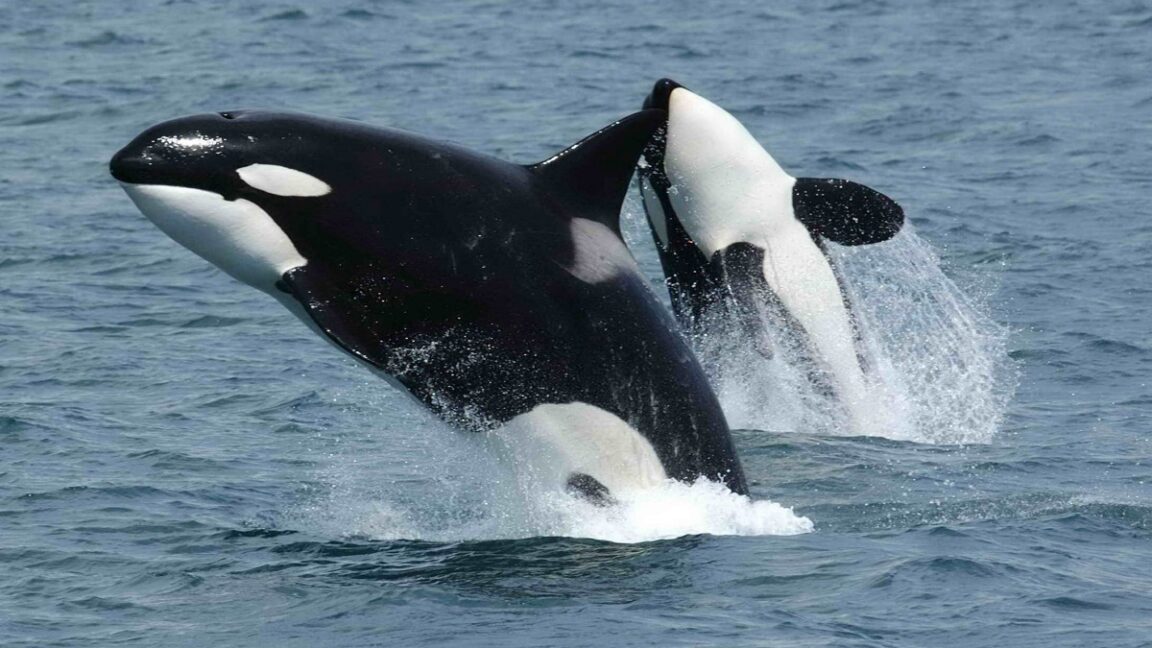
Recent reports have highlighted fascinating behaviors exhibited by orcas. Notably, there have been instances where these marine mammals have rammed boats, sometimes with catastrophic results. Researchers suggest that such behaviors may be culturally learned and passed down through generations. In the Gulf of California, killer whales have been observed collaborating to ram a sunfish, causing it to burst into pieces. While orcas typically use force to extract meat from their prey, this behavior suggests a novel purpose. A recent study published in “Frontiers in Ethology” sheds light on this phenomenon.
Co-author Kathryn Ayers, a member of the nonprofit organization Beneath The Waves dedicated to ocean health, remarked, “We think this may help young killer whales access food more easily, or it may simply be for fun.” Orcas are widely recognized for their playful interactions with their food.
Killer whales deploy a cooperative hunting strategy that involves both hitting and capturing their prey, sometimes consuming it and at other times not. This ramming behavior could serve as a mode of social interaction, playful engagement, or a method of social learning. For instance, orcas have been spotted ramming a whale shark while another holds the prey steady. Their cooperative strategies include creating schools of migrating rays, cutting off escape routes during hunts for great white sharks, and deliberately generating waves to topple penguins off ice floes.
In hunting scenarios involving sunfish, killer whales typically employ three main tactics: targeting the pectoral fin, slicing open the sunfish’s body to remove internal organs, and then using their beaks to extract remaining flesh. The newly identified “ram-to-fragment” behavior might represent an advanced version of these strategies.
Playful Behavior with Food
The first documented instance of this behavior occurred in July 2024, off the coast of San Jose del Cabo, Mexico. Tourists captured footage of three adult female orcas, one male orca, and a juvenile orca capturing and consuming a spiny ray. Shortly after, the same group filmed an adult female holding a dead sunfish, likely already with its internal organs extracted due to a visible wound on its side. When the male killer whale lunged at the carcass, the female released it just before impact, resulting in a loud sound as it shattered and sent pieces of flesh flying through the water. The young orcas continued to consume the smaller fragments, while the adults feasted on the remaining portions of the shattered body.
Source: arstechnica.com