


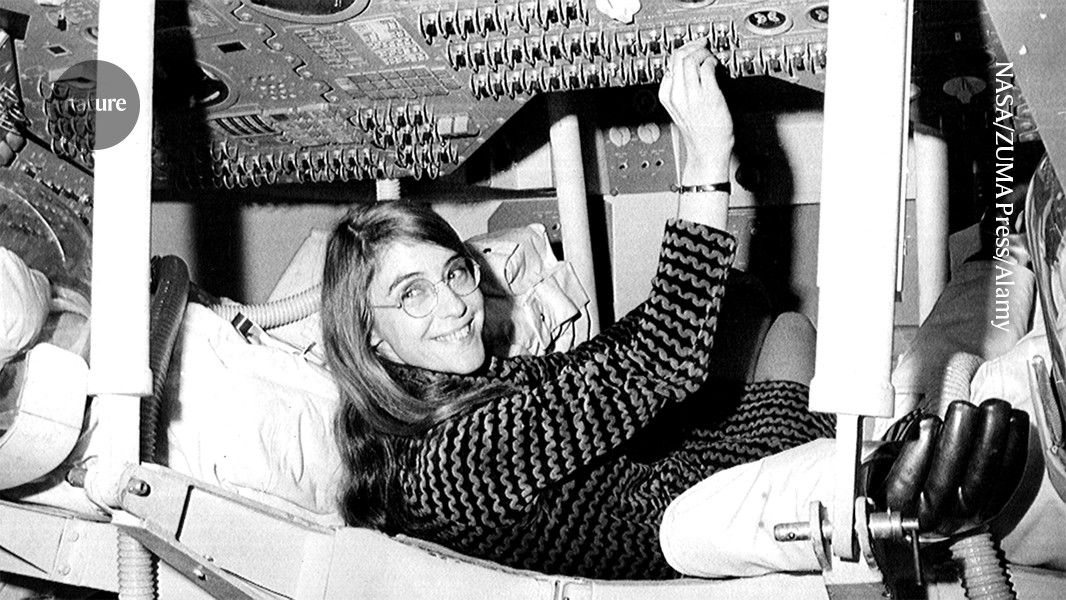
Margaret Hamilton, NASA Apollo Software Pioneer, Dies at 90
Margaret Hamilton helped develop the software that guided NASA’s Apollo missions and pioneered reliable computer programming.
Credit: NASA/ZUMA Press/Alamy
Computer science pioneer Margaret Hamilton has died at the age of 90. She is best known for developing software for NASA’s Apollo program, which brought the first humans to the Moon.
Hamilton had a profound influence on computing. An expert in systems engineering and human–computer interaction, she helped develop pioneering methods for reliable computer programming. She is often credited with coining the term “software engineering”. Her work on logical procedures and systems designed to continue operating in the presence of errors helped establish software development as a discipline comparable in importance to computer hardware.
The Moon belongs to all of us — not just the countries that can afford to reach it
From weather forecasting to the Apollo program
Before her work on Apollo at the Massachusetts Institute of Technology (MIT) in Cambridge, Hamilton worked on weather forecasting and air-defense software. She later became a software entrepreneur, founding a company specializing in programming languages and systems used in fields including space, defense, energy and communications.
Hamilton was born Margaret Heafield in 1936 in Paoli, Indiana. Her parents later moved the family to Michigan and encouraged her interests in both technical and humanities subjects. She began her undergraduate studies at the University of Michigan in Ann Arbor before transferring to Earlham College in Richmond, Indiana, where she earned a bachelor’s degree in mathematics with a minor in philosophy in 1958.
The following year, Hamilton moved to Boston, Massachusetts, with her first husband, James Cox Hamilton. He was a chemist and student council president. Their daughter, Lauren, said that Hamilton was a mathematics prodigy and a homecoming queen.
Hamilton had originally planned to attend graduate school, but instead began working for Edward Lorenz in MIT’s meteorology department. Lorenz was a founder of modern chaos theory, which explores how small changes in complex systems can lead to large and unpredictable effects. Although Hamilton had no previous programming experience, she helped develop weather-forecasting software using the LGP-30, a computer with 4,096 words of memory.
Building reliable software for NASA’s Moon missions
In 1961, Hamilton, then a working mother, moved to a project at MIT Lincoln Laboratory. She worked on the coding for the Semi-Automatic Ground Environment (SAGE), a defense system developed to help protect against Soviet air attacks.
Years later, when she learned that a laboratory at MIT’s main campus was looking for a programmer to help send a person to the Moon, she applied immediately. Hamilton became the first programmer hired for MIT’s Apollo program.
At the time, women represented only a small share of the US science and engineering workforce. Although NASA’s Apollo mission team was largely male, Hamilton worked alongside many women who made important contributions in mathematics, coding and engineering.

First photos of Artemis II: See the stunning ‘Earth Set’ and more
Hamilton was selected to lead the team responsible for writing and testing software for the Apollo Guidance Computer. With the space race in full swing, engineers and programmers at the MIT laboratory faced intense pressure to accomplish a task that had once seemed impossible — guiding astronauts safely to the Moon and back.
Looking back on her work, Hamilton said: “I had no choice but to be a pioneer.”
Source: www.nature.com