


Arctic Sea Ice Melt Season Has Lengthened by 40 Days Since 1979—But the Trend Stabilized After 2010
NASA-led research finds that Arctic sea ice now melts for about 40 days longer than it did in 1979. Most of the increase occurred before 2010, while recent changes have been shaped more strongly by weather patterns and cloud cover.
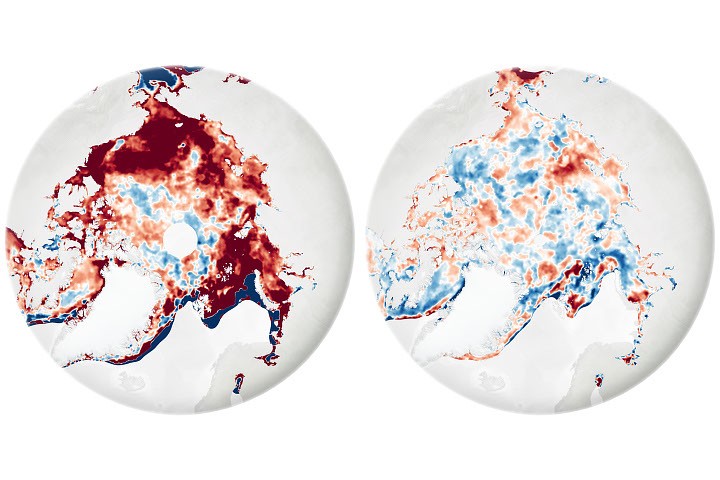
For decades, Arctic sea ice began melting earlier in spring and froze later in fall, extending the melt season and contributing to widespread ice loss. A new NASA-led study finds that the Arctic’s melting season lengthened dramatically after satellite records began in 1979—but the trend unexpectedly stabilized around 2010.
Arctic sea ice now melts about 40 days longer
Researchers found that the Arctic sea ice melt season is about 40 days longer today than it was in 1979. Most of that increase occurred before 2010. Since then, the average length of the melt season has remained relatively stable over the long term, despite substantial year-to-year fluctuations.
The study analyzed satellite observations from 1979 through 2023 to determine when Arctic sea ice begins melting each spring and refreezes in the fall. The researchers found that the longer melt season was driven primarily by ice freezing later in the year, rather than by melting earlier in spring.
“Previously, ice would exist for years without melting every summer,” said study co-author Lynette Boisvert, an ice scientist at NASA’s Goddard Space Flight Center. “Now that the ice is thinner and less abundant, it’s more variable.”
On average, the decline in Arctic sea ice thickness and extent that occurred during the 2000s appears to have halted for the time being.
Why did the Arctic melt season stabilize?
To understand the change, researchers examined the Arctic’s energy balance—the net difference between heat entering from the Sun, atmosphere, and ocean and the outgoing infrared radiation emitted into space.
During the rapid ice loss of the 2000s, shrinking sea ice exposed darker seawater. The ocean absorbed more sunlight, adding energy that delayed autumn freeze-up and extended the melt season. Much of the Arctic’s remaining ice is now younger and thinner than the multi-year ice that was once widespread across the Arctic Ocean, making it more vulnerable to changes in cloud cover, storms, and winds.
From 2000 to 2009, some areas experienced melt-season increases of up to five days per year. Since 2010, however, changes in cloud patterns have reduced the amount of sunlight reaching parts of the Arctic Ocean. As a result, the melt season continues to vary from year to year but has remained relatively stable over longer periods.

Climate change is still affecting the Arctic
The apparent stabilization does not mean that global climate change has stopped affecting the Arctic. The region continues to warm almost four times faster than the global average, and the remaining sea ice is much thinner than it was decades ago.
Instead, the findings suggest that the Arctic may be entering a new phase in which annual weather patterns have a stronger influence on the length of the melt season than they did in the past.
“The length of the snowmelt season is largely determined by atmospheric influences,” Boisvert said. “They seem to play a larger role because ice is generally thinner and more fragile to begin with.”
Could Arctic sea ice loss accelerate again?
Researchers caution that the recent stabilization may be temporary. Thick Arctic ice remains year-round north of Greenland and the Canadian Arctic Archipelago. If ice loss continues in these regions, rapid sea ice loss could resume and potentially extend the melt season even further.
The study highlights the importance of continued satellite observations of Arctic sea ice and the energy balance that controls its growth and melting. It remains an open question whether the recent stabilization represents a permanent change in the Arctic melt season or a pause before another period of rapid change.
Image by Michala Garrison using data from NASA Earth Observatory. Boisvert, L., et al. (2026). Article by James Riordon/NASA Earth Science News Team.
Sources
- Boisvert, L. et al. (2026). The highly volatile situation has recently stabilized due to the prolonged Arctic ice melt season. Communications Earth & Environment, 7, 552.
- Marcus, T. et al. (2009). Recent changes in Arctic sea ice melt onset, freezing, and length of the thaw season. JGR Oceans, 114(C12).
- NASA Earth Observatory (September 16, 2016). Sea Ice. Accessed September 17, 2026.
Source: science.nasa.gov