


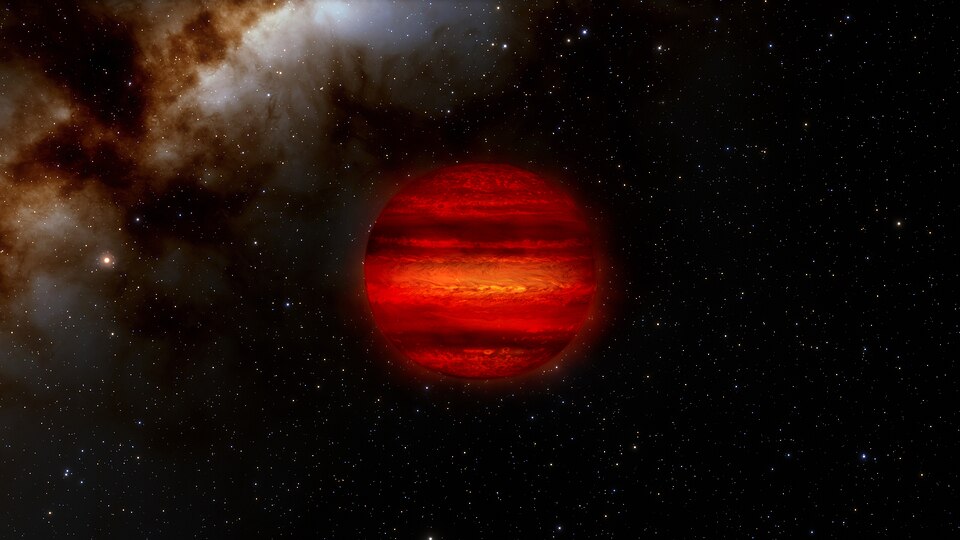
Beyond our solar system, the boundary between planets and stars is not always clear. Astronomers use the term substellar object for celestial bodies that fall between planets and stars in size and mass. One important type of substellar object is the brown dwarf. Brown dwarfs form from collapsing clouds of gas like stars, but they do not have enough mass to sustain hydrogen fusion in their cores. Some can briefly fuse deuterium, a heavier form of hydrogen, while others are cool enough to develop complex atmospheres.
Astronomers recently identified a group of unusual substellar objects in IC 348, a young star-forming region in the Milky Way. Using data from the James Webb Space Telescope’s Near-Infrared Spectrograph (JWST NIRSpec), researchers detected free-floating objects with masses ranging from approximately 0.2% to 1.2% of the Sun’s mass. That is roughly equivalent to several times the mass of Jupiter. Their atmospheres also contain carbon-based molecules known as hydrocarbons. Because they are smaller than previously known brown dwarfs, scientists have referred to them as H-type objects.
To determine where H-type objects fit within the substellar spectrum, researchers Richard J. Parker and Catalina Alves de Oliveira studied survey data from IC 348 and conducted computer simulations of the region’s evolution. Their central question was whether these objects formed directly from collapsing gas clouds, like stars and brown dwarfs, or whether they formed as planets around stars before being gravitationally ejected into interstellar space.
The researchers first examined observations of IC 348 collected with JWST NIRSpec and the SpeX near-infrared spectrograph (SpeX) at the NASA Infrared Telescope Facility. The star-forming region contains 495 stars and brown dwarfs, along with nine H-type objects. Estimates place IC 348’s age between approximately 1 and 3 million years, although other studies have suggested an age of 5 to 6 million years.
Parker and Alves de Oliveira compared the positions of the stars, brown dwarfs, and H-type objects within the cluster. They found no clear difference in the spatial distribution of the three groups. The team then simulated IC 348’s evolution over 10 million years. Their models began with a massive gas cloud whose material was distributed among 495 objects. They placed Jupiter-sized planets around stars with approximately the Sun’s mass to test whether gravitational interactions could eject the planets from their systems.
The simulations also examined Jupiter-sized planets orbiting at distances comparable to the orbits of Earth, Jupiter, and Neptune. The researchers varied the size and stellar density of the simulated cluster to explore different formation scenarios. They found that when Jupiter-sized planets orbited at a distance similar to Jupiter’s, between five and 15 planets could be ejected from their host stars in a cluster resembling IC 348.
Although that number is broadly consistent with the nine known H-type objects, the simulated planets became more widely dispersed than the observed objects. Their distribution more closely resembled the locations of stars and brown dwarfs in the cluster. Because the planet-ejection simulations did not reproduce the observed pattern, the researchers concluded that H-type objects are more likely to be an especially low-mass category of brown dwarfs than escaped planets.
The findings support the idea that H-type objects form more like brown dwarfs than planets, but their exact origins remain uncertain. Astronomers continue to debate how brown dwarfs form. Some may be ejected from collapsing gas clouds before they finish growing, while others could lose their outer layers through radiation from nearby massive stars. A third possibility is that brown dwarfs form in a similar way to stars but never accumulate enough mass to begin sustained hydrogen fusion. Future observations with JWST and other infrared telescopes could help clarify the origins of these mysterious objects and improve our understanding of substellar astronomy.
Post views: 43
Source: sciworthy.com