


Enceladus’ Ice Grains Reveal How Saturn’s Hidden Ocean May Concentrate Life-Building Chemicals
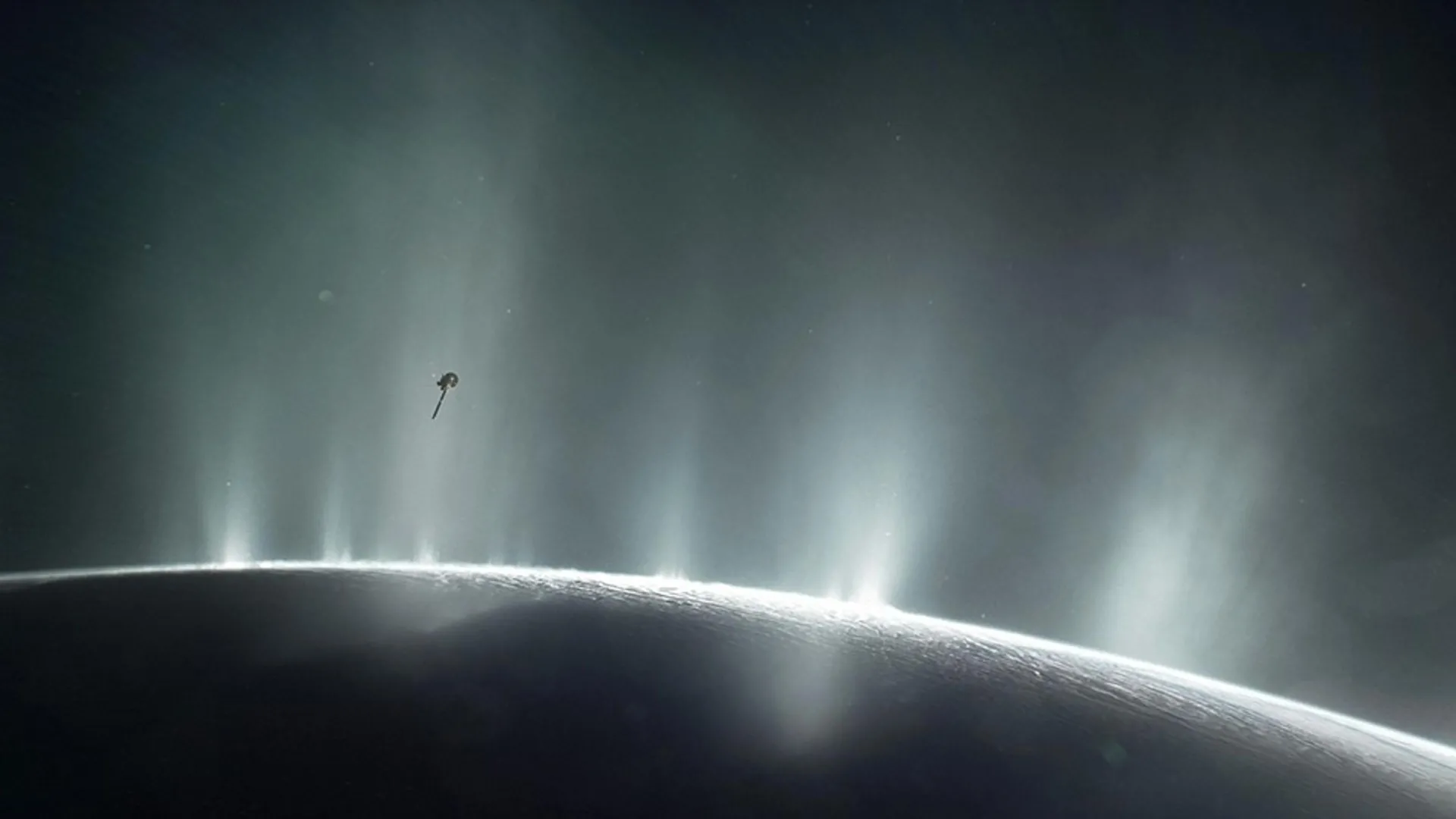
Saturn’s moon Enceladus is covered in ice, but beneath its frozen shell lies a global ocean. Near the moon’s south pole, cracks in the icy crust release water vapor and ice particles into space. These particles give scientists an unusual way to study an alien ocean without drilling through kilometers of ice.
An international team, including researchers from the Earth and Life Science Institute (ELSI) at the Tokyo University of Science, investigated how seawater from beneath Enceladus’ surface becomes the tiny ice grains detected in space.
Cassini discovered a surprising variety of Enceladus ice grains
From 2004 to 2017, the Space Dust Analyzer aboard NASA’s Cassini spacecraft measured the composition of individual ice particles in Saturn’s E ring. The ring is continuously supplied with material ejected from Enceladus.
A team led by Professor Frank Postberg of the Free University of Berlin examined 961 mass spectra from salt-rich particles known as type 3 particles. If these grains were simply small samples of the same seawater, scientists might expect them to contain roughly the same mixture of salts.
Instead, the grains showed dramatic chemical differences.
Some were especially rich in sodium chloride, while others contained more carbonates, phosphates, or potassium chloride. One particularly striking pattern was that chloride and carbonate rarely appeared together in the same sodium-rich grain.
This raised a basic question: If the grains all came from the same ocean, why were their chemical compositions so different?
Laboratory experiments recreate Enceladus’ ocean droplets
To investigate, ELSI professor Yasuto Sekine and his colleagues created laboratory droplets containing the main salt thought to be present in Enceladus’ ocean.
The researchers froze droplets of different sizes under different cooling conditions and studied how the chemical elements were distributed after the droplets solidified.
The results showed that the speed of freezing plays a major role.
In a droplet about 200 micrometers in diameter, the salt separated into different regions when freezing occurred relatively slowly, at rates below about 10 K per minute. When a droplet froze faster, its chemical components remained more uniformly mixed.
“What surprised us was that the diversity we saw with Cassini could emerge from droplets that originate from essentially the same seawater,” Sekine said. “Our experiments show that when relatively large ocean water droplets freeze slowly, different salts can separate within them. When those frozen water droplets later break up, they can produce much smaller ice grains, each with a very different chemical composition.”
A slow journey through Enceladus’ icy crust
The discovery may also reveal what happens inside Enceladus’ icy crust.
Early studies generally assumed that seawater droplets from Enceladus would freeze rapidly and travel quickly toward space after leaving the ocean. The new experiment suggests a different scenario.
Droplets may initially move much more slowly through underground vent systems, following complex paths through cracks in the ice before reaching the surface.
Researchers suggest that ocean water first forms droplets tens to hundreds of micrometers across. As these droplets slowly move through deeper sections of the vent, they gradually freeze, giving the salts enough time to separate into different regions.
Conditions change closer to the surface. Gas begins moving faster, and the frozen droplets can strike the walls of narrow ice channels at high speed. These collisions can break the droplets into smaller pieces.
Each fragment may come from a different salt-rich region within the original frozen droplet, creating particles with very different chemical compositions. These pieces can escape into space and become part of Saturn’s E ring.
“Cassini data showed that these salt-rich grains are much more chemically diverse than the average ocean composition suggests,” Postberg said. “Combining these observations with freezing experiments provides a physical explanation. Cassini may have sampled fragments of larger frozen ocean droplets. Each particle stores different components that were separated on the way to the surface. The abundance of individual components in the ocean is reflected in the number of fragments in which a particular component is found.”
Enceladus may naturally concentrate important compounds
The discovery could be particularly important for future missions to Enceladus.
When droplets freeze and break apart, individual compounds can become concentrated in specific particles. This process does more than separate different salts. Previous studies have also shown that organic substances can be separated from one another and appear in high concentrations within certain particles.
That natural concentration process could make future analysis easier.
Compounds that are highly diluted and mixed with many other substances in Enceladus’ ocean may be easier to detect when they are concentrated in individual ice grains.
On Earth, laboratories often go to great lengths to separate and concentrate chemicals before analyzing samples. Enceladus may perform both of these “sample preparation” steps naturally: chemical components separate, and some become concentrated in particular ice particles.
Could Enceladus’ ice grains support prebiotic chemistry?
Slow freezing may have another important consequence.
As ice crystals grow, small pockets of liquid brine can remain trapped between them. Salts and organic compounds can become highly concentrated inside these pockets.
This concentration may be important for prebiotic chemistry, including chemical processes that could precede the emergence of life. One major challenge in prebiotic chemistry is bringing normally dilute molecules into close contact with one another.
Much of the material ejected from Enceladus eventually falls back onto the moon. As a result, freezing, concentration, and recycling could occur repeatedly.
Understanding how Enceladus forms its ice particles therefore does more than explain Cassini’s unusual measurements. It may provide new clues about the hidden environment beneath the moon’s surface and help future spacecraft interpret the particles they collect while searching for evidence of habitability and possible signs of life.
Source: www.sciencedaily.com