


Jet Propulsion Laboratory at 90: From Rocket Tests to the Future of Space Exploration
Interstellar probes. Lunar drones. Helicopters on Mars.
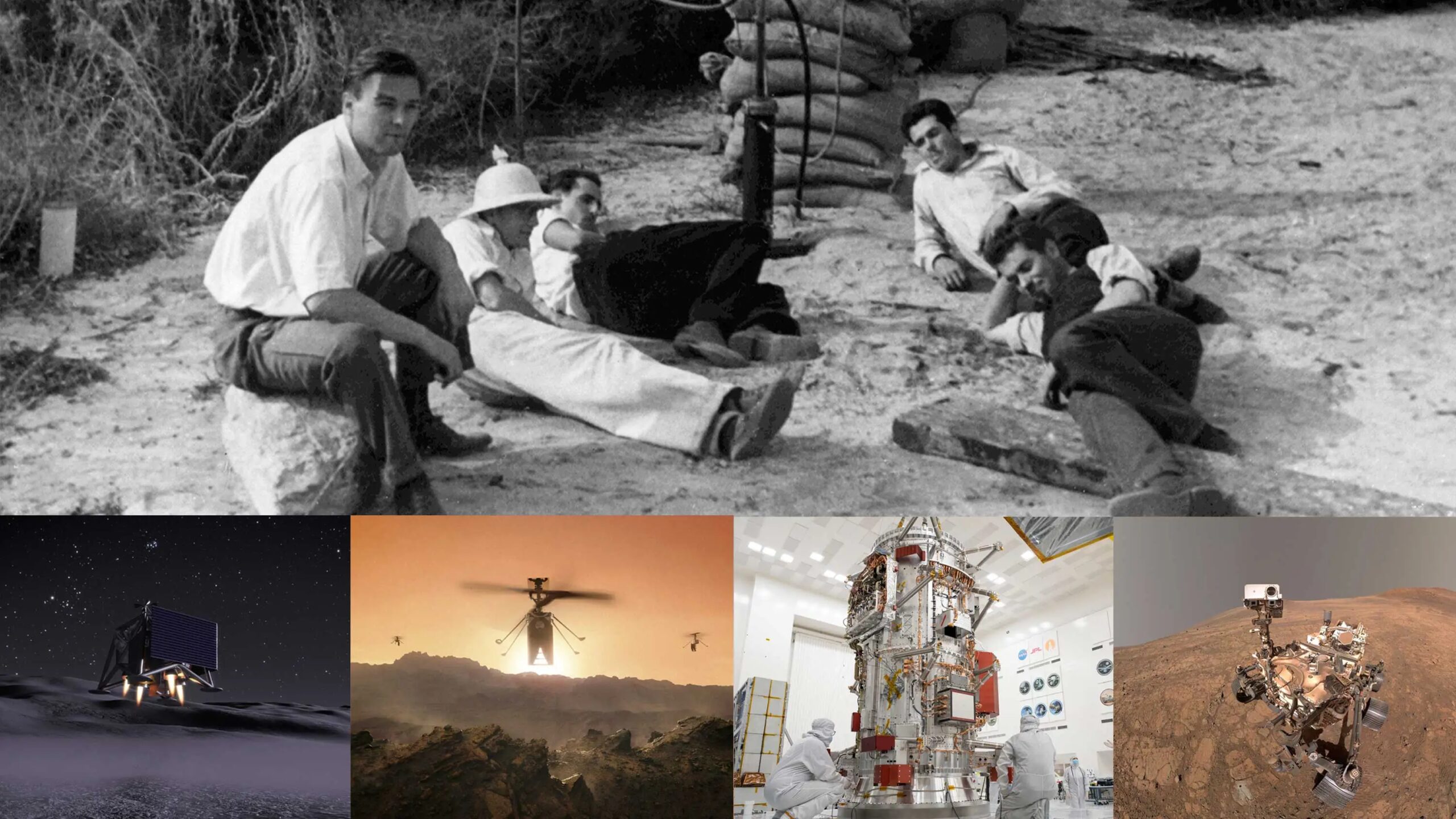
Ninety years after a group of Caltech graduate students and hobbyists began testing rocket propulsion in Pasadena’s Arroyo Seco, the Jet Propulsion Laboratory (JPL) continues to shape the future of space exploration. Now managed by the California Institute of Technology for NASA, JPL is celebrating a legacy of historic firsts while developing missions that could transform our understanding of Mars, the Moon, Earth and the wider universe.
JPL’s historic space exploration milestones
The group’s rocket tests began on October 31, 1936. JPL initially worked as a contractor for the U.S. military before becoming part of the newly formed NASA.
JPL launched America’s first artificial satellite, Explorer 1. The spacecraft became the first to conduct science in space when its onboard Geiger counter discovered radiation belts surrounding Earth. That achievement went beyond simply placing a spacecraft in orbit, as the Soviet Union’s Sputnik had done.
Within six years of joining NASA, JPL sent America’s first mission to the Moon. Ranger 7 was part of a series of missions that helped establish JPL’s role in planetary exploration.
The laboratory has since guided numerous milestones, including the first planetary flyby, the first spacecraft to visit all four gas giant planets, the first infrared telescope, the first Mars rover and the first rotary-wing vehicle to fly over Mars.
JPL’s next generation of missions
Many more firsts are underway.
“For 90 years, JPL’s first-of-its-kind missions have changed our understanding of the universe and our place in it,” said Dave Gallagher, JPL director starting in 2025.
In 1992, two years after beginning work as an engineer at the laboratory, Gallagher led a JPL team that built and tested the Wide Field and Planetary Camera 2. NASA’s Hubble Space Telescope used the camera to capture many of the mission’s most iconic images.
“We stand on an extraordinary foundation and are ready to push the boundaries with an exciting new mission to help future generations go even further,” Gallagher said.
Three helicopters planned for Mars
Managed by JPL and aiming for launch in 2028, Skyfall will deploy three helicopters during their descent over Mars. The mission is designed to explore and map hidden ice deposits while analyzing Martian weather patterns.
Lunar drones and solar science
JPL is also supporting NASA’s development of a lunar base through Moonfall, a mission that landed a group of large propelled drones at the Moon’s south pole in the same year. The mission is scheduled to launch in 2027.
Sunrise, or the Solar Radio Interferometer Space Experiment, will fly spacecraft in formation to create a radio antenna several miles wide. The mission will study the Sun’s activity, and its findings could help make space exploration safer for humanity.
Searching for dangerous asteroids
Protecting humanity is also a central purpose of asteroid exploration. The JPL-managed NEO Surveyor, or Near-Earth Object Surveyor, will search for potentially dangerous space rocks that other telescopes cannot find.
Once an object is discovered, NASA can provide a threat assessment and plan accordingly.
JPL missions are monitoring Earth
The same laboratory that launched the first oceanographic satellite in 1978 is also developing missions designed to better measure Earth’s vital signs.
One mission will monitor the movement of water by measuring small changes in gravity. Another will study how powerful tropical convective storms form. A third will examine how different types of air pollution affect human health.
These projects join other Earth missions and instruments led by JPL. NISAR, the NASA-ISRO Synthetic Aperture Radar mission, is a partnership with the Indian Space Research Organization. It can pinpoint how Earth’s surface changes in relation to natural disasters.
JPL is also involved in research into rare earth elements, which are important to modern technology. An instrument in the AVIRIS, or Airborne Visible Infrared Imaging Spectrometer, series is being used to support this work. The AVIRIS sensor installed on the aircraft was developed at JPL.
From camera-on-a-chip technology to far-infrared astronomy
JPL’s Microdevices Laboratory invented “camera-on-a-chip” technology, which enables cameras in mobile phones.
The laboratory is also developing detectors for PRIMA, the Far Infrared Exploration Mission for Astrophysics. The newly announced NASA mission will expand humanity’s understanding of the universe by studying radiant energy visible only in the far-infrared spectrum.
“By bringing together the best of Caltech and JPL’s scientific talent and engineering ingenuity, we will advance NASA’s priorities and continue to power America’s space leadership,” said Caltech President Ray Jayawardhana, who is also a professor of astronomy.
“I can only imagine what the Caltech students doing their rocket experiments in a small spot on a riverbed would think if they could learn what Caltech and JPL have accomplished since then and where they’re going next. Ninety years later, that same bold spirit continues to break new ground and inspire humanity,” Jayawardhana said.
Voyager continues JPL’s legacy of discovery
JPL’s 90th anniversary comes just weeks before another milestone for Voyager 1, reached on November 18. At that point, the spacecraft will be a full light-day from Earth—the distance light travels in 24 hours—approximately 16 billion miles, or 26 billion kilometers.
Ed Stone led the Voyager mission for 50 years, including 10 years as JPL director. Stone died in 2024, but Voyager 1 continues traveling deeper into interstellar space than any other spacecraft has ventured.
The Voyager spacecraft will turn 50 next year. They rely on NASA’s Deep Space Network, developed by JPL during the Apollo era, to receive commands and send scientific data back to Earth.
Stone once said that both Voyagers were exploring regions no spacecraft had visited before and that “every day is a day of discovery.” The same can be said about JPL.
-end-
Media inquiries
Matthew Segal
Jet Propulsion Laboratory, Pasadena, California
818-354-8307
[email protected]
2026-073
Source: www.nasa.gov