


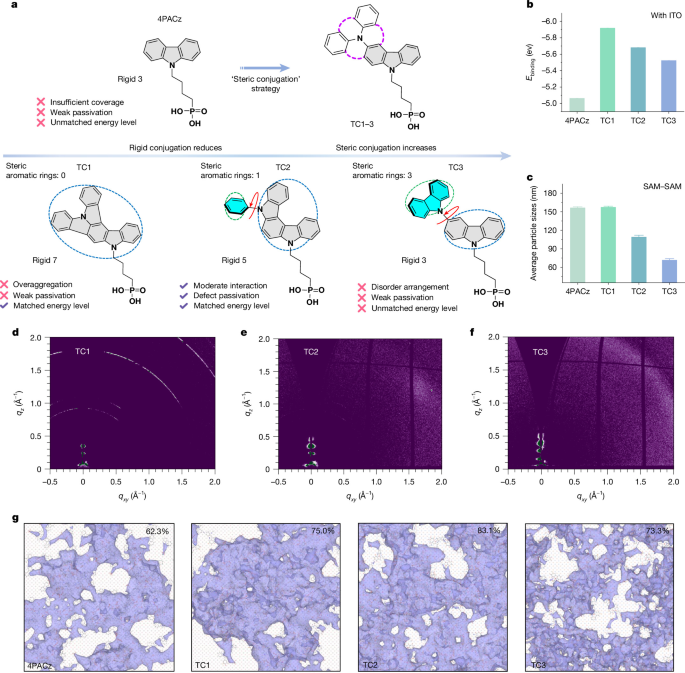
The cited literature surveys recent advances in perovskite photovoltaics, particularly perovskite/silicon tandem solar cells, self-assembled molecular layers, interface passivation, stability, ion migration, crystallization and computational modeling. The references span studies published from 1992 to 2026 in journals including Nature, Science, Nature Materials, Nature Photonics and Advanced Energy Materials.
Perovskite and tandem solar-cell research
- Jia, L. et al. Efficient perovskite/silicon tandem with asymmetric self-assembly molecule. Nature 644, 912–919 (2025). Article
- Wu, W. et al. Stable and uniform self-assembled organic diradical molecules for perovskite photovoltaics. Science 389, 195–199 (2025). Article
- Green, M. A. et al. Solar cell efficiency tables (version 67). Progress in Photovoltaics: Research and Applications 34, 482–496 (2026). Article
- Liu, J. et al. Perovskite/silicon tandem solar cells with bilayer interface passivation. Nature 635, 596–603 (2024). Article
- Ugur, E. et al. Enhanced cation interaction in perovskites for efficient tandem solar cells with silicon. Science 385, 533–538 (2024). Article
- Aydin, E. et al. Enhanced optoelectronic coupling for perovskite/silicon tandem solar cells. Nature 623, 732–738 (2023). Article
- Mariotti, S. et al. Interface engineering for high-performance, triple-halide perovskite–silicon tandem solar cells. Science 381, 63–69 (2023). Article
- Chin, X. Y. et al. Interface passivation for 31.25%-efficient perovskite/silicon tandem solar cells. Science 381, 59–63 (2023). Article
- Li, N. et al. Optimal perovskite vapor partitioning on textured silicon for high-stability tandem solar cells. Science 390, eadz3698 (2026). Article
- Chen, Y. et al. Nuclei engineering for even halide distribution in stable perovskite/silicon tandem solar cells. Science 385, 554–560 (2024). Article
- Fei, C. et al. Limiting phosphonic acid interlayer–perovskite reactivity to stabilize perovskite solar modules. Science 391, eadz7969 (2026). Article
- Liu, S. et al. Buried interface molecular hybrid for inverted perovskite solar cells. Nature 632, 536–542 (2024). Article
- Liang, Y. et al. A matrix-confined molecular layer for perovskite photovoltaic modules. Nature 648, 91–96 (2025). Article
- Jiang, W. et al. Toughened self-assembled monolayers for durable perovskite solar cells. Nature 646, 95–101 (2025). Article
- Luo, C. et al. Engineering bonding sites enables uniform and robust self-assembled monolayer for stable perovskite solar cells. Nature Materials 24, 1265–1272 (2025). Article
- Fei, C. et al. Strong-bonding hole-transport layers reduce ultraviolet degradation of perovskite solar cells. Science 384, 1126–1134 (2024). Article
- Guo, C. et al. Bifacially reinforced self-assembled monolayer interfaces for minimized recombination loss and enhanced stability in perovskite/silicon tandem solar cells. Advanced Materials 37, 2504520 (2025). Article
- Feng, Y. et al. Homogenized self-assembled molecules for inverted perovskite solar cells. Angewandte Chemie International Edition 64, e202505876 (2025). Article
- He, R. et al. Improving interface quality for 1-cm2 all-perovskite tandem solar cells. Nature 618, 80–86 (2023). Article
- Zhou, J. et al. Molecular contacts with an orthogonal π-skeleton induce amorphization to enhance perovskite solar cell performance. Nature Chemistry 17, 564–570 (2025). Article
- Zhao, K. et al. peri-Fused polyaromatic molecular contacts for perovskite solar cells. Nature 632, 301–306 (2024). Article
- Wang, X. et al. Regulating phase homogeneity by self-assembled molecules for enhanced efficiency and stability of inverted perovskite solar cells. Nature Photonics 18, 1269–1275 (2024). Article
- Park, S. M. et al. Low-loss contacts on textured substrates for inverted perovskite solar cells. Nature 624, 289–294 (2023). Article
- Geng, C. et al. Two-terminal perovskite/Cu(In,Ga)Se2 tandems with conformal coatings based on commercial bottom cells with >26% efficiency. Energy & Environmental Science 18, 8907–8917 (2025). Article
- Zhang, Y. et al. A π-conjugated molecular bridge strategy for constructing efficient hole transport pathways in inverted perovskite solar cells. Angewandte Chemie International Edition 64, e202514640 (2025). Article
- Du, J. et al. Face-on oriented self-assembled molecules with enhanced π–π stacking for highly efficient inverted perovskite solar cells on rough FTO substrates. Energy & Environmental Science 18, 3196–3210 (2025). Article
- Zhu, P. et al. Symmetry-driven engineering of long-range-ordered π–π stacking molecules for high-efficiency perovskite photovoltaics. Nature Synthesis 5, 64–73 (2026). Article
- Chang, Y. et al. Highly oriented and ordered co-assembly monolayers for inverted perovskite solar cells. Angewandte Chemie International Edition 64, e202418883 (2025). Article
- Zhang, D. et al. Perovskite crystallization control via an engineered self-assembled monolayer in perovskite–silicon tandem solar cells. Nature Photonics 20, 40–48 (2026). Article
- Xiong, S. et al. Disentangling perovskite surface work functions and electron extraction energy offsets to drive high photovoltaic efficiency. Science Bulletin 70, 1968–1975 (2025). Article
- Gutierrez-Partida, E. et al. Toward understanding the built-in field in perovskite solar cells through layer-by-layer surface photovoltage measurements. ACS Applied Materials & Interfaces 17, 11176–11186 (2025). Article
- Warby, J. et al. Mismatch of quasi-Fermi level splitting and Voc in perovskite solar cells. Advanced Energy Materials 13, 2303135 (2023). Article
- Liu, J. et al. Efficient and stable perovskite-silicon tandem solar cells through contact displacement by MgFx. Science 377, 302–306 (2022). Article
- Xu, F. et al. Stabilized perovskite phases enabling efficient perovskite/perovskite/silicon triple-junction solar cells. Nature Materials 25, 259–266 (2026). Article
- Er-Raji, O. et al. Electron accumulation across the perovskite layer enhances tandem solar cells with textured silicon. Science 390, eadx1745 (2025). Article
- Ye, F. et al. Minimizing recombination at the perovskite/C60 interface through a volatile highly dense molecular interlayer. ACS Energy Letters 10, 2942–2951 (2025). Article
Ion migration, stability and degradation
- Thiesbrummel, J. et al. Ion-induced field screening as a dominant factor in perovskite solar cell operational stability. Nature Energy 9, 664–676 (2024). Article
- Thiesbrummel, J. et al. Universal current losses in perovskite solar cells due to mobile ions. Advanced Energy Materials 11, 2101447 (2021). Article
- Kalasariya, N. et al. How halide segregation governs the ion density evolution and ionic performance losses: from degradation to recovery. Advanced Energy Materials 16, e03866 (2026). Article
- Diethelm, M. et al. Probing ionic conductivity and electric field screening in perovskite solar cells: a novel exploration through ion drift currents. Energy & Environmental Science 18, 1385–1397 (2025). Article
- Knight, A. J. & Herz, L. M. Preventing phase segregation in mixed-halide perovskites: a perspective. Energy & Environmental Science 13, 2024–2046 (2020). Article
Measurement and computational methods
- Siefer, G., Baur, C. & Bett, A. W. External quantum efficiency measurements of germanium bottom subcells: measurement artifacts and correction procedures. In Proceedings of the 2010 35th IEEE Photovoltaic Specialists Conference, 704–707 (IEEE, 2010).
- Steiner, M. A. et al. Measuring IV curves and subcell photocurrents in the presence of luminescent coupling. IEEE Journal of Photovoltaics 3, 879–887 (2013). Article
- Lu, T. & Chen, F. Multiwfn: a multifunctional wavefunction analyzer. Journal of Computational Chemistry 33, 580–592 (2012). Article
- Neese, F. Software update: the ORCA program system—version 5.0. Wiley Interdisciplinary Reviews: Computational Molecular Science 12, e1606 (2022). Article
- Kresse, G. & Hafner, J. Ab initio molecular dynamics for liquid metals. Physical Review B 47, 558–561 (1993). Article
- Kresse, G. & Hafner, J. Ab initio molecular-dynamics simulation of the liquid-metal–amorphous-semiconductor transition in germanium. Physical Review B 49, 14251–14269 (1994). Article
- Thompson, A. P. et al. LAMMPS—a flexible simulation tool for particle-based materials modeling at the atomic, meso, and continuum scales. Computer Physics Communications 271, 108171 (2022). Article
- Dodda, L. S., Cabeza de Vaca, I., Tirado-Rives, J. & Jorgensen, W. L. LigParGen web server: an automatic OPLS-AA parameter generator for organic ligands. Nucleic Acids Research 45, W331–W336 (2017). Article
- Meltzer, C. et al. Indentation and self-healing mechanisms of a self-assembled monolayer—a combined experimental and modeling study. Journal of the American Chemical Society 136, 10718–10727 (2014). Article
- Li, D. et al. Co-adsorbed self-assembled monolayer enables high-performance perovskite and organic solar cells. Nature Communications 15, 7605 (2024). Article
- Lorenzoni, A., Mosca Conte, A., Pecchia, A. & Mercuri, F. Nanoscale morphology and electronic coupling at the interface between indium tin oxide and organic molecular materials. Nanoscale 10, 9376–9385 (2018). Article
- Rappe, A. K., Casewit, C. J., Colwell, K. S., Goddard, W. A. III & Skiff, W. M. UFF, a full periodic table force field for molecular mechanics and molecular dynamics simulations. Journal of the American Chemical Society 114, 10024–10035 (1992). Article
- Martínez, L., Andrade, R., Birgin, E. G. & Martínez, J. M. PACKMOL: a package for building initial configurations for molecular dynamics simulations. Journal of Computational Chemistry 30, 2157–2164 (2009). Article
- Stukowski, A. Visualization and analysis of atomistic simulation data with OVITO–the Open Visualization Tool. Modeling and Simulation in Materials Science and Engineering 18, 015012 (2010). Article
Source: www.nature.com