


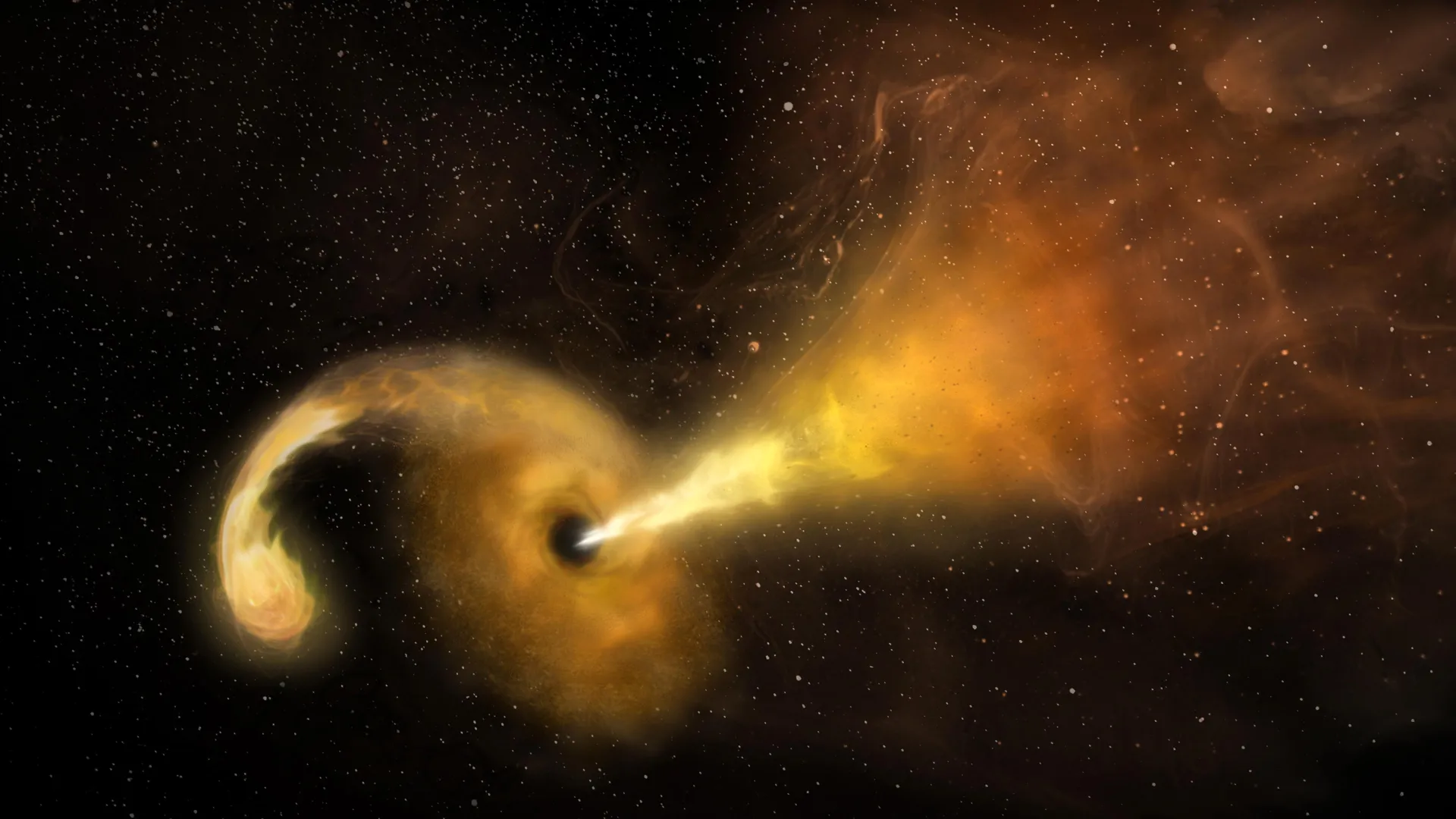
NASA’s Neil Gehrels Swift Observatory has detected a rare supermassive black hole located far from the center of a distant galaxy as it tore apart and consumed a star. Astronomers describe the object as an apparent “orphan” black hole because it lies unusually far from the galactic core, where supermassive black holes are typically found. No confirmed tidal disruption event has previously been observed at such a great distance from a galaxy’s center.
“We were searching for stellar tidal disruption events as a way to identify otherwise invisible supermassive black holes that have wandered away from the galactic cores where they normally reside,” said Robert Stein, a research fellow at The University of Maryland, College Park, and NASA’s Goddard Space Flight Center in Greenbelt, Maryland. “This discovery, one of only a few confirmed examples so far, validates a new detection technique and gives us a way to find more wandering black holes.”
The study, led by Stein, was published July 27 in The Astrophysical Journal Letters.
A Star Torn Apart by a Hidden Supermassive Black Hole
The discovery began with an exceptionally bright flare created when a star passed too close to a massive black hole and was destroyed by its powerful gravitational forces. Astronomers call this phenomenon a tidal disruption event, or TDE.
The black hole has an estimated mass of about 1 million times that of the Sun. Scientists first suspected its presence in November 2025, when the Zwicky Transient Facility, or ZTF, at Palomar Observatory in Southern California detected an unusual burst of light from a galaxy approximately 750 million light-years from Earth.
“ZTF detects around half a million flashes every night, but our new artificial intelligence algorithm automatically identified one that closely resembled a tidal disruption event, even though it appeared far from the galaxy’s center,” Stein said.
For several months, the flare became brighter in ultraviolet wavelengths than the entire galaxy surrounding it. At its peak, the event briefly shone with the power of approximately 10 billion Suns.
NASA’s Swift Observatory Confirms the Powerful Cosmic Flare
After ZTF detected the flare, astronomers used additional observatories to study its origin. The Southern Astrophysical Research telescope, known as SOAR, in Chile analyzed the source’s spectrum and found evidence consistent with a tidal disruption event.
Researchers then used NASA’s Neil Gehrels Swift Observatory to observe wavelengths that ground-based telescopes cannot detect. Swift’s Ultraviolet/Optical Telescope, or UVOT, measured the flare’s temperature at roughly 54,000 degrees Fahrenheit (30,000 degrees Celsius).
“Combining all of these observations allowed us to eliminate other possible explanations and confirm that this was a tidal disruption event, despite its unusual position,” said Jonathan Carney, a doctoral student at the University of North Carolina at Chapel Hill. Carney obtained the first spectra supporting the flare’s interpretation as a TDE.
Supermassive Black Holes Usually Hide in Galactic Cores
Almost every galaxy in the universe appears to host a supermassive black hole at its center. In any individual galaxy, a star may pass close enough to the central black hole to be ripped apart by tidal forces roughly once every 100,000 years.
Although tidal disruption events are extremely rare within individual galaxies, astronomers monitor millions of galaxies in search of them. Current surveys identify approximately 30 TDEs across the universe each year.
Before 2024, every confirmed tidal disruption event had been detected in a galaxy’s central region. This was partly because astronomers focused their searches there, since all known supermassive black holes had been found at galactic centers. A TDE also requires a very massive black hole because smaller black holes cannot produce the necessary gravitational forces in the same way.
That assumption began to change when astronomers found evidence of a star being destroyed about 2,600 light-years from the center of its host galaxy. The discovery encouraged scientists to search beyond galactic cores for signs of wandering supermassive black holes.
The newly identified event is even more distant from its galaxy’s center. The star was destroyed more than 30,000 light-years from the galactic core.
How Did This “Orphan” Black Hole Reach the Galaxy’s Outskirts?
The black hole’s unusual location raises important questions about its origin and history.
“This black hole must have originally formed in the center of a galaxy, but probably not the galaxy where we now observe it,” Stein said. “We believe the host galaxy still contains its own supermassive black hole at the center. The black hole consuming the star may have originated in a smaller galaxy that later merged with the larger system.”
Researchers have proposed two possible explanations for how the black hole reached the galaxy’s outskirts.
In one scenario, three or more galaxies merged. Their central supermassive black holes may have entered a gravitational interaction that eventually expelled the lightest black hole toward the edge of the newly combined galaxy.
Another possibility is that a dwarf galaxy is still merging with the larger galaxy. As stars from the dwarf galaxy moved into the larger system, one star may have passed close to the dwarf galaxy’s own supermassive black hole and triggered the observed tidal disruption event.
“Additional discoveries could help reveal the origin of this apparent ‘orphan’ black hole,” Stein said. “The central scientific question is: How common are wandering supermassive black holes?”
NASA’s Swift Observatory Awaits an Orbit Boost
Astronomers may soon be able to address that question by finding more supermassive black holes displaced from galactic centers.
“Pointed science observations with Swift’s UVOT and XRT, or X-Ray Telescope, instruments are temporarily suspended while the mission awaits an orbit boost planned for this summer,” said co-author S. Bradley Cenko, Swift’s principal investigator at NASA Goddard.
Swift’s primary mission operated from 2004 to 2006, but the spacecraft has continued studying the changing universe for more than two decades. Atmospheric drag is gradually lowering its orbit around Earth. Raising the spacecraft to a higher orbit could extend its scientific operations.
“Once normal operations resume, Swift could continue searching for additional examples of supermassive black holes located far from galactic centers.”
New Surveys Will Search for Wandering Black Holes
In the coming years, astronomers plan to apply this detection strategy to data from the newly operational Vera C. Rubin Observatory in Chile, jointly funded by the U.S. Department of Energy and the National Science Foundation, as well as NASA’s upcoming Nancy Grace Roman Space Telescope.
“Rubin’s wide and deep surveys will discover far more tidal disruption events than current observatories can detect, including events located away from galactic centers,” Carney said. “Roman’s space-based observations will expand the search even further by detecting more distant events and looking back across 9 billion years of cosmic history.”
By combining observations from Rubin, Roman, Swift, and ground-based telescopes, scientists could identify many more wandering supermassive black holes. These discoveries may help astronomers create the most comprehensive census yet of the universe’s largest black holes and better understand how galaxies and their central black holes evolve.
Source: www.sciencedaily.com