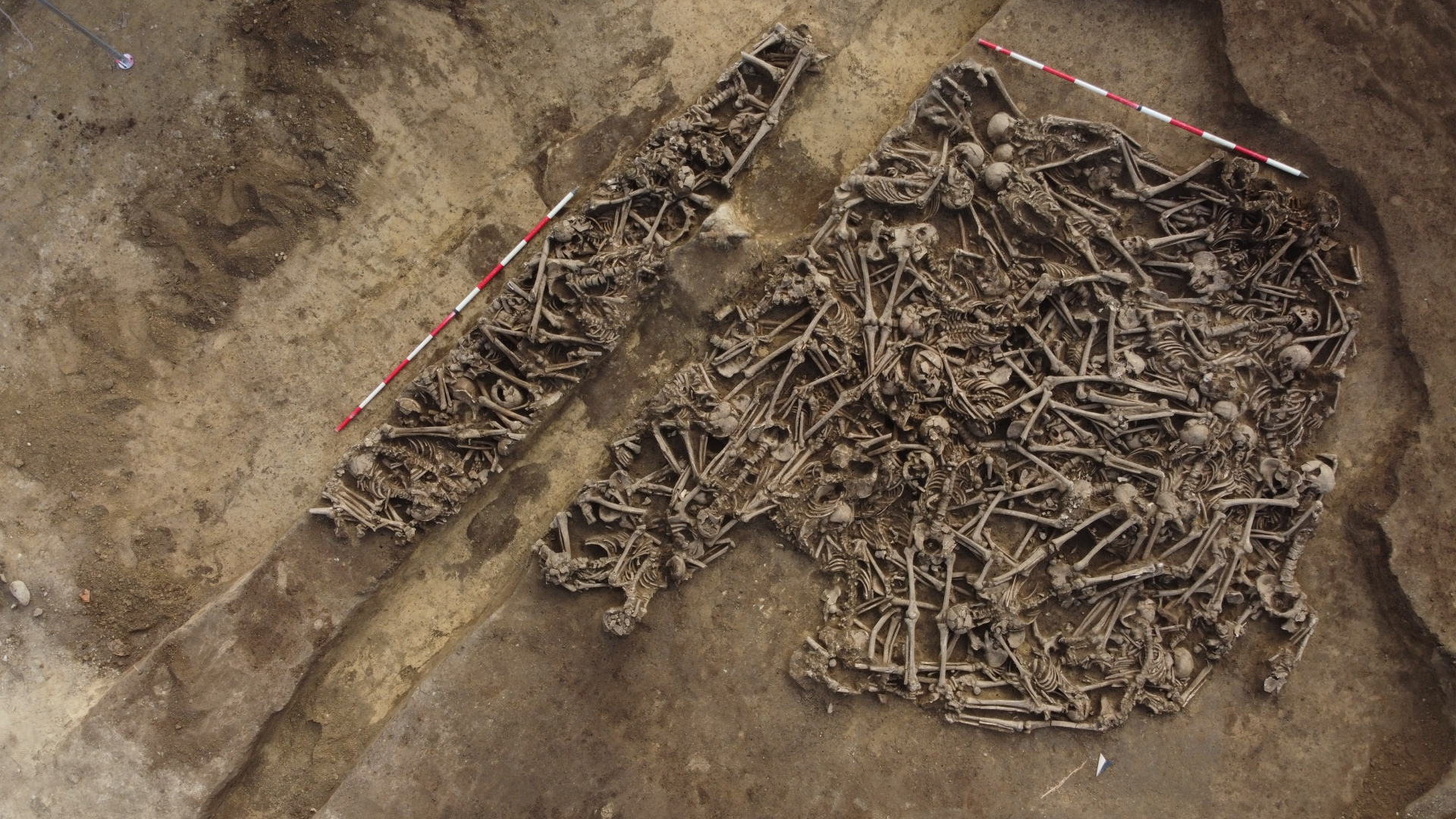
BERLIN — Archaeologists investigating a Roman-era mass grave near Vienna have found evidence that many of the young men buried there suffered severe injuries to the groin before they died. The discovery may provide new clues about a violent conflict near the Roman military settlement of Vindobona, although researchers have not yet identified the combatants.
New analysis confirms that at least 129 people were buried in an “extremely chaotic” mass grave discovered beneath a soccer field in Vienna’s Hasenleitengasse district in 2024. The burial dates to the first or second century A.D., and the evidence suggests that many of those buried may have been Roman war casualties.
“This is a great discovery,” Sheridan Strang, a bioarchaeologist with the archaeological company Novetus, told Live Science. Strang presented the findings on Aug. 6 at the 25th European Paleopathological Society Conference. The research has not yet been peer-reviewed.
from the latest videoslive science
The mass grave was found in the Hasenleitengasse district on the outskirts of modern Vienna. During the Roman period, the area was part of Vindobona, an important Roman military settlement. Archaeologists estimate that the 129 skeletons belonged to men between 18 and 35 years old. Although typical grave goods were absent, researchers recovered several weapons. At least two-thirds of the individuals showed signs of violent trauma sustained before or around the time of death.
Several people buried in the Roman-era mass grave had injuries to the groin and pelvis.
(Image credit: S. Strang, Novetus GmbH)
“We determined that these people were most likely soldiers who died during a mass violent incident, either in combat or during military operations,” Strang said. “However, there is no other evidence of a battle in this area during this period.”
The Vindobona military camp was founded in the late first century A.D. as part of the Roman province of Pannonia. Positioned along the Danube River, the camp helped defend the empire’s northern frontier against Germanic groups, including the Marcomanni. A major conflict occurred near Vindobona during the Marcomannic Wars, around A.D. 166 to 180, but historical and archaeological evidence does not specifically link that battle to the Hasenleitengasse grave.
Analysis of the skeletons revealed sharp-force injuries from swords and daggers across several parts of the body. Blunt-force trauma was concentrated mainly on the skull. The most distinctive finding was projectile trauma focused around the pelvis and groin.
Get the world’s most fascinating discoveries delivered straight to your inbox.
Researchers believe the pelvic injuries may have been caused by throwing spears used against opponents on foot or horseback. Attackers could have aimed at gaps in an enemy’s armor, targeting areas that were difficult to protect.
“We have one specimen that had the spearhead still embedded in its pelvis when it was excavated,” Strang told Live Science. “The injuries show that these sensitive areas were deliberately targeted.”
The Hasenleitengasse mass grave could offer valuable insight into Roman warfare and the use of projectile weapons. Patrick Randolph-Quinney, a biological anthropologist at Uppsala University who was not involved in the research, said the concentration of projectile injuries in the groin and lower limbs may indicate a lack of armor in those areas. It may also suggest that attackers understood how to incapacitate the body by targeting vulnerable soft tissue.
Because there is no written account of the specific conflict and no archaeological evidence beyond the human remains and weapons, researchers are still investigating who the victims and attackers were.
“We don’t know whether they were Romans, Marcomanni or members of another Germanic group from the region,” Strang said.
DNA analysis of 25 skeletons confirmed that all were chromosomally male. The results also showed diverse ancestry. According to Strang, some of the men came from the Italian Peninsula, others from mainland Europe and at least three from the Levant, a region of the eastern Mediterranean and western Asia.
“These people could have been Roman soldiers,” Strang said. “But they may not all have been Roman. The grave could contain a mixture of Romans and Germanic tribes.”
Further research is underway. Scientists hope to study the skeletons for evidence of health, diet, disease and geographic origins, helping to reconstruct the lives of the people buried in this unusual Roman mass grave.
From Augustus to Nero, discover how much you know about ancient Rome’s most famous leaders in this article:Roman emperor quiz!