


Nazi Germany’s Atomic Bomb Reactor Was Far From Ready, New Study Finds
A forensic analysis of uranium cubes and wartime records suggests Werner Heisenberg’s B8 reactor had less than half the heavy water and uranium needed to sustain a nuclear fission chain reaction.
Nazi Germany was nowhere near completing a nuclear reactor for its atomic bomb program, according to a new study that challenges claims made by German physicist Werner Heisenberg after World War II.
Heisenberg, who led development of the project’s B8 reactor, wrote in 1947 that the reactor was nearly complete at the end of the war. However, he also said the reactor was “completely inadequate” for producing a self-sustaining fission reaction because it lacked relatively small amounts of uranium.
The new research suggests the shortfall was far greater than Heisenberg indicated. The B8 reactor had less than half the heavy water and about half the uranium required to sustain a nuclear chain reaction.
Germany’s B8 reactor was missing key materials
If it had worked, the B8 reactor would have demonstrated that a sustained nuclear fission chain reaction was possible. It could also have represented an important step toward developing specialized reactors capable of producing weapons-grade plutonium from uranium.
Instead, the first atomic bombs were developed by the United States and used against Hiroshima and Nagasaki in 1945.
The study, published in PNAS Nexus, combines historical documents with forensic analysis of two uranium cubes left over from Germany’s nuclear program. The researchers used those findings to reconstruct how far the B8 reactor had progressed.
“My results argue that Heisenberg was off by a factor of approximately two,” said study first author Patrick Park, a doctoral student at Princeton University who co-authored the research while attending Columbia University.
Park said Heisenberg’s error was understandable because his calculations were approximate and the German nuclear project was disrupted by Allied bombing. After Berlin was bombed, the project was moved to a stone basement in the German town of Haigerloch.
“My results claim that Heisenberg was off by about a factor of two.”
— Patrick Park, doctoral student at Princeton University
“At the time, many details of neutron physics were unknown,” Park told Live Science via email. “I think he did the best he could given the circumstances.”
How the Nazi nuclear reactor was supposed to work
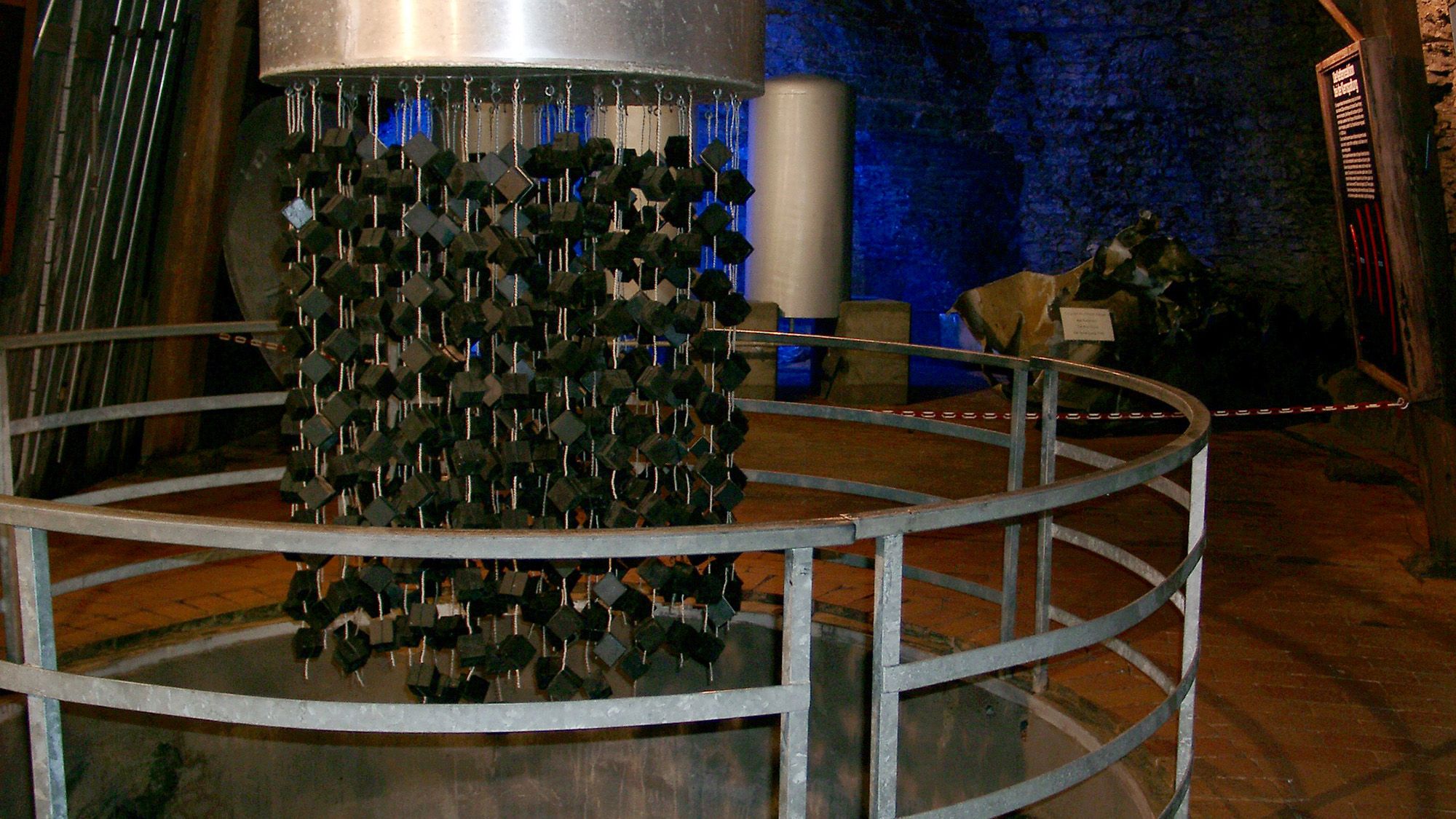
The B8 reactor consisted of five concentric uranium cubes suspended by chains inside a tank of heavy water. German scientists planned to place a radium-beryllium neutron source at the reactor’s core. The neutrons would split uranium nuclei, releasing additional neutrons and potentially creating a self-sustaining chain reaction.
Heavy water contains deuterium, a hydrogen isotope. In a nuclear reactor, heavy water can slow down fast neutrons produced by fission, increasing the likelihood that they will trigger fission in nearby uranium atoms.
Many nuclear reactors use graphite blocks or rods for the same moderating purpose. German scientists used small amounts of graphite in their reactor designs, but primarily as a coating intended to reflect neutrons back into the reactor.
Researchers reconstructed the B8 reactor
To determine how close Germany came to operating a reactor, the researchers traced archival records for hundreds of uranium cubes used by German scientists. They then combined historical records with measurements of two surviving cubes and information about the heavy water and graphite used in the project.
The resulting mathematical model closely matched historical measurements. It showed that the B8 reactor was far from achieving a stable nuclear reaction.
The research also helps explain why German scientists chose a heavy-water reactor rather than a graphite-moderated design. A graphite reactor would not have been viable in wartime Germany because locally sourced coal contained high concentrations of boron. Boron absorbs neutrons, making the resulting graphite unsuitable for sustaining a chain reaction.
Germany did not have enough heavy water
The heavy water used in the B8 reactor came from a single plant in Norway, which Germany occupied from April 1940 until May 1945. Researchers determined that the reactor contained only about 370 gallons, or 1,400 liters, of heavy water.
The reactor would have needed more than 780 gallons, or approximately 3,000 liters, to operate.
Producing heavy water required extraordinary effort. Although the Norwegian plant produced as much as possible, the researchers wrote that the B8 reactor would have required more than twice the total amount produced by the plant during the entire war.
The reactor also lacked enough uranium
The B8 reactor contained 664 uranium cubes. Each cube weighed approximately 5.11 pounds, or 2.32 kilograms, for a total of about 3,390 pounds, or 1,540 kilograms, of uranium.
Other experimental groups held additional cubes, bringing Germany’s total wartime inventory to approximately 1,100 uranium cubes. However, the researchers calculated that the B8 reactor would have required at least 1,200 cubes to sustain a chain reaction.
That meant Germany lacked both the heavy water and the uranium needed to operate the reactor in 1945. The researchers concluded that Germany was unable to build either a functioning heavy-water reactor or a viable graphite reactor during World War II.
“We conclude that Germany was unable to build either heavy water or graphite reactors during World War II,” the researchers wrote.
Why Germany pursued the wrong reactor design
Mark Walker, a historian at Union College in Schenectady, New York, who was not involved in the study, said the findings help explain Germany’s decision to pursue a heavy-water reactor.
Graphite reactors were not feasible because of the boron contamination in locally available graphite. At the same time, German scientists did not yet know how much heavy water would be necessary for their alternative design.
Walker, who wrote Hitler’s Atomic Bomb: History, Legend, and the Twin Legacies of Auschwitz and Hiroshima, agreed that Germany could not have produced a functioning graphite reactor during the war.
“This paper argues that if the Germans had done something they weren’t doing, this would have failed,” Walker told Live Science via email. “It’s counterfactual history, but it’s an interesting engineering analysis.”
Reference: Park, P. J., Robertson, B., Hebert, M. E., Zhao, J., Sibels, C. B., and Koss, T. W. (2026). “Nuclear archeology reevaluates Heisenberg’s last reactor test.” PNAS Nexus, 5(9).
Source: www.livescience.com