


Homo antecessor Skull Thickness Resembled Neanderthals and Modern Humans
New research on three adult skull fragments from Spain’s Gran Dolina cave suggests that Homo antecessor had cranial bone thickness more similar to Neanderthals and modern humans than to earlier, more archaic hominins.
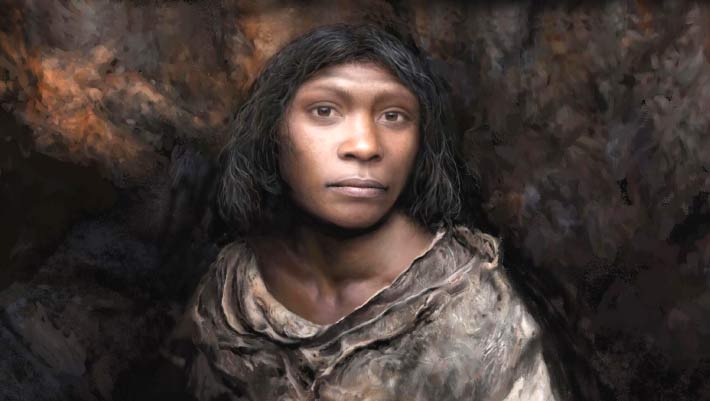
An artist’s rendering of a Homo antecessor individual known as the Girl of Gran Dolina. Image credit: Tom Björklund.
Homo antecessor was an early human species that lived in Europe between approximately 1.2 million and 600,000 years ago.
The species was first identified in 1994 from fossils discovered at the Gran Dolina cave site in the Sierra de Atapuerca, a karstic system located about 15 km east of Burgos in northern Spain.
Homo antecessor was similar in height to modern humans and was fully adapted to walking upright on two legs.
“The phylogenetic position of Homo antecessor has been the subject of extensive debate since its initial description,” said Rafael Gallareto-Sande of the National Research Center on Human Evolution (CENIEH) in Spain and his colleagues.
“Originally proposed as the last common ancestor of Neanderthals and modern humans because of its combination of advanced facial features and primitive postcranial and dental traits, later morphological and proteomic studies refined this interpretation. They instead suggested that the species occupied a stem position within that evolutionary group.”
“Despite its importance, the cranial morphology of Homo antecessor remains poorly understood because the fossil record is fragmentary.”
For the new study, the researchers examined parietal bone fragments from three adult Homo antecessor individuals discovered in the TD6 unit of Gran Dolina cave.
The analysis showed that the total thickness of the cranial vault in all three specimens falls within the range observed in modern humans and Neanderthals. It was also clearly thinner than the skull bone of Homo erectus and other early Pleistocene hominins.
The finding is significant because unusually thick cranial bones have traditionally been regarded as a characteristic of more archaic human relatives.
“This is the first time we have been able to compare the cranial thickness of this species quantitatively, layer by layer, with available data from other members of the genus Homo,” Gallareto-Sande said.
“This provides extremely valuable information that helps us interpret the evolutionary position of the species.”
Before this research, scientists had studied only one Homo antecessor parietal bone in detail. That specimen, described in 2017, belonged to a juvenile.
The three newly analyzed fragments, cataloged as ATD6-115, ATD6-128 and ATD6-401, are the first adult parietal remains examined in this way. They provide a more reliable indication of cranial bone structure at physical maturity.
Using computed microtomography, the researchers measured the three internal layers of each skull fragment: the outer table, the spongy diploë and the inner table. They also examined vascular channels and small pores on the surface of the bone.
The diploë was the thickest layer in every specimen, accounting for 41 to 50% of the total cranial bone thickness. This distribution is consistent with patterns documented in Neanderthals and modern humans.
However, the Homo antecessor fragments differed from both groups in two respects: they had a relatively thinner outer table and a thicker inner table.
According to the researchers, these results support the evolutionary “mosaic” pattern originally proposed when Homo antecessor was named from the Gran Dolina fossils.
The cranial bone data add another combination of primitive and derived traits to the species’ anatomical profile. Nevertheless, the scientists emphasize that the fossil sample remains small and fragmentary, meaning future discoveries could modify the current interpretation.
“The available sample is still limited and fragmentary, so any new fragment could refine these results,” Gallareto-Sande said.
“We hope that future excavation campaigns will continue to yield new cranial remains, allowing us to test these observations and explore their implications in greater depth.”
The findings were published online in the Journal of Human Evolution.
_____
Rafael Gallareto-Sande et al. 2026. Parietal thickness and Homo antecessor: A description of three new fragments from Gran Dolina, Atapuerca, Spain. Journal of Human Evolution 218, 103870; doi: 10.1016/j.jhevol.2026.103870
Source: www.sci.news