


NASA’s Nuclear-Electric Propulsion Could Reach Mars by 2029
Space propulsion powered by nuclear reactors has made little progress despite decades of research. The United States has started and ended several nuclear space programs over the past 75 years. The latest cancellation was DRACO, a nuclear-thermal propulsion project developed by NASA and the Department of Defense. The program ended in 2025 amid concerns about experimental costs, its inability to compete with conventional rockets on price, and the difficulty of conducting safe and effective ground tests.
NASA’s $2 Billion Nuclear Propulsion Bet
After years of hesitation, NASA appears ready to make a roughly $2 billion investment in nuclear interplanetary travel. The agency is pursuing nuclear-electric propulsion, a system that uses the heat generated by uranium fission to produce electricity.
That electricity ionizes a propellant gas, which is then expelled from the spacecraft with the help of a magnetic field to generate thrust. The system produces very low thrust, but it is highly efficient and can operate for long periods, according to Sebastian Corbisiello, national technical director for the U.S. Department of Energy’s space reactor program.
What Would a Nuclear-Electric Spacecraft Look Like?
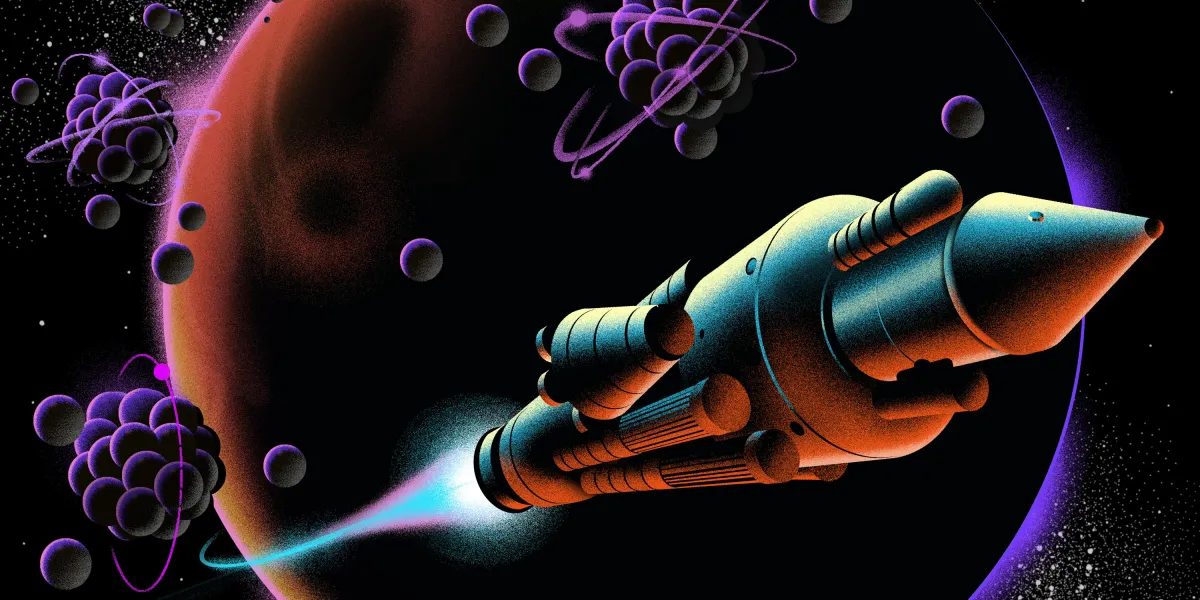
A presentation by Steve Sinacore, program director for NASA’s SR-1 program, offers clues about the spacecraft’s design. Concept art depicts a giant, arrow-shaped vehicle with the power and propulsion systems at the rear and a uranium-fueled nuclear reactor at the front.
The reactor is expected to produce at least 20 kilowatts of power. Large fins, similar to those used on other nuclear power systems, would help radiate excess heat into space.
Why Nuclear Reactors Must Stay Off During Launch
Like other spacecraft hardware, the nuclear reactor must be tested on the ground before being launched. Ensuring that the system can survive the shaking and vibration of a rocket launch while maintaining safety will be a major challenge.
For safety reasons, the reactor would remain switched off until approximately two days after launch, when the spacecraft is far enough from Earth. Uranium itself is not considered highly dangerous in this context, but the radioactive waste produced during reactor operation requires careful handling.
If SR-1 performs as planned, a nuclear-electric spacecraft could make the journey to Mars in approximately one year.
Could SR-1 Launch by 2028 and Reach Mars by 2029?
NASA says Idaho National Laboratory, which is building the SR-1 reactor, is making progress toward a launch in late 2028. Major components are being procured, while integration work on the power and propulsion systems is moving forward, Sinacore said in MIT Technology Review.
That schedule would make a Mars mission in 2029 possible, although the timeline is highly ambitious. NASA’s Artemis program could also influence the project’s future. Artemis aims to begin establishing the foundations of a base near the Moon’s south pole by the end of this decade.
China and Russia Are Also Pursuing Nuclear Space Power
“This is a pretty aggressive schedule,” said Lindsey Holmes, vice president of advanced projects at aerospace company Analytical Mechanics Associates. She suspects that competition with China and Russia may be helping drive the push toward nuclear space technology.
The two countries have discussed plans to install a nuclear reactor on the Moon during the mid-2030s to provide power for a jointly operated lunar base. Their deep-space nuclear ambitions could increase pressure on NASA to demonstrate its own reactor technology.
Whether SR-1 launches successfully or fails in space, its development could help NASA build nuclear reactors for the Moon. Because the lunar surface is a vacuum, like space itself, many of the technologies required for an interplanetary nuclear spacecraft and a lunar reactor are similar.
If nuclear-electric propulsion works for deep-space spacecraft, the same advances could support long-term lunar exploration and future bases beyond Earth.
SR-1 Progress Meter: 6/10
Most of the technology for SR-1 already exists. The challenge is integrating the components and proving that the complete system can operate safely in space.
Source: www.technologyreview.com