


Close Menu
HitechubHitechub
    What's Hot
    Science

    Pigeons Utilize Superparamagnetic Immune Cells in Their Livers to Detect Earth’s Magnetic Field

    Science

    Jellyfish that have no brain, but remember what happened in the past

    Science

    Humans came to America 7,000 years earlier than previously thought !?

    Important Pages:
    • About Us
    • Privacy Policy
    • Terms & Conditions
    Facebook X (Twitter) Instagram Pinterest
    Facebook X (Twitter) Instagram
    HitechubHitechub
    Thursday, June 4
    • Technology
      1. AI
      2. Gadgets
      3. View All

      This is the most popular CEO in the world

      Sectors in which “Chat-GPT” is most often used

      AI Pioneer Expresses Concern About Potential for AI to Surpass Humanity

      Artificial intelligence has begun to “swallow” professions

      What’s new in Android 14

      Europeans have about 700 million old mobile phones in their drawers

      Here’s how you can tell if your phone is being tapped

      “Sneaker X” – computer case in the shape of a sneaker

      Russian Gamers Unite to Prevent Nuclear War: Join the Fight Online

      Challenges of Space Travel: Why Journeying to Space is So Difficult

      NASA Astronaut Casts Historic Vote from Space

      Discover the Future of Comfort: What If You Could Wear a Chair?

    • Science
      1. Space
      2. Wheels
      3. View All

      Galaxies in the universe are growing more slowly than they should

      “Espace” presented the new lander “Apex 1.0”

      The largest asteroid sample ever collected has arrived on Earth

      (VIDEO) Incredible flight of the Parker Solar Probe

      Toyota wants to make a new generation battery with a range of up to 1,200 km

      Meet Toyota’s lunar “baby” that could make exploring the Moon easier

      Microlino – Is this the perfect city car?

      Alfa Romeo 4C gets an electric successor

      How Parenthood Can Impact Your Love Life: Keeping the Spark Alive After Babies

      Discover the Giant Scorpion That Dominated Ancient Britain in the Devonian Period

      Pigeons Utilize Superparamagnetic Immune Cells in Their Livers to Detect Earth’s Magnetic Field

      Webb Telescope Discovers Methane in Interstellar Comet 3I/ATLAS

    HitechubHitechub
    Home » Discover the Giant Scorpion That Dominated Ancient Britain in the Devonian Period
    Science

    Discover the Giant Scorpion That Dominated Ancient Britain in the Devonian Period

    Share Facebook Twitter Pinterest WhatsApp
    Share
    Facebook Twitter LinkedIn Pinterest WhatsApp

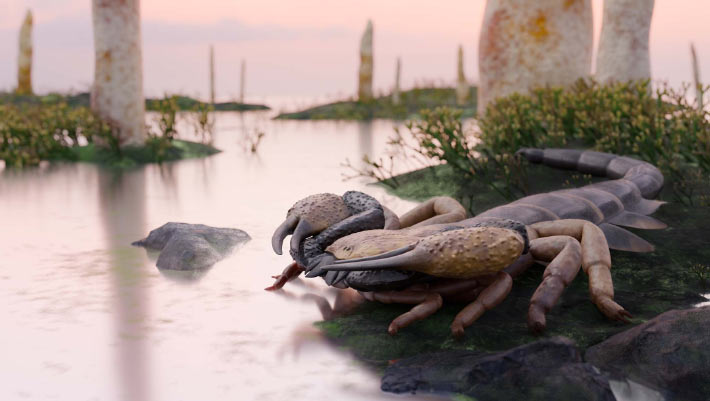
    Paleontologists have confirmed that Praearcturus gigas is the largest scorpion ever discovered, which roamed the shallow seas during the Devonian period, approximately 415 million years ago.

    Praearcturus gigas. Image credit: Franz Anthony.

    This ancient creature measured approximately 1 meter (3.3 ft) in length and was armed with formidable pincers over 16 centimeters (6.3 inches) long. The Praearcturus gigas was likely a formidable predator that inhabited floodplains during its time.

    Initially classified as an isopod in 1871, its classification evolved over the years as paleontologists compared it to various arthropod groups and re-evaluated its status, including a limited edition illustration of this giant scorpion from the 1980s.

    “When people think of giant arthropods, they often envision the Carboniferous rainforests of late Earth’s history, teeming with huge insects like millipedes and dragonflies,” explains Dr. Richard Howard, lead author and curator of fossil arthropods at the Natural History Museum in London.

    “However, Praearcturus gigas thrived at least 50 million years earlier, long before trees evolved, during a time when life on land was just beginning.”

    “Confirming that this animal is a scorpion fundamentally alters our understanding of when and how these exceptional creatures evolved to such extraordinary sizes.”

    In a recent study, Dr. Howard and his team utilized modern analytical techniques and extensive comparisons with fossil records to conclude that Praearcturus gigas is indeed a scorpion.

    “Praearcturus gigas has intrigued paleontologists for over a century,” remarked co-author Dr. Russell Garwood from the University of Manchester.

    “By collaborating on materials from various collections and employing advanced imaging technology, we’ve painted a clearer picture of this ancient creature, which is truly exciting.”

    “What’s fascinating about Praearcturus gigas is its significant size during a time when terrestrial life was relatively small; however, it inhabited a world capable of sustaining giant predators.”

    “To further unravel this ancient ecosystem, we compared the size of scorpion fossils with other contemporary animals.”

    “The unusual size of Praearcturus gigas leads us to believe it likely inhabited aquatic environments where life had room to grow.”

    Praearcturus gigas existed during the early Devonian period, a time when simple plants and fungi were just beginning to proliferate across the landscape, and complex terrestrial ecosystems like forests had yet to form.

    This indicates that unlike later megafauna, this ancient scorpion did not benefit from the high atmospheric oxygen levels associated with expanded forest ecosystems.

    Instead, its large size may reflect an environment with limited competition from other large predators.

    This suggests that Praearcturus gigas could have grown to such a size due to the scarcity of large animals, enabling it to dominate its environment uniquely.

    Fossil evidence implies this giant scorpion may have led a semi-aquatic lifestyle.

    “During that era, the distinctions between land and sea were much less defined,” noted co-author Dr. Greg Edgecombe, a paleontologist at the Natural History Museum in London.

    “Praearcturus gigas provides us with a compelling glimpse into the adaptive strategies of early animals in response to changing environments.”

    “It may even represent an evolutionary lineage that returned to aquatic habitats after its early ancestors had commenced life on land.”

    The team’s study is published in this week’s edition of Paleontology.

    _____

    Richard J. Howard et al. 2026. Revised description of Praearcturus gigas: A giant scorpion from the Lower Devonian (Rochkovian) of Britain. Paleontology 69 (3): e70064; doi: 10.1111/pala.70064

    Source: www.sci.news

    Share. Facebook Twitter Pinterest LinkedIn WhatsApp
    Previous ArticlePigeons Utilize Superparamagnetic Immune Cells in Their Livers to Detect Earth’s Magnetic Field
    Next Article How Parenthood Can Impact Your Love Life: Keeping the Spark Alive After Babies

    Related Posts

    Science

    How Parenthood Can Impact Your Love Life: Keeping the Spark Alive After Babies

    Science

    Pigeons Utilize Superparamagnetic Immune Cells in Their Livers to Detect Earth’s Magnetic Field

    Science

    Webb Telescope Discovers Methane in Interstellar Comet 3I/ATLAS

    Science

    Silent Spring: How Rachel Carson’s 1962 Science Book Transformed the World

    Science

    New Axolotl Fossil Discovered in Mexico: A Significant Paleontological Find

    Science

    When Food is Scarce: This Single-Celled Organism Becomes a Giant Man-Eater for Survival

    Science

    Unlocking Multitasking: How Science Reveals Your Brain’s Potential with Practice

    Science

    Revealing the Truth: Stonehenge’s Altar Stones Likely Not Transported by Glaciers

    Add A Comment
    Leave A Reply Cancel Reply

    Stay In Touch
    • Facebook
    • Twitter
    • Instagram
    • Pinterest
    Top Picks
    Science

    Fishing Restrictions Lifted in Western Reservoirs Facing Drought-Related Drying

    Recently, Colorado concluded its unrestricted fishing period at Antero Reservoir, where approximately 5 million sport…

    Astronomers Discover Clearest Evidence of an Exoplanet’s Magnetic Field Yet

    10 Greatest Scientific Discoveries of the 21st Century

    The Best Phones to Buy in 2023: Our Top 10 Picks

    The world’s first artificial energy island has received a construction permit

    Most Popular
    AI

    Can ChatGPT diagnose patients just like doctors?

    Technology

    How fast commercial airplanes really are?

    Categories
    • AI (13)
    • Gadgets (10)
    • Science (48)
    • Space (9)
    • Technology (37)
    • Wheels (9)
    Our Picks
    Science

    Exploring Earth’s Mysterious Triple Symmetry and Its Impact on Climate Change

    Technology

    The story of traffic lights

    © 2026 Hitechub.
    • Home
    • About Us
    • Privacy Policy
    • Terms & Conditions

    Type above and press Enter to search. Press Esc to cancel.

    We are using cookies to give you the best experience on our website.

    You can find out more about which cookies we are using or switch them off in .

    Ad Blocker Enabled!
    Ad Blocker Enabled!
    Our website is made possible by displaying online advertisements to our visitors. Please support us by disabling your Ad Blocker.
    Go to mobile version
    Hitechub
    Powered by  GDPR Cookie Compliance
    Privacy Overview

    This website uses cookies so that we can provide you with the best user experience possible. Cookie information is stored in your browser and performs functions such as recognising you when you return to our website and helping our team to understand which sections of the website you find most interesting and useful.

    Strictly Necessary Cookies

    Strictly Necessary Cookie should be enabled at all times so that we can save your preferences for cookie settings.