


NVIDIA says its Vera Rubin platform delivered leading results across the latest MLPerf Training and MLPerf Endpoints benchmarks, including more than 10 times the agent-AI throughput per watt of the previous-generation GB300 NVL72 in its first MLPerf Endpoints submission. The company also reported up to twice the performance per GPU of the GB300 NVL72 in MLPerf Training v6.1, along with near-linear scaling on large GPU clusters.
The latest MLPerf results were announced today. According to NVIDIA, the Vera Rubin platform demonstrated performance across AI training, post-training and agent inference, with further gains expected as the company continues to optimize its CUDA-based software stack.
NVIDIA reports full MLPerf Training v6.1 coverage
AI agents are increasingly being used to write code, run business workflows, answer customer questions and support scientific research. Faster training can help new agents reach users sooner, allow drug-discovery models to respond more quickly to new test data, and help fraud-detection systems adapt to emerging threats.
MLPerf Training measures how quickly a system can train different AI models to a specified accuracy level. NVIDIA says its platform was the only one to submit results across every benchmark in this round, covering large language models, image generation, recommender systems and post-training reinforcement learning.
At its debut, the NVIDIA Vera Rubin NVL72 delivered up to twice the performance per GPU of the highly optimized NVIDIA GB300 NVL72 system. NVIDIA described these results as an early indication of the pace of generational improvement.
Scaling to thousands of GPUs
NVIDIA also reported strong performance at scale. In the DeepSeek-V3 benchmark, a Vera Rubin NVL72 system scaled from 256 GPUs to 1,024 GPUs with approximately 97% efficiency. Increasing the GPU count fourfold reduced training time from 16 minutes to approximately four minutes.
NVIDIA also submitted results from a GB300 system with 10,240 GPUs, the largest system size in this round. Microsoft Azure matched that scale with 10,240 NVIDIA GPUs in a GB200 system.
Large-scale results depend on more than simply adding GPUs. The GPUs must communicate efficiently for additional hardware to reduce training time. NVIDIA’s NVLink scale-up network connects GPUs within each system so they can operate as a unified platform. Across the data center, NVIDIA Quantum-X800 InfiniBand and Spectrum-X Ethernet scale-out networks connect the systems.
NVIDIA says that, combined with optimized software, these networking technologies allow thousands of GPUs to work together while reducing the time required to train increasingly capable models.
Vera Rubin targets agent inference efficiency
AI agents may need to reason, call tools and check their work multiple times to complete a task. A travel agent might plan and book an entire trip, while an IT agent could identify and fix a problem before a user submits a support ticket.
Each step generates tokens. Because AI data centers operate within power constraints, throughput measured in tokens per second per watt determines how many agents a system can serve and how efficiently it can respond.
MLPerf Endpoints tests systems using agent coding tasks and enterprise workflows, while checking that agents continue to complete tasks correctly. NVIDIA says Vera Rubin led all of the agent benchmarks in this submission.
Preliminary results using Kimi K3, a large-scale open model designed for agent workflows, show the Vera Rubin NVL72 delivering more than 10 times the throughput per watt of the NVIDIA GB300 NVL72 at the same response speed.
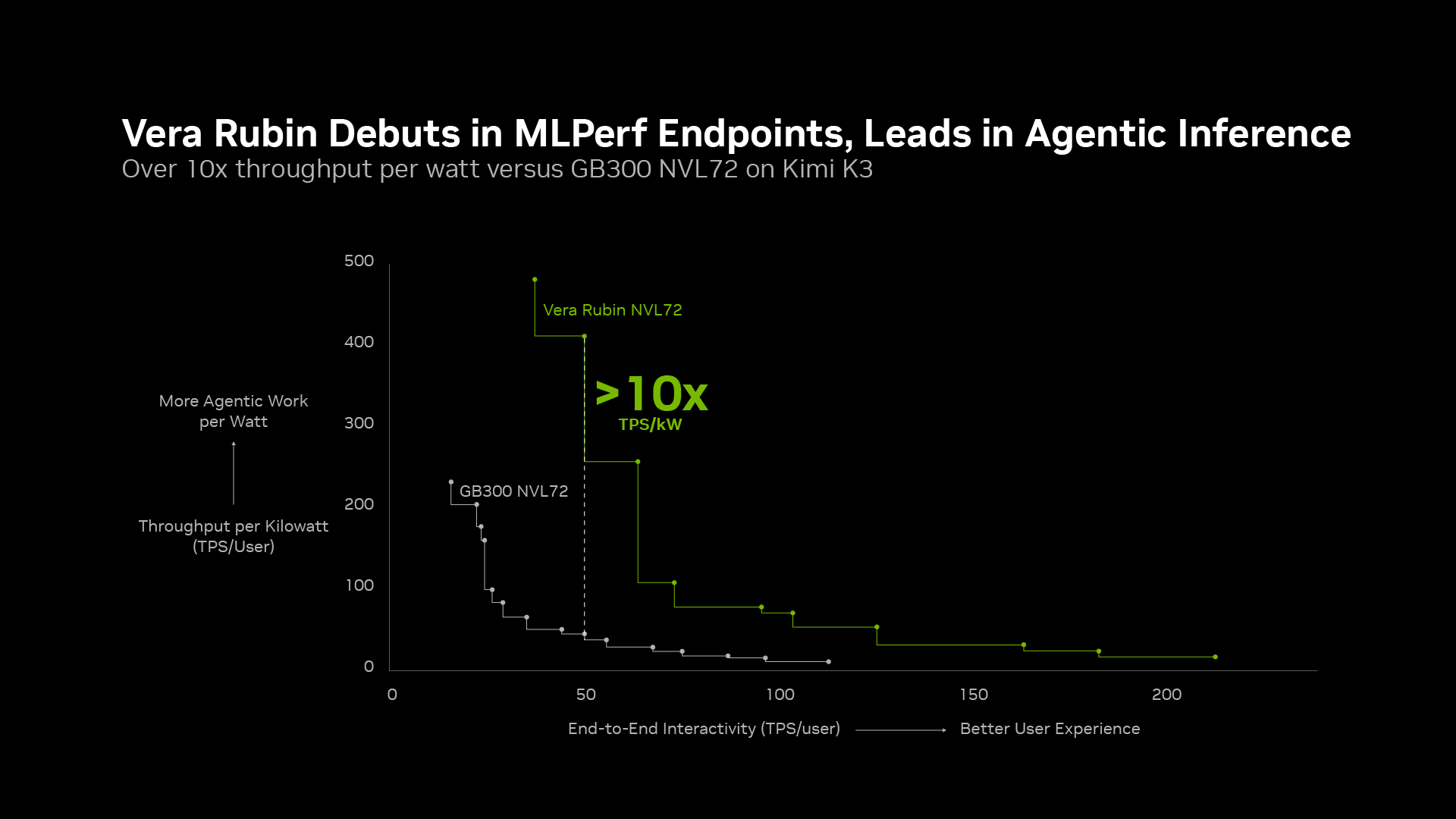
AI services must balance serving many users simultaneously with maintaining fast response times. NVIDIA says Vera Rubin improves both sides of that trade-off by serving more users while responding more quickly.
Results span partners and workloads
NVIDIA partners participated extensively in MLPerf Training, with submissions from 20 organizations, including ASUS, Azure, Cisco, CoreWeave, Crusoe, Dell Technologies, Firmus, Giga Computing, Google Cloud, HPE, Inventec, Krai, Lambda, Nebius, Oracle, Quanta Cloud Technology (QCT), Supermicro, TTA and the University of Florida.
NVIDIA says these submissions demonstrate how its programmable platform, together with open-source libraries and frameworks, enables partners to optimize AI training performance across a broad ecosystem.
The company also pointed to results beyond MLPerf. Vera Rubin delivered strong performance on independent benchmarks including SemiAnalysis AgentX and Artificial Analysis AgentPerf. NVIDIA says the same infrastructure can support pre-training, post-training and agent inference, as well as workloads outside AI, including high-performance computing highlighted at the SC26 conference.
Further details are available in NVIDIA’s technical coverage of MLPerf Training and MLPerf Endpoints.
Source: blogs.nvidia.com