


Francis Halzen Wins the 2026 Nobel Prize in Physics for IceCube Neutrino Discoveries
The Belgian physicist was honored for founding the IceCube Neutrino Observatory and revealing elusive, high-energy particles arriving from the depths of the universe.
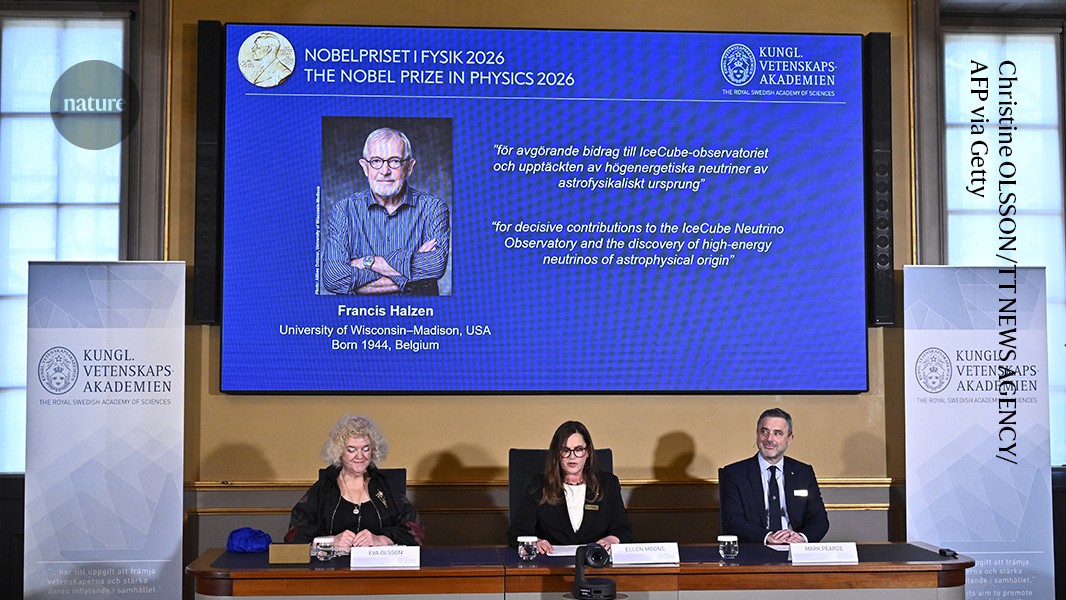
Neutrino physics pioneer Francis Halzen has been announced as the winner of the 2026 Nobel Prize in Physics.
Credit: Christine OLSSON/TT NEWS AGENCY/AFP via Getty
Belgian physicist Francis Halzen has been awarded the 2026 Nobel Prize in Physics for founding the IceCube Neutrino Observatory and discovering elusive, high-energy particles known as neutrinos that come from deep in the universe.
Halzen, who is based at the University of Wisconsin–Madison, will receive the full prize money of 12 million Swedish kronor—approximately US$1.2 million. The award was announced on October 6 by the Royal Swedish Academy of Sciences in Stockholm.
“It was a huge surprise and I obviously didn’t expect it,” Halzen said at the Nobel press conference after the announcement. “This is a reflection of the really brave people who came on board with this project when no respectable conservative physicist would have joined me. But a lot of talented people did, and that’s why I’m here.”
Neutrinos are the second-most common particles in the universe after photons. More than a billion neutrinos pass through a person’s hand every second, but high-energy neutrinos are extremely rare and difficult to detect.
Located in Antarctica, IceCube was designed to study particles ejected by some of the universe’s most energetic environments, including supernovae and gamma-ray bursts. Because neutrinos pass straight through matter, they travel back toward Earth in a direct line from these phenomena, giving researchers a unique way to investigate distant astrophysical sources.

The IceCube Neutrino Observatory in Antarctica is the brainchild of Nobel Prize winner Francis Halzen.
Credit: Ilya Bodo, IceCube/NSF
How IceCube detects high-energy neutrinos
Although neutrinos are everywhere, they are extremely difficult to detect because they are unaffected by magnetic fields and rarely interact with matter. In the 1980s, Halzen proposed using detector strings lowered more than 1.5 kilometers into transparent Antarctic ice. The ice is largely free from the interference found at Earth’s surface, allowing the observatory to detect rare, faint flashes of light produced when fast-moving neutrinos collide with atoms.
Halzen theorized that, if the detector were large enough, it could capture neutrinos and use their paths to determine where they came from. Researchers could then trace the particles back to their cosmic sources.
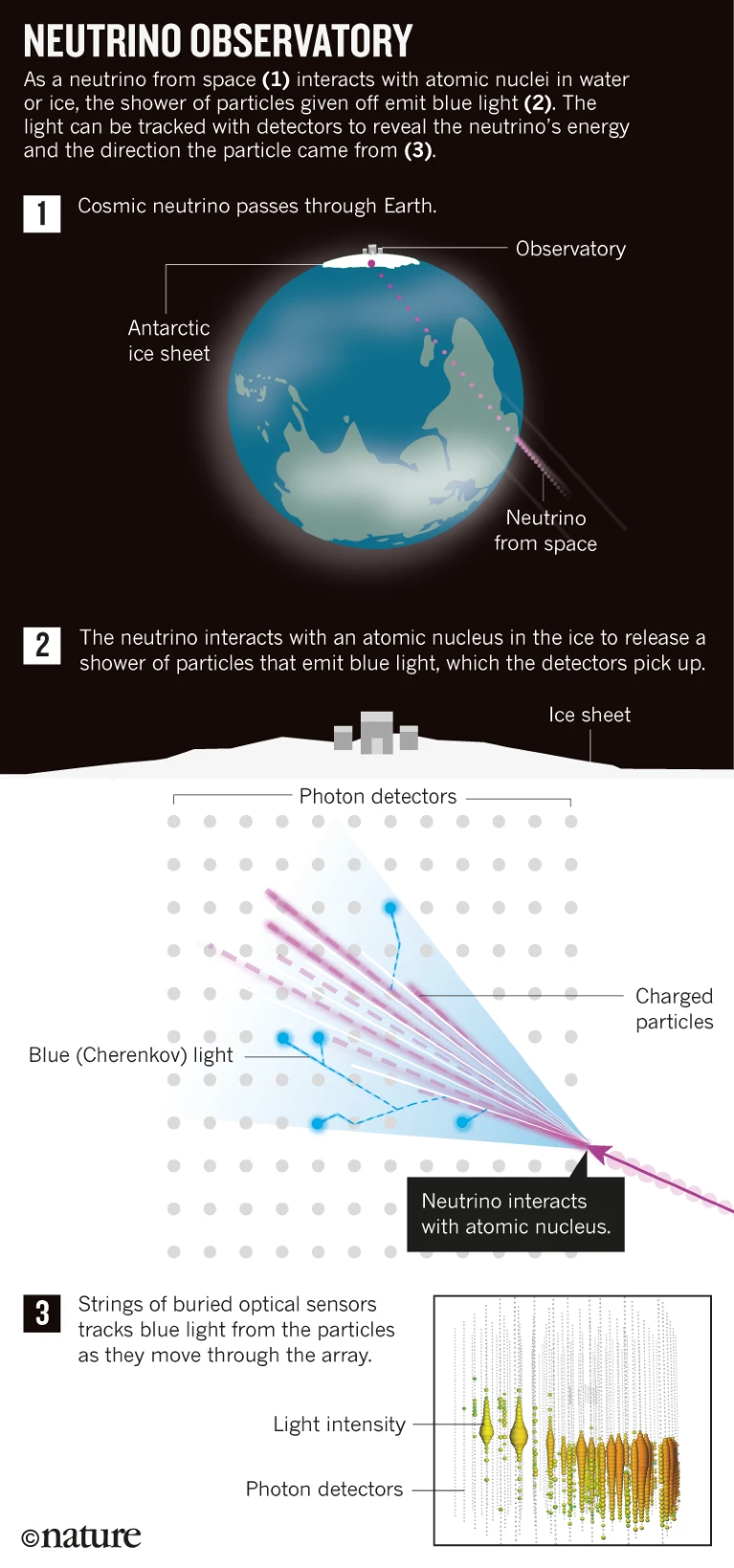
The 5,160-sensor IceCube Neutrino Observatory was completed in 2011. More than 450 researchers now work on the project.
“After 15 years of development and another 10 years of construction, there was no guarantee that we would see anything,” Halzen, IceCube’s principal investigator, told APS News in 2025. “A lot of people thought we wouldn’t see anything, but we did.”
IceCube opens a new era of neutrino astronomy
Within two years, the detectors were observing extremely energetic neutrinos from beyond the Milky Way. In 2013, the IceCube collaboration published results showing the existence of neutrinos with energies too high to have been produced anywhere in the Solar System. The findings established a new field of neutrino astronomy.1
“The biggest risk we took was that no one knew if the Kilometer Cube detector was big enough to actually detect exoatmospheric neutrinos from space,” Halzen said at the Nobel press conference. “But it only took us two years to detect it.”
“We found evidence that neutrinos are coming from supermassive black holes in other galaxies. And neutrinos shine so brightly that you can’t see the Milky Way when you look at the neutrino sky.”
In 2014, IceCube detected three neutrinos with energies on the order of petaelectronvolts—thousands of times higher than the energy produced by Earth’s most advanced particle collider. The events were nicknamed Bert, Ernie and Big Bird.
Three years later, the collaboration detected high-energy neutrinos and, for the first time, traced them to a specific source: a distant galaxy called TXS 0506+056, often referred to as the “Texas Event.”

The IceCube detector is sunk deep into Antarctic ice, where it can capture high-energy neutrinos with less interference.
Credit: Yuya Makino, IceCube/NSF
Tracing cosmic neutrinos to a distant galaxy
Subsequent observations suggested that the source was a blazar—a violent galaxy with a supermassive black hole at its center that can flare dramatically in brightness. A 2018 study examined the blazar using a range of telescopes and described its source across seven papers.
Source: www.nature.com