


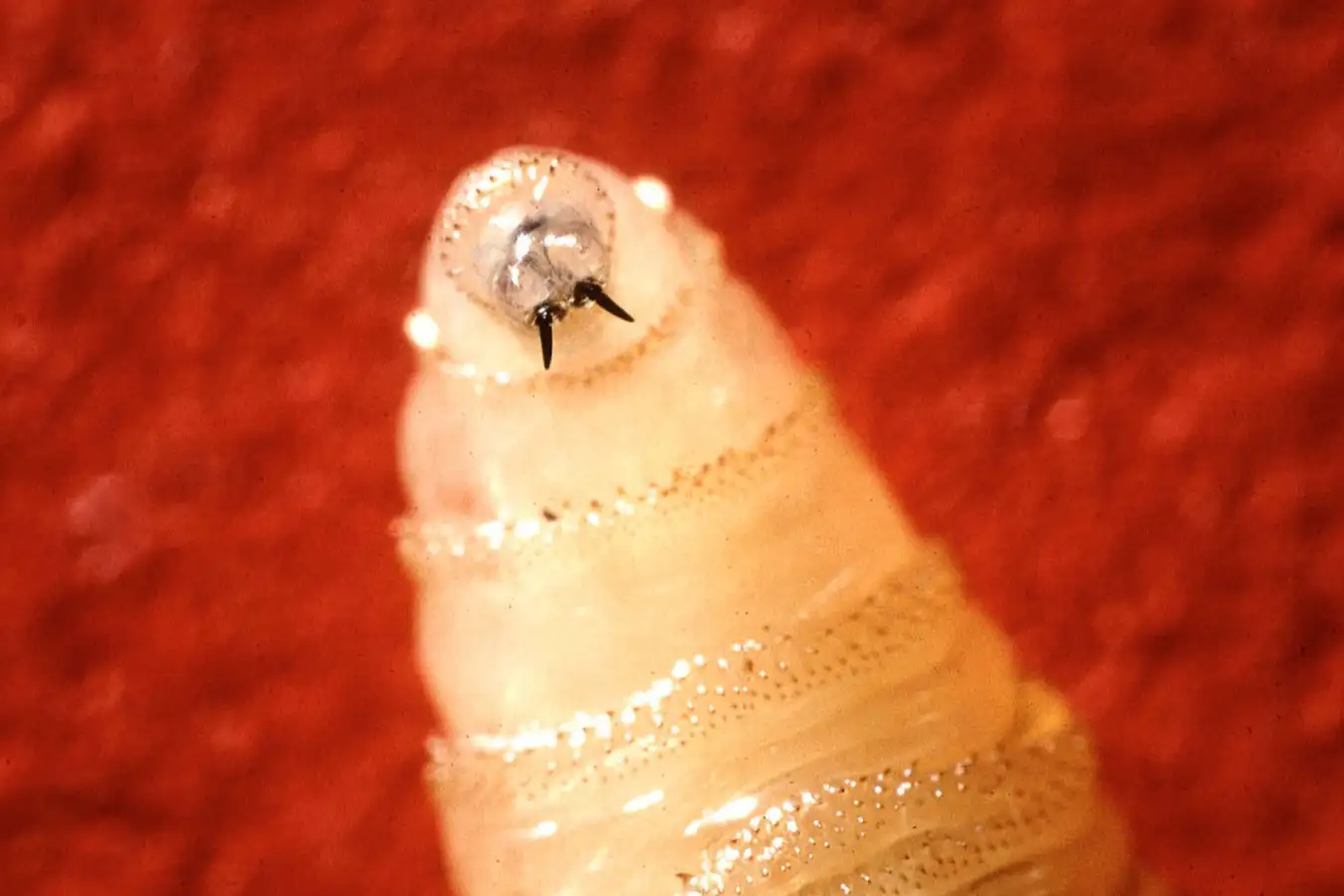
The fang-like lower jaw of a screwworm larva.
Scott Camazine/Alamy
In certain instances, the extinction of a species can be beneficial. While this notion is contentious, consider the positive impact of eradication of malaria-carrying mosquitoes.
Thanks to advancements in genetic technology, we can potentially achieve this via extinction drives, also known as gene drives. These mechanisms can override evolutionary processes and disseminate detrimental traits throughout a population. However, the implementation of this technology against malaria-carrying mosquitoes is not imminent. Instead, Kevin Esvelt, a biologist at MIT, emphasizes the screwworm (Cochliomyia hominivorax) as a candidate for initial intervention.
“I bet on the New World screwworm fly, a pest infamous in Texas,” Esvelt states. “Believe it or not, it’s even more despised than the malaria mosquito.”
Screwworm flies lay their eggs in the open wounds of mammals and birds. When the larvae hatch, they burrow into the flesh, causing severe pain and suffering. If not managed, these screwworm larvae can inflict significant harm, proving disastrous for livestock farmers and impacting meat quality.
Historically, screwworms plagued much of the Americas but were eradicated from North and Central America in the 1960s, remaining a persistent issue in parts of South America.
The successful eradication in North America relied on the sterile insect technique. This approach takes advantage of female screwworms’ one-time mating habits; if they mate with sterilized males, no offspring result. By irradiating screwworms and releasing them in higher quantities than wild populations, local eradication can be achieved.
While effective, this sterile insect strategy is costly and has yet to be attempted in South America. Thus, even if the U.S. and Mexico eliminate screwworms again, it wouldn’t assist the South American populations. Gene drives could change that.
Understanding Gene Drives
Gene drives encompass any method that skews the rate of trait inheritance. Typically, a parent’s DNA is passed to half of its offspring. If harmful, this DNA could diminish survival rates in those offspring, ultimately phasing out unfavorable traits in the population.
A gene drive consists of DNA that guarantees inheritance to more than 50% of offspring. For instance, some functions by diminishing the motility of sperm lacking the gene drive. The CRISPR gene drive developed by Esvelt operates by copying segments from one chromosome to another.
This mechanism ensures wild-type organisms with mate drives produce offspring that inherit them, allowing undesirable traits to persist and proliferate within a population, defying natural selection. This technique can even affect reproductive capability by targeting essential reproductive genes.
A significant advantage of gene drive technology is its self-propagation; there’s no need to release vast quantities of insects at great expense. It’s applicable to species that engage in multiple mating events and presents a more eco-friendly alternative to widespread pesticide use, which is detrimental to numerous non-target species.
The Controversy Surrounding Gene Drives
While I advocate for gene drives to combat malaria-carrying mosquitoes, the reality is more complex. Genetic modification faces substantial opposition, particularly in Africa, where perceptions of genetic engineering often skew negative. For example, a promising gene drive initiative in Burkina Faso was prematurely halted following governmental intervention.
As an analogy, supporting or opposing genetic modification parallels the stance one might take on hammers; both are tools that can yield various outcomes depending on their application. Genetic modifications permeate our food systems, whether intentional or not, making it essential to examine the purpose behind their use.
Gene drives are similarly multifaceted. The potential risks require careful evaluation; despite perceptions of uncontrollability, they already exist naturally within various species, including ours. Adverse gene drives are unlikely to flourish due to evolving resistance among populations.
“Resistance is inevitable,” Esvelt said. “However, multiple iterations of the gene drive can overcome this challenge,” he added.
To effectively eradicate various insect populations, the release of gene drive-bearing individuals across numerous regions may be necessary. While implementation in Africa is fraught with challenges, Esvelt remains optimistic about potential success in the Americas, where acceptance of genetically modified organisms is more widespread.
Initiatives are already underway aimed at developing gene drives targeting screwworms, with efforts from institutions like the National Institute of Agricultural Technology (INIA) in Uruguay and programs led by the DARPA Guardian Program. While progress updates are sparse, existing advancements in mosquito gene drives suggest a promising future for screwworm interventions.
Recently, Colossal Biosciences proposed creating a gene drive for screwworms. However, they may face hurdles, as Esvelt noted that the company lacks experience in gene drive technology.
Concerns regarding unintended ecological consequences often surface when discussing gene drives. However, considering humanity’s extensive environmental alterations, including mass extinctions, the potential for saving millions of lives by eliminating certain pests warrants serious consideration.
In the case of screwworms, their eradication has previously shown a lack of detrimental ecological impacts in North America. Moreover, preserving samples of screwworms through viable cryopreservation techniques could facilitate their reintroduction if unforeseen complications arise post-eradication.
Stay informed; in coming years, the debut of innovative gene drives could lead to breakthroughs in pest control across the Americas, with potential applications ranging from screwworms to vectors of diseases such as malaria and dengue fever.
Topics:
Source: www.newscientist.com