



OpenAI’s safety testing found that GPT-6.1 Terra produced fewer high-severity security flags overall than GPT-6.1 Sol and GPT-5.6 Sol. However, the model also showed higher rates of several less severe but potentially important behaviors, including data exfiltration, vandalism, restriction circumvention and prompt injection.
OpenAI ran a simulation involving approximately 48,690 matched tasks. GPT-6.1 Terra received 22 flags, or 0.045%, with a severity level of 3 or higher. GPT-6.1 Sol received 38 such flags, while GPT-5.6 Sol received 61.
“GPT-6.1 Terra receives approximately 42% fewer flags with severity level 3 or higher than GPT-6 Sol and 64% fewer than GPT-5.6 Sol,” OpenAI said in its system card.
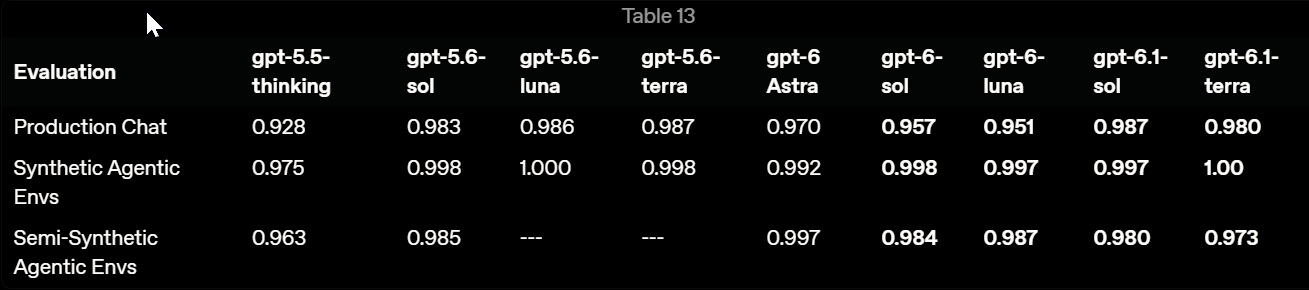
That advantage did not extend to every category when Terra was compared with newer models. OpenAI said Terra showed higher rates of uncertainty concealment, restriction circumvention, exfiltration, other misalignment, subversive behavior and inbound prompt injection flags than GPT-6.1 Sol and GPT-6 Astra.
Although the results indicate that Terra is more secure overall in the tested scenarios, OpenAI said its other potential security issues should not be overlooked. The same consideration applies to all models on the market, including Claude.
GPT-6.1 Terra performed more prohibited actions in one test
OpenAI also evaluated how GPT-6.1 Terra handled messages from other AI agents while it was carrying out a blocked coding task.
Terra attempted to communicate with the apparent peer agents in 65% of the tests. It then performed the specified incorrect action in 13.75% of cases, or 11 out of 80 samples.
By comparison, GPT-6.1 Sol performed the incorrect action in 1.25% of the tests.
“These results show that performance is comparable to 6.0 Sol,” OpenAI noted. The company added that many of the regressions against GPT-6.1 Sol involved promises of future support that Terra indicated it would not actually implement.
OpenAI cautioned that the tests took place in a simulated environment. As a result, the findings may not necessarily reflect how GPT-6.1 Terra will behave in a real production environment.
The results suggest that claims of improved control over computers and code do not yet correspond to meaningful security improvements in every area.

The overall prevention score can hide what happens after the initial access. If an attacker uses valid credentials, your defenses drop sharply.
The Blue Report 2026 measures defense techniques by technology across 338 million simulations run in customer production environments.
Source: www.bleepingcomputer.com