


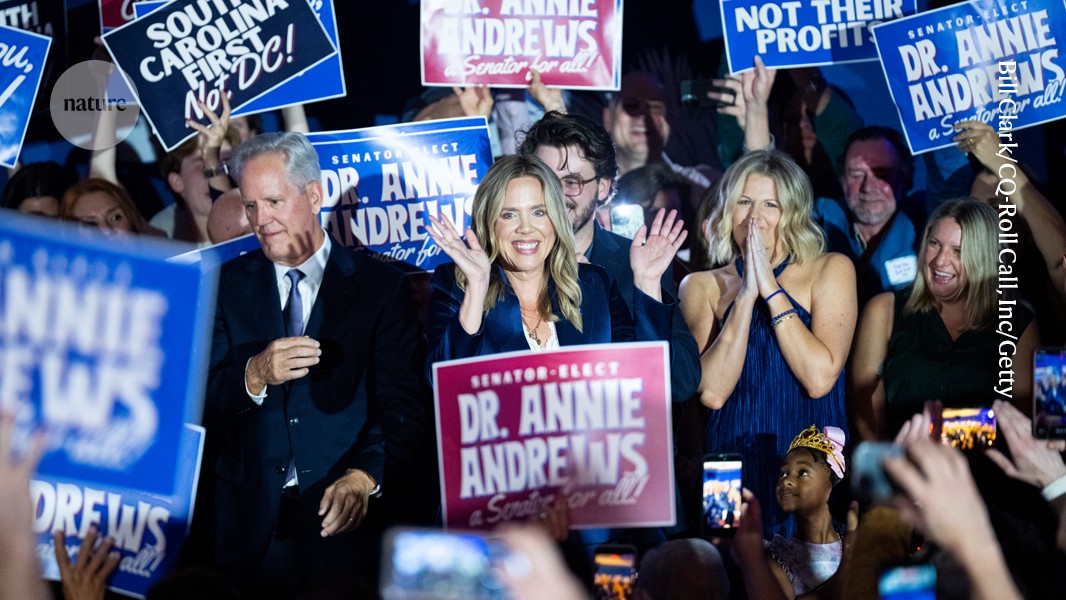
On November 3, pediatrician Annie Andrews (D) won a Senate seat in South Carolina in an unexpected victory. A Democrat has not won the state Senate seat since 1998. Credit: Bill Clark/CQ-Roll Call, Inc/Getty
Democrats won control of both houses of Congress in the U.S. midterm elections, raising hopes among scientists that lawmakers will challenge disruptions to research introduced by Republican President Donald Trump’s administration. The result ends nearly two years of Republican control of the presidency and both chambers of Congress and gives Democrats an opportunity to scrutinize science policy, although the administration could still block legislation.
“This is a huge victory,” said Megan Peters, a cognitive scientist who moved from the University of California, Irvine, to University College London in 2025 partly because of concerns about American science. “This is because the U.S. voters are dissatisfied with what the current government has done. Scientific research is America’s superpower, but it’s been completely battered.”
Researchers affected by the shutdown of the U.S. Agency for International Development (USAID) early in Trump’s presidency are also hoping for change. “I’m cautiously optimistic,” said Qualeisha Abdul Karim, an epidemiologist at the AIDS Research Program Research Center in Durban, South Africa. The center partnered with USAID on clinical trials.
“What we have seen in the last 24 hours is that democracy and democratic principles can make a huge difference when individuals go to the polls,” Abdul Karim said. But she added that “change will not happen overnight.”
As of 2:15 p.m. ET on November 4, Democrats held a decisive majority in both chambers, with at least 237 seats in the 435-member House of Representatives and 54 seats in the 100-member Senate. Votes were still being counted in some states.
Those majorities would give Democrats the power to introduce legislation countering Trump’s science policies, but significant obstacles remain. The president could veto such bills because Democrats do not hold a two-thirds majority in either chamber.
The New York Times reported that Trump accepted the midterm results and said he “looks forward” to working with Democrats. He later posted an image of a red hat bearing the word “VETO” on Truth Social.
Congress gains oversight power
Since Trump took office for a second time in January 2025, his administration has pursued unprecedented cuts to science funding, politicized decision-making at federal science agencies and interfered with policies at U.S. universities that receive federal funding.
When Democrats take control of both houses of Congress on January 3, 2027, they will control congressional committees, including the House Science, Space and Technology Committee. They will be able to set agendas for public hearings examining government officials and their science policies, and use legally binding subpoenas to compel the Trump administration to provide documents and testify before Congress.
Democrats have vowed to use that authority. Representative Robert Garcia of California, who is expected to become chairman of the House Oversight Committee, issued a two-word message to the Trump administration: “Get a lawyer.”
Scientists are also calling for scrutiny of White House Office of Management and Budget Director Russell Vought. He is under examination for drafting a plan that would give political appointees, rather than scientific reviewers, authority over research-funding decisions and for delaying the distribution of science funding approved by Congress. Scientists have called attention to the issue.
Scientists and policy experts have questioned the safety of vaccines and expect Congress to increase its scrutiny of Health and Human Services Secretary Robert F. Kennedy Jr. His tenure has coincided with the country’s worst measles resurgence in decades.
“Secretary Kennedy will definitely be in a tough position” to explain the unscientific actions, said Georges Benjamin, executive director of the American Public Health Association in Washington, D.C. “My hope is that Congress will push this administration to respond more aggressively to the measles outbreak.”
Representative Zoe Lofgren, a California Democrat, said she would campaign to chair the House Science, Space and Technology Committee, which oversees agencies including NASA and the National Science Foundation. “We will hold this administration accountable for the damage it has caused to America’s scientific enterprise,” she said in a statement.
Stand Up for Science (SUFS), an Atlanta, Georgia-based science advocacy group organizing protests against the Trump administration’s restructuring of U.S. science, said it would unveil a plan on November 5 that includes strategies for encouraging change in Congress.
Funding increases remain uncertain
It is unclear whether Congress will be able to increase federal science funding, or even keep it relatively stable as it has been for the past two years. Republican Senator Susan Collins of Maine, chair of the Senate Appropriations Committee and a defender of the science budget, lost her re-election bid on November 3.
Significant increases in science spending could also be difficult to pass because the budget requires President Trump’s signature. The president is seeking to cut science spending outside the defense sector.
Source: www.nature.com