


Human Brain Organoids Implanted in Mice Raise New Ethical Questions
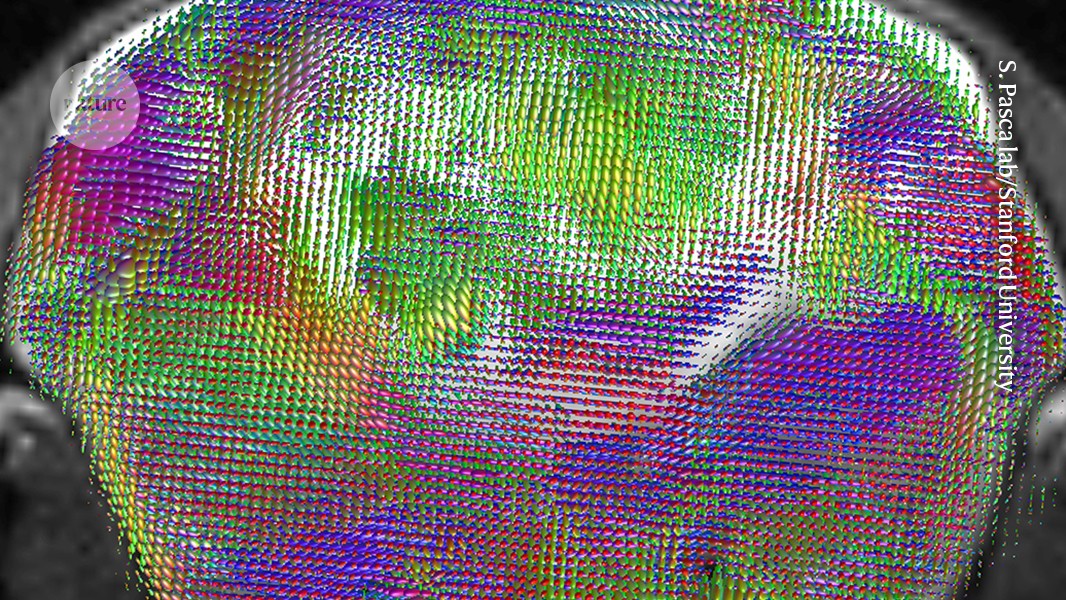
A cross-sectional MRI scan of one of the lab-grown human brain organoids implanted into a mouse. The colors represent the direction of the nerve fibers: green from top to bottom, red from front to back, and blue from side to side.
Credit: S. Pasca lab/Stanford University
For several days in mid-September, neuroscientist and stem-cell biologist Serge Pashka found himself unable to put down his phone. As one of the lead authors of a study in which researchers at Stanford University in California reported successfully transplanting human brain organoids into mice, he was conducting numerous interviews each day.
The mice had been bred so that they lacked almost all of their cerebral cortex. The transplanted, laboratory-grown human tissue survived and developed functional connections with the mouse brain and spinal cord (K. Kaganovsky et al., Nature 658, 430–441; 2026).
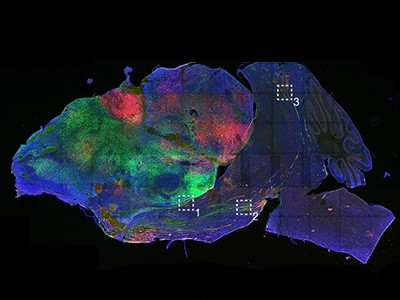
Read the paper: Developmental heterologous corticogenesis in mice using human-derived organoids
A major advance in human brain research
The achievement is a significant breakthrough. Animal research can reveal only so much about the human brain, while opportunities to study living human brain tissue inside the body are limited.
About a decade ago, researchers began creating organoids: small, three-dimensional cell structures grown in the laboratory that mimic some of the functions of real organs. This latest discovery represents the most extensive integration of human brain cells into animals to date. It could open new possibilities for understanding neurological conditions such as cerebral palsy and autism spectrum disorders, as well as for testing potential interventions.
Why human brain organoids raise ethical concerns
At the same time, brain organoids grown in the laboratory are raising increasingly serious ethical questions. Researchers have asked whether animals implanted with human brain organoids might develop human-like consciousness or cognitive characteristics. They are also considering how such properties should be measured and what additional monitoring might be required.
Discussions about creating an international oversight mechanism for brain organoid research are already well underway. These measures were recommended in a policy paper published last year (SP Pashka et al., Science 390, 574–577; 2025), ahead of a conference held in late 2025.
Pashka and his colleagues co-organized the meeting with Stanford bioethicist Henry Greeley. Scientists, ethicists, philosophers, policymakers, science communicators and families of people affected by brain diseases attended the event at California’s Asilomar Conference Center. The site is best known for hosting a 1975 meeting of scientists and research funders about the need for safety precautions and oversight during the early development of genetic-engineering technology.
Hybrid brains: The ethics of transplanting human neurons into animals
Building stronger oversight for brain organoid studies
A great deal has changed in the 50 years since the Asilomar meeting. Today, life-science research plans must pass through a range of regulatory and ethical processes before experiments can begin. These processes are designed to ensure that research involving biological specimens is conducted safely, that consent is obtained from research participants and cell donors, and that animal-welfare requirements are met.
However, some of the questions raised by the latest brain-organoid research are not routinely addressed.
The appropriate form of additional oversight and its terms of reference are still being considered. The 2025 Asilomar Conference Report, published earlier this month (go.nature.com/4dvagey), indicates that scientists strongly support oversight mechanisms that serve the research community. These could include regularly updated, practical guidance for research groups.
A central question is whether existing organizations and research networks should monitor this work or whether new institutions should be established. The answer matters because the organization ultimately responsible for oversight will need sufficient authority within the research community to ensure that its recommendations are followed.
Scientific academies and professional societies already have that authority. Most, however, represent individual fields such as stem-cell research or neuroscience. Brain-organoid research involves scientists from those fields as well as experts in the social sciences and humanities, so effective oversight may require broader representation.
Independent ethics advice throughout the research process
The ethical arrangements behind Stanford’s latest study may offer a way forward. Alongside existing research-ethics and safety requirements, Stanford University established an independent group of ethics advisers who reported to research institutions. Its members came from the sciences, social sciences, humanities and patient organizations.
The advisers were involved throughout the project. They reviewed the experimental design and documentation and suggested changes when necessary. They were important partners in the research process.
Independent ethics advisers should be closely involved throughout the life of a research project. Not every university has Stanford’s resources, but oversight mechanisms could help provide similar services to institutions that lack them.
A mini model of the human brain reveals how this complex organ is formed
Lessons from earlier biotechnology debates
Early research into genetic modification in food and agriculture became embroiled in extensive public and media controversy across Europe, Africa and the United States. One reason was the perception that scientists were moving too quickly and had not consulted widely enough. There were also concerns that researchers needed a deeper understanding of potential risks and hazards before large-scale deployment.
The lessons from that era are clear. Research involving brain organoids has already produced important findings and offers hope that treatments for people diagnosed with brain disorders may one day be possible. For that promise to be realized responsibly, the work must follow the highest safety standards, minimize harm and involve a wide range of stakeholders, including scientists, social scientists and patient groups.
Source: www.nature.com