


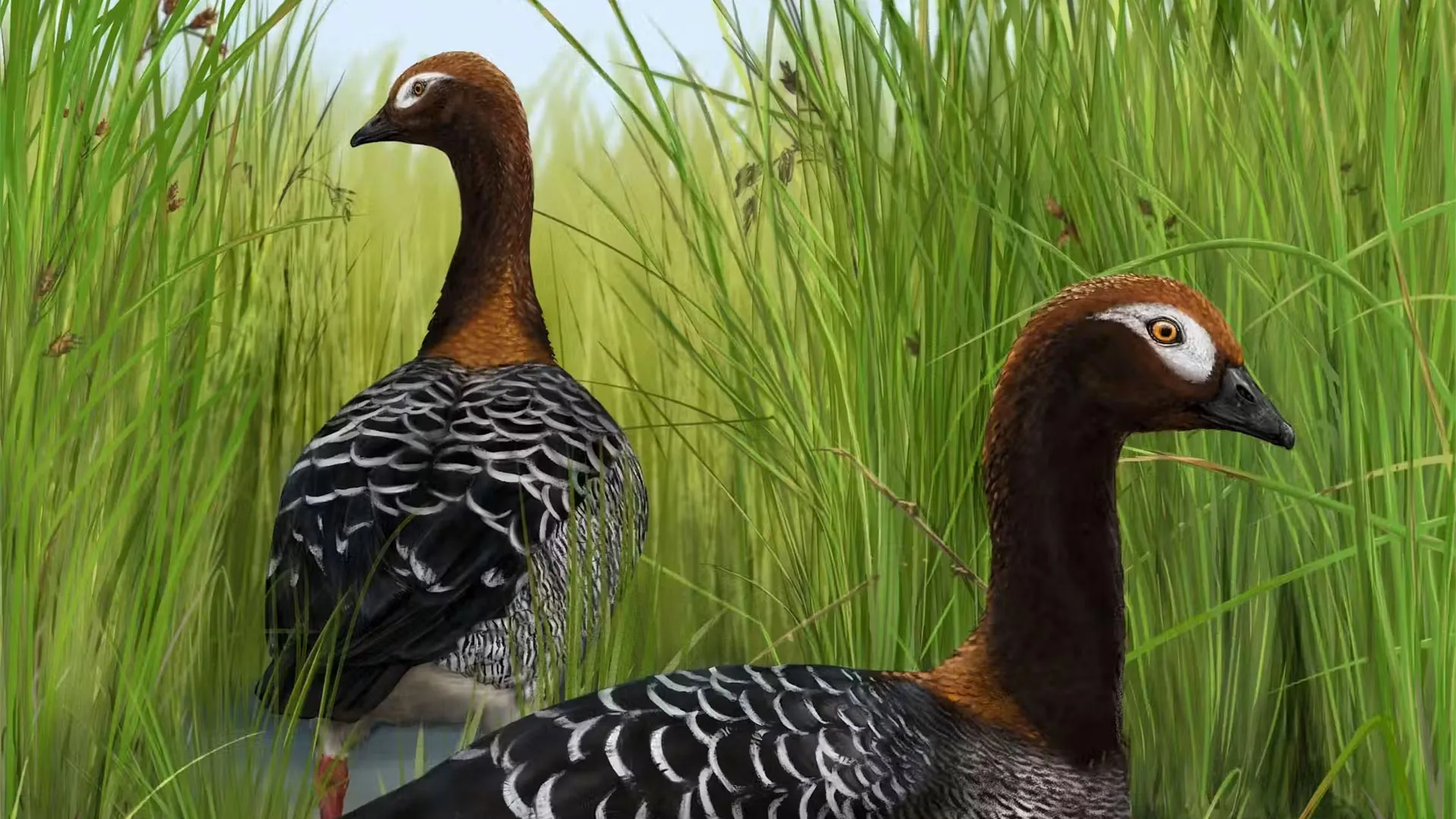
A rare goose fossil unearthed at an ancient lake in Central Otago is reshaping scientists’ understanding of the evolution of New Zealand’s unique bird species. Researchers from the University of Otago’s Otakou Whakaifu Waka assert that this discovery strengthens the growing evidence that the origins of Aotearoa’s avian fauna are more dynamic than previously believed.
Associate Professor Nick Lawrence, director of the Otago Institute of Paleogenetics, co-authored a groundbreaking study exploring the relationship between fossils and their evolutionary paths.
This research, categorized as historical biology, was conducted by an international team from the University of Otago, Te Papa Tongarewa Museum, and the University of Cambridge (UK). The scientists examined fossil materials retrieved from the renowned St. Bathans fossil deposit.
New Species Discovered Among Fossils
Lawrence noted that while waterfowl fossils are plentiful at St. Bathans, goose fossils are significantly rarer.
To delve deeper, the research team reanalyzed all fossil bones previously categorized as belonging to geese. They compared these fossils with other waterfowl remains from the site as well as a comprehensive collection of skeletons from both living and extinct birds.
“We identified that the bones represent an undescribed species, roughly the size of a small goose,” he explains.
The newly identified bird has been named Maetelchen Ruti. Its name draws inspiration from the nursery rhyme “Old Mother Goose” and signifies the resurgence of an ancient goose from fossil deposits. In ancient Greek, Maeterchen means “Mother Goose,” while Ruti translates to “mud” in Latin.
“The St. Bathans goose exhibits no close relation to the recently extinct giant flightless New Zealand goose, Nemiornis, or its Australian relative, the Cape Barren goose,” explained Lawrence.
Rethinking the Evolution of New Zealand Birds
When combined with recent genetic findings, this discovery indicates that New Zealand’s avian history is considerably more intricate than previously assumed by scientists.
Alan Tennyson, lead author from Te Papa, noted that while many bird species took millions of years to reach New Zealand, some of the country’s most iconic large birds arrived relatively recently—within the last 4 to 5 million years. Notable recent arrivals include the Forbes harrier, the takahe, and the colossal Haast’s eagle.
“Prior theories suggested that the St. Bathans goose was a direct ancestor of the flightless giant goose, Nemiornis, indicating this lineage had a long history in Zealandia, spanning at least 14 million years,” he stated.
“However, this runs contrary to genetic evidence suggesting that Nemiornis‘ ancestry originated from Australia only about 7 million years ago, a theory that has since been reconsidered.”
“Our thorough reassessment validates the late arrival theory.”
DNA and Fossils Reveal a More Dynamic Past
Lawrence explained that the ancestors of St. Bathans birds arrived in Zealandia over 14 million years ago, but the lineage ultimately became extinct without leaving any descendants.
“By utilizing all available tools, including DNA and fossils, we can intricately reconstruct how Zealandia’s dynamic geological, climatological, and anthropogenic influences have shaped the evolution of Aotearoa’s fauna,” he remarked.
He noted that the giant flightless Nemiornis geese exemplify the rapid evolutionary changes that island species undergo.
“Recent evolution of giant flightless creatures like Nemiornis demonstrates striking morphological changes that can occur over short evolutionary periods on islands. Standing a meter tall and weighing up to 18 kilograms, these geese were the largest in the world.”
Source: www.sciencedaily.com