


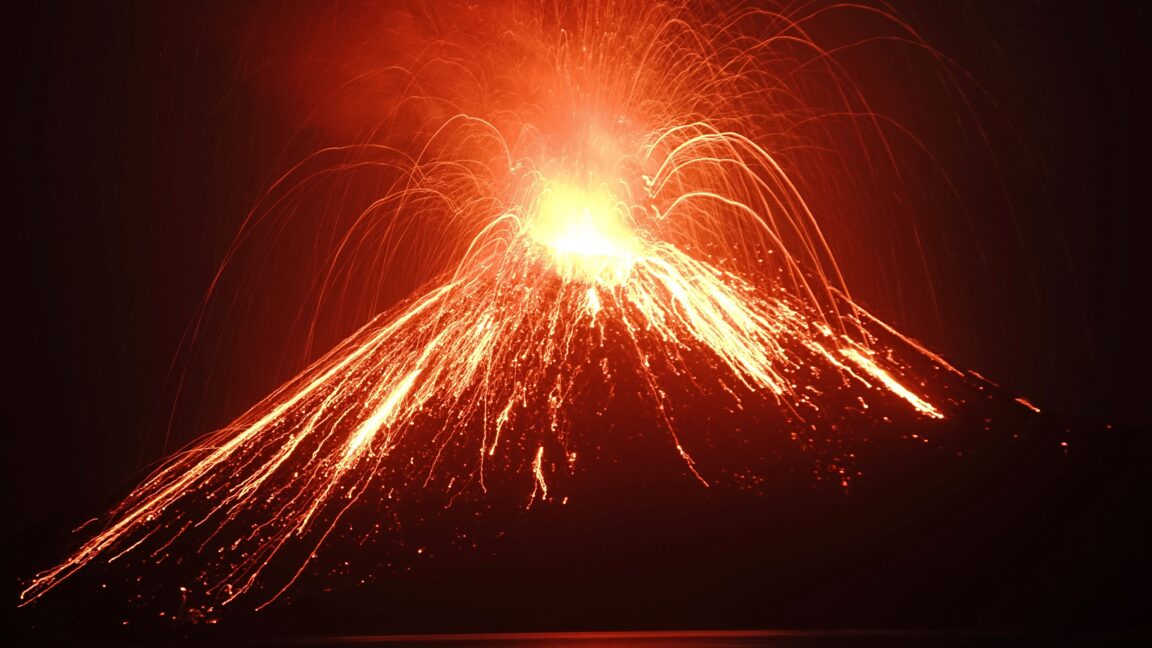
Polar ice cores contain unusually high levels of sulfur dating to around 536 AD, providing strong evidence of a powerful volcanic eruption. However, scientists still do not know which volcano erupted. No surviving written records clearly describe the event, and Iceland—one possible location—had not yet been settled by humans.
credit:
Knowable Magazine
The 1257 Samalas Eruption and the Decline of an Empire
Scientists have found stronger evidence identifying the volcano responsible for one of history’s most powerful eruptions. Until 2013, researchers knew from ice cores that a massive eruption had occurred in 1257, producing more sulfur than any other eruption in several thousand years. That year, an interdisciplinary research team used radiocarbon dating to analyze volcanic ash, pumice, and other deposits.
The research linked the deposits to Indonesia’s Samalas volcano, which erupted in 1257. The discovery solved a long-standing volcanic mystery and helped scientists better understand the eruption’s global climate effects.
Tree-ring studies examine annual growth patterns to identify years of favorable or unfavorable weather. Research shows widespread cooling from 1257 to 1259 across North America and Eurasia. Poor harvests contributed to famine in Britain, while unusually wet and cold summers damaged rice production in Japan.
Some researchers have suggested that the Samalas eruption may also have influenced the decline of the Mongol Empire. The empire’s final ruler died during an epidemic in China in 1259, and some scientists have proposed that climate-related crop failures and disease may have contributed to the political collapse. However, the relationship remains a matter of ongoing research.
Volcanic Eruptions and the Black Death
About a century after the Samalas eruption, scientists identified another possible connection between volcanic activity, climate change, and disease. Between 1346 and 1352, the Black Death killed an estimated half of Europe’s population. The pandemic was caused by the Yersinia pestis bacterium, which spread primarily through infected fleas.
Historical accounts from Europe and Asia describe unusually dark skies during this period, possibly caused by volcanic aerosols or persistent atmospheric haze. Ice core data supports the idea that a major eruption—or several eruptions—occurred around 1345, although the volcano’s location has not been identified.
Volcanic cooling could have reduced harvests, increased food shortages, and weakened populations, potentially making communities more vulnerable to infectious disease. While scientists continue to study the connection, volcanic eruptions remain an important factor in understanding how climate shocks shaped human history.
Source: arstechnica.com